
DOW, DIA Stress and Invest in AI Needs for the Future
The accelerated evolution of artificial intelligence (AI) is transforming operations across the U.S. Department of War (DOW), Defense Intelligence Agency (DIA) and industry partners. Through enhanced acquisition, adoption and training programs, agencies and organizations are looking to break barriers to innovation.
“The Fires Center of Excellence and Fort Sill teaches that a core-level fire support coordination cell can … execute about 13 to 14 targets a day,” stated Cameron Stanley, chief digital and AI officer at the DOW. “In Operation Epic Fury, we were executing more than 1,000 a day, I mean 13,000 in 38 days. That’s tactical fires missions,” he continued, speaking on the possibilities of modern and AI-powered warfare.
The success of the mission was not due to following doctrine, he explained, but rather by reimagining the approach through digital tool use and by incorporating tools in dynamic ways.
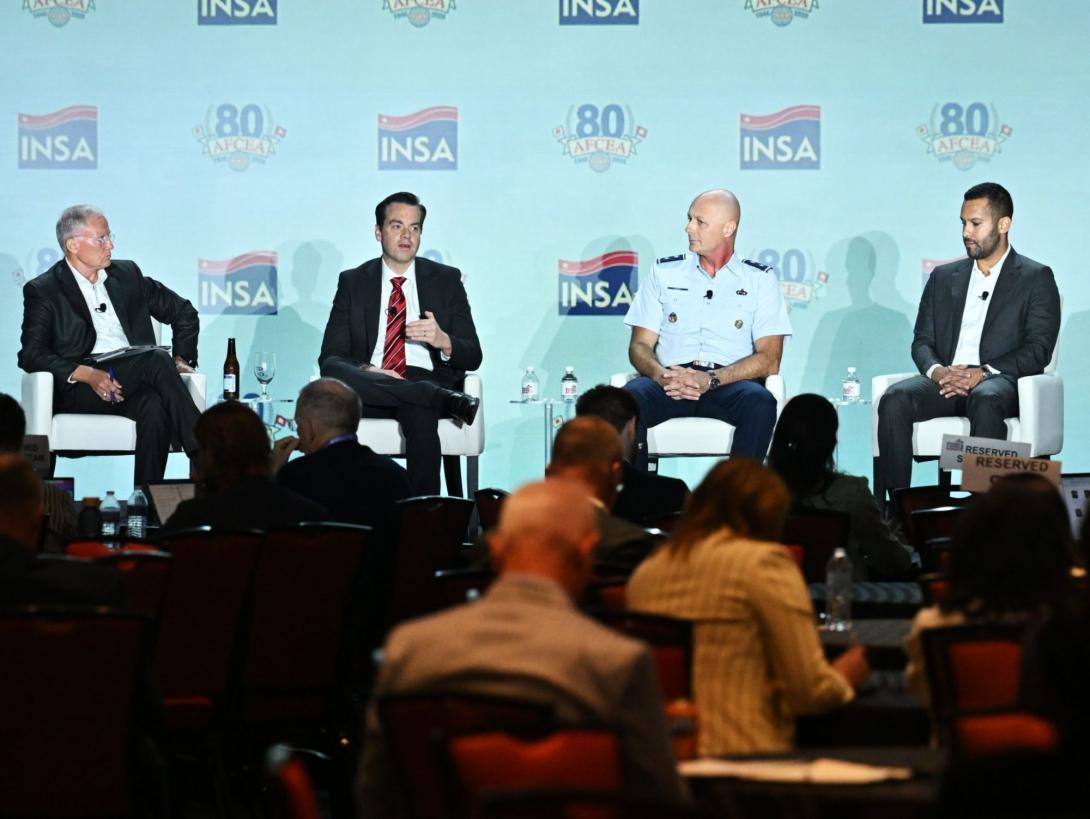
Stanley was addressing the 2026 Intelligence & National Security Summit audience alongside fellow panelists Maj. Gen. Robert Kinney, USAF, military and mobilization assistant to the director at the DIA; and Capitol AI CEO Shaun Modi. The discussion was moderated by Touchstone Futures CEO Lt. Gen. Bob Ashley Jr., USA (Ret.).
While the department is making strides in advancing its digital architecture and AI, Stanley noted it is “absolutely terrifying how far we have to go.”
“We in [the Chief Digital and Artificial Intelligence Office] (CDAO) continue to push the envelope with a number of different things,” he said, noting industry’s help in fielding, delivering and deploying AI tools throughout the enterprise at speed and scale. The team has undergone reorganization and restructuring to meet its ambitious AI goals, Stanley continued.
“We’ve done everything from GenAI.mil, where we have actually not just brought in the GenAI tools and remotely accessed them … we’ve actually recreated the entire generative AI experience that you would have outside of the department,” he said. The initiative is undergoing further expansion, the CDAO added.
While the current GenAI.mil browser has Gemini, users will soon be able to also access Grok and ChatGPT. “That’s coming very, very soon,” Stanley said. “You will be able to actually have the exact same user experience. The difference is you’re taking those first-in-class, first-in-breed models and being able to use that against U.S. government, U.S. [DOW] data.”
The department also consolidated oversight of the Maven Smart System under the CDAO this spring, with the system’s capabilities to be expanded to further services and organizations.
Additionally, Stanley’s team has been tasked to establish the AI arsenal to secure the “appropriate amount of data capacity that’s required for us to process large amounts of data very quickly using frontier AI.”
At the DIA, Kinney’s priority is rapid acquisition at scale. Currently, his team is on a 90-day sprint to create an enterprise AI platform. Part of the initiative is an AI gateway called ChatDIA.
“We also are working to [Model Context Protocol] MCP certain legacy datasets,” he said. “For me and our team at DIA, it’s about building out that ecosystem. It’s not about buying things necessarily and deploying them; it’s about open architectures, open [application programming interfaces], plug and play, agility, that is what we’re doing.”
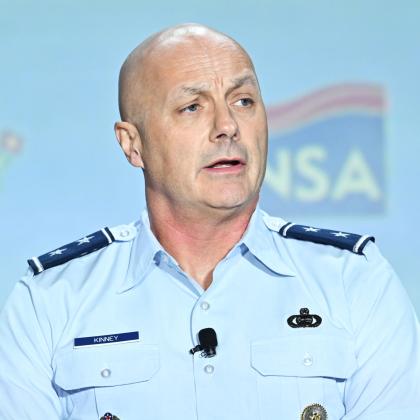
For me and our team at DIA, it’s about building out that ecosystem. It’s not about buying things necessarily and deploying them; it’s about open architectures, open APIs, plug and play, agility.
The panelists also discussed the workforce, as training ramps up to deliver tomorrow’s capabilities.
At the DIA, Kinney said there are currently three tiers of AI training: beginner, mid-tier and top-tier.
“That said, we’re exploring AI capabilities that you can apply to your own … AI training journey, which I think has great promise that you can tailor-make it to your own desires and wishes,” he said. “We’re just scratching the surface on this and partnering with our other teammates in the [intelligence community].”
AI training goes beyond awareness, Kinney added, noting that one day intelligence analysts will have the ability to build their own AI agents.
Meanwhile, Stanley pushed for a new approach to acquiring and retaining talent. As skilled AI and software professionals are drawn to industry opportunities, the department must rethink traditional workforce models and create new incentives to attract technical expertise.
“It’s a different world now,” he said. “We’re seeing it across the department, but intelligence in particular … it’s a big issue because you can’t convince these kids who are doing the exact same work for wearing a green badge versus a blue badge that wearing a blue badge is cool, when they’re like, 'Why? Everything else about this looks much more appealing, I don’t really need to do this.' And the mission only goes so far …”
The 2026 Intelligence & National Security Summit is co-hosted by AFCEA International and INSA. SIGNAL Media is the official media of AFCEA International.



Comments