
AI-Assisted Robot That Learns Patient Mobility Patterns Within Reach
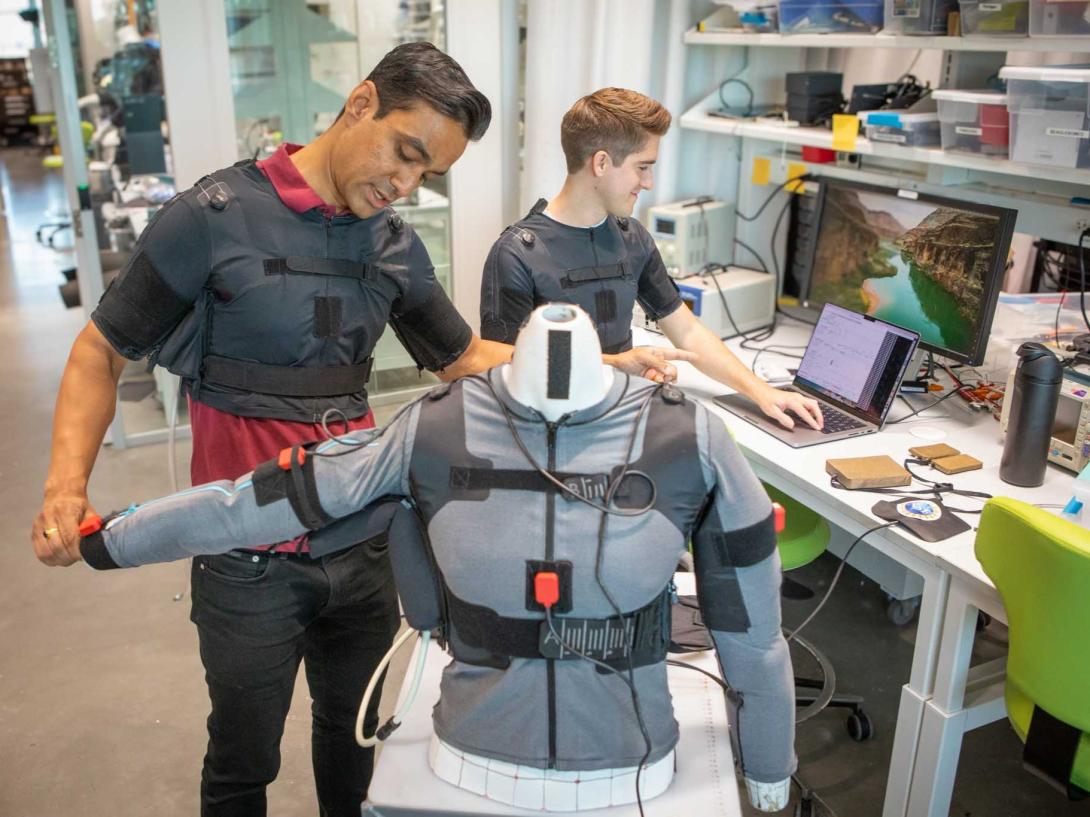

Within two years, researchers from Harvard University’s Move Laboratory could launch a startup company that will provide a soft, wearable robotic system that learns the wearer’s movement patterns and assists those with arm and shoulder mobility challenges caused by strokes or amyotrophic lateral sclerosis (ALS), a nervous system disease that affects nerve cells in the brain and spinal cord. Ultimately, the system known as Reachable could assist warfighters and others with traumatic brain injuries.
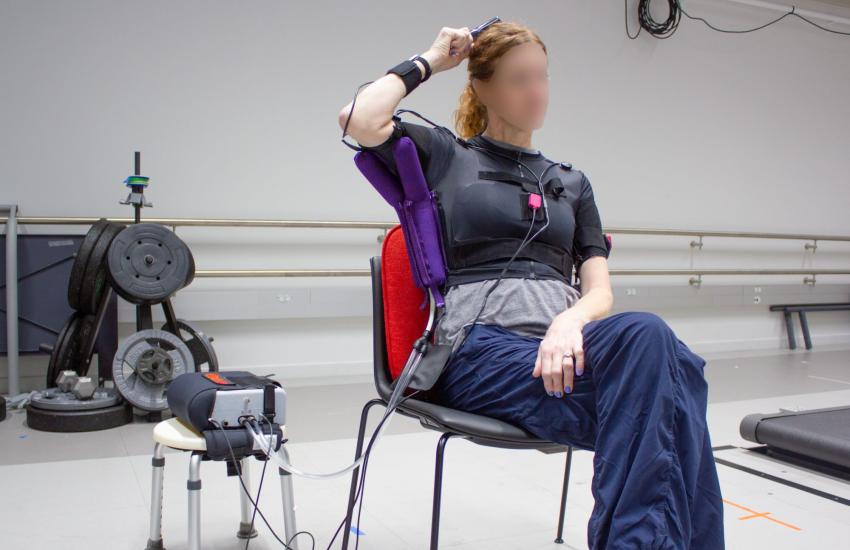
Reachable is an exosuit vest that pairs motion and pressure sensors with a machine learning algorithm to learn about a patient’s individualized movement patterns and personalize assistance. It uses a balloon under the armpit that automatically inflates and deflates to lift and lower arms.
“A robot is something that has sensors, like our robot has motion sensors and force sensors that are in the device, so it can sense what’s going on,” James Arnold, a graduate student and co-author of a recent research paper on Reachable, said in a SIGNAL Media interview. “And then the other thing a robot needs is actuators, which is something that can apply force, which our robot does by inflating and deflating the balloon. The last thing usually a robot needs is some kind of interaction with the environment. In our case, the person wearing the device is sort of like the environment.”
The use of machine learning algorithms is the latest breakthrough in the system. “What we showed here was that having these algorithms trained to each person was important for the algorithm to correctly identify when the person was trying to do certain movements,” Arnold offered. “For these people with different upper limb impairments—people post-stroke or living with ALS—there’s quite a lot of variability in how the condition affects their movement. These patterns of what the data and the sensors look like are quite different for each person. So, it’s convenient to have an algorithm that can just take some examples of what it looks like when the person is doing these motions, and then automatically identify those patterns in the future.”
A Harvard article published in August relates the story of Kate Nycz, who was diagnosed with ALS in 2018. People with a neurodegenerative disease like ALS or who have had a stroke often suffer from impaired movement of the shoulder, arm or hands, preventing them from daily tasks like tooth-brushing, hair-combing or eating, the article explains.
“My arm can get to maybe 90 degrees, but then it fatigues and falls,” Nycz is quoted as saying. “To eat or do a repetitive motion with my right hand, which was my dominant hand, is difficult. I’ve mainly become left-handed.”
Nycz has provided data and user testing for several iterations of the device, including the latest, which includes a personalized motor feedback component. “I’m big on technology and devices to help improve quality of life for people living with ALS ... I feel like this robot could help with that goal,” she said in the Harvard article.
Prabhat Pathak, Harvard postdoctoral fellow and co-author of a recent Reachable study published in Nature Communications, explained in an interview with SIGNAL Media that neurological impairment from a stroke or ALS causes abnormal muscle movement. Some stroke survivors, for example, may be unable to move a shoulder without also moving the elbow.
“To decode these complex movements is really important, where we can use proper sensing modules and also develop these very robust machine learning algorithms. Decoding that information is quite crucial for operating these devices so that it can help people who have disabilities,” Pathak said.
Military veterans with traumatic brain injuries also could benefit. “Simply having them lift [their arms] so that they can do activities of daily living will be quite important,” Pathak noted.
The researchers said they continue to improve the Reachable system and hope to bring it to market soon. “If a stroke survivor, or anyone in the military who has suffered from these kinds of diseases, wants to use this robot at their home, we will potentially be able to enable that. Hopefully, within the next one year, or the next two years, we’ll be able to bring this product into the market.”
The current version of the system works best for people in wheelchairs. But it will be improved, in part by reducing the size and weight of the electrical box that contains the pump, valves and battery, which currently weighs about five pounds. “The goal would be to reduce the size of that to something people would be able to put on independently because right now, you need some assistance. There’s been a lot of work in the lab towards that goal of miniaturizing everything,” Arnold reported.
But commercializing the product involves more than just improving the technology, such as determining how to produce a product that insurance companies will pay for. “These are the kinds of discussions that we’re having right now. But yeah, the current plan is to have a startup, and then potentially, in the future, we could license the technology to others.”
The technology might eventually be adapted for other joints as well. “Our focus right now is all on the upper body. Obviously, being able to support all of the joints would be the ideal situation, but that adds a lot of complexity for the goal of miniaturizing things and making it practical for people to customize it to themselves,” Arnold said. “It’s sort of a balancing act of just how complicated you want to make the system, and the more complicated you make it, maybe more people can benefit from it, but maybe less people are willing to use it.”
Supporting the shoulder, Arnold said, provides “a lot of bang for your buck, since it’s the joint that requires the most force to lift.” Additionally, shoulder support can improve the movement of other joints. “We also found that for a lot of people, off-loading their shoulder allows them to use their other joints better. But definitely, there’s a use case for people who, for example, have very little residual elbow movement. Supporting their elbow would allow them to do more tasks.”
But there are researchers in the Harvard lab conducting similar research on the lower body, such as the hip and ankle, Arnold noted.
The machine learning algorithms also could see improvements. “That field is moving quite quickly, so there’s lots of new machine learning architectures and things. One of the improvements to our robot would be increasing the computing capabilities,” Arnold said. “Future versions of the robot will be more powerful and be able to run larger machine learning models that can potentially be trained on many people’s data, and then maybe it requires less individual data to personalize it.”
Larger, more varied data sets could allow the robot to learn much faster than the 15 minutes it currently takes for the system to learn someone’s movement patterns. “We are doing more experiments with new devices, with other people, with other injuries. We’ll have a larger data set and [more] examples of people, different kinds of movements. That will allow, in the future, for us to make something that will just be plug and play.”
The Harvard research is funded by the National Science Foundation’s Convergence Accelerator program, which builds on basic research and discovery to “accelerate solutions toward real-world impact,” according to the foundation’s website.



Comments