
U.S.-U.K. Collaboration Could Expand Quantum Research With Chemicals
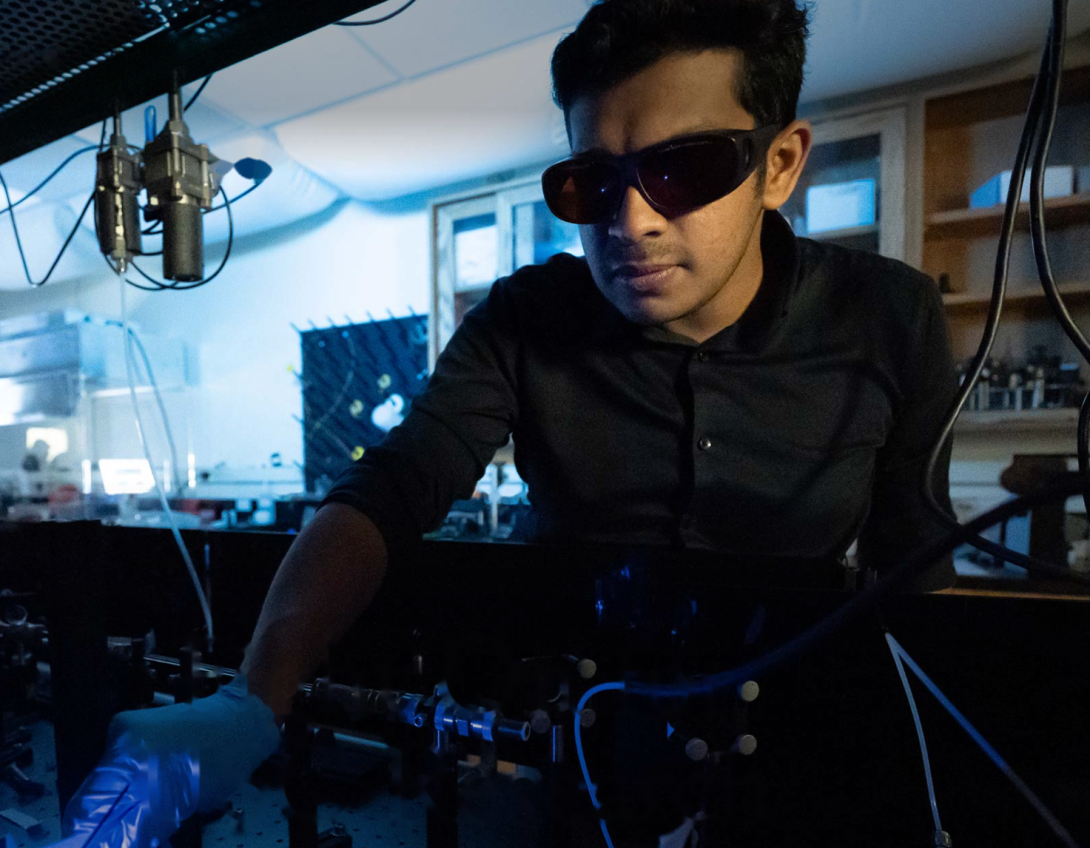

The U.S. National Science Foundation (NSF) and the United Kingdom Research and Innovation (UKRI) are joining forces on eight projects to explore quantum information effects on chemical reactions and molecular systems. The partnership could potentially create new types of molecular-based qubits and other fundamental components of quantum computing, quantum sensing and quantum communications.
Quantum information science (QIS) is a fast-evolving field, according to a report in the Journal of Physical Chemistry Letters. One aim is to exploit quantum mechanical phenomena and information sciences to develop technologies with quantum-enhanced functionalities. A second prominent aim is to advance our fundamental understanding of nature at the molecular scale. Concomitantly, researchers across a breadth of fields are interested in seeking new physical, chemical and biological phenomena that are explained by quantum mechanics, and which have no classical counterpart.
QIS is considered essential to national security. In 2018, President Donald Trump signed the National Quantum Initiative Act, which authorized the NSF, the National Institute of Science and Technology and the Department of Energy to strengthen QIS programs, centers and consortia. The act also calls for coordinated research and development efforts across the government, including industry, civilian, defense and intelligence sectors.
Atoms, ions and photons have powered first‑generation quantum devices, but molecules offer richer energy levels and built‑in structure. That can make entanglement easier to engineer, sensing more precise and devices more compact. If the work pays off, near‑term wins will likely come from sensing. Quantum sensors can read tiny magnetic and electric fields, locate objects without GPS and monitor biological or chemical activity in real time. Those capabilities matter for disaster response, environmental monitoring and defense. Security planners also track the cryptography angle. As quantum computers mature, they could threaten today’s encryption, so governments around the world are investing in post‑quantum cryptography and racing to gain an edge in the quantum domain.
The NSF announced the UKRI partnership in September. In that announcement, White House Office of Science and Technology Policy Director Michael Kratsios said the partnership “will reshape our knowledge of quantum mechanics and open new frontiers in quantum computing, sensing, and communicating.”
Kratsios noted that the U.S.-UK partnership builds on the technology prosperity, which officials from the United States, United Kingdom and Northern Ireland signed in September. The memorandum of understanding is designed to enable collaboration on strategic science and technology disciplines, including artificial intelligence, civil nuclear, fusion and quantum technologies.
Brian Stone, who is performing the duties of NSF director, added in the release that the partnership “lays the foundation for advances that can transform everyday life. “These projects demonstrate the power of shared investment in tackling real-world challenges, from more powerful computing to next-generation navigation and sensing tools.”
And Jane Nicholson, executive director for research with the UKRI’s Engineering and Physical Sciences Research Council, asserted that the investment “opens new pathways for transformative science and the quantum technologies of the generation yet to come.”
John Papanikolas, the NSF lead for the effort, told SIGNAL Media that the effort brings together chemists and quantum information researchers. “The chemistry community needs to bring the people that know how to make molecules together with the people that understand the quantum information,” he said.
Goals include turning the complexity of chemical systems into an advantage by building molecular qubits, molecular-scale memory and ultrasensitive molecular compasses for navigation and detection.
Chemists can create new quantum components, such as qubits, the fundamental units of information in quantum computing. “What chemistry brings to the table here is the ability of chemists to make almost anything. Chemists can create molecular structures. They can precisely position atoms with respect to each other within a molecule. They can create molecules with specific symmetries and so on,” Papanikolas explained.
Essentially, he indicated, chemistry researchers could expand the palette of quantum components. “And that ability to create new molecules could dramatically expand the possible qubit structure. One way in which chemistry could contribute to this overall effort of quantum information science is that it could expand the palette of different components that could be used in quantum technologies. You wouldn’t be limited to the handful of atoms, ions or photons that are successful or useful qubit structures.”
Researchers with the NSF’s Division of Chemistry want to involve chemists in an underexplored area of quantum research: the mysterious phenomenon known as entanglement. “Part of what we in the chemistry section are trying to do is to get the chemistry community to engage in that topic in a serious way. I think as the community starts to explore this concept in the context of molecules and chemical systems, they’ll begin to understand what it can do and where it can go. So, it might not be just creating new qubits,” Papanikolas suggested.
Simply explained, when two qubits are entangled, whatever happens to one instantly happens to the other, no matter how far apart they are. Some have compared it to twins who are miles apart, but when one experiences pain, the other does as well.
Papanikolas used a coin-flipping metaphor to describe entanglement. “Classically, if you had two coins, just two regular coins, and you flipped them, you would end up with heads/heads or heads/tails or tails/ heads or tails/tails. But in a quantum mechanical system, if those two coins were entangled, then their results or their observations would be correlated. So, if I flip both coins and one was heads, the other one would be heads too. Or if one was tails, other one would be tails too. And the strange thing about that entanglement is that that interaction can exist over or extends over large distances.”
With a relatively new area of quantum research, though, new mysteries arise. For example, what happens if a scientist entangles two molecules? “If I have two molecules [and] I’m going to react them, they’re going to react, and they’re going to form products. Let’s say I take those two molecules that are going to react and I entangle those two molecules. Are the products of the chemical reaction entangled? That’s an open question,” Papanikolas indicated. “Nobody knows really the answer to that question. If the answer is yes, it could be a way of transferring entanglement from one particle to another.”

So, advances could reach far beyond new quantum structures. Scientists could discover “new strategies for using these concepts in the context of quantum technologies,” he elaborated.
Additionally, QIS might help advance chemical research, Papanikolas noted. “Could one use entanglement to perform different types of measurements that change how we think about chemistry? Could we build an instrument that uses entanglement, for example, to make measurements on smaller quantities of molecules, or very short length scales, or very short time scales? So, it’s not just understanding how these concepts of quantum information, concepts of entanglement, of coherent superposition, what role they play in chemistry, but how they can be harnessed or exploited to advance chemistry research.”
It was once thought that molecules were too unstable to be used for qubits, but scientists have seen an array of recent breakthroughs not related to the NSF-UKRI agreement. In January of last year, for example, Harvard researchers announced they had succeeded for the first time in trapping molecules to perform quantum operations. They did so by using ultra-cold polar molecules as qubits and published their findings in Nature. That research was also funded by the NSF, along with the Air Force of Scientific Research, the Physics Frontier Center and the Multidisciplinary Research Program of the University Research Initiative.
In another world first, in January of this year, University of Oxford researchers announced that they engineered a quantum mechanical process inside proteins, opening the door to a new class of quantum-enabled biological technologies. The researchers created a new class of biomolecules called magneto-sensitive fluorescent proteins that interact with magnetic fields and radio waves. This is enabled by quantum mechanical interactions within the protein and occurs when it is exposed to light of an appropriate wavelength.
As part of the study, the team created a prototype imaging instrument that can locate the engineered proteins using a similar mechanism to magnetic resonance imaging, but unlike MRI, it would be able to track specific molecules or gene expression within a living organism. Such measurements are central to medical challenges, including targeted drug delivery and monitoring genetic changes inside tumors, according to the university announcement.
The eight projects being funded right now include one from Northwestern University and the University of Oxford on molecular compasses “capable of sensitive detection of both the magnitude and direction of weak magnetic fields with applications in quantum sensing and quantum navigation,” along with a variety of approaches to better understand quantum entanglement, coherence and memory. Among other possible benefits, they could lead to advances in computing, sensing and communications.
But those eight projects might be just the beginning. “We’re just at the beginning of what I think is probably going to be a pretty long journey. Hopefully, NSF and the NSF chemistry section will see more chemistry researchers engaged in this topic. We might see more proposals, which would lead to more ideas and more rapid progress, but I think it would also lead to more students being trained in this area, which would ensure the future growth of the field,” Papanikolas offered. “And that combination of advancing science and building the scientific workforce are two major goals of sort of NSF in the work that we do.”



Comments