
Qualifying Quantum Tools for Future Deployment


As the world transitions to and emphasizes the importance of creating sophisticated quantum-based capabilities to prepare for the future battlefield, U.S. Army Combat Capabilities Development Command (DEVCOM) Army Research Laboratory (ARL) crews are striving to construct, evaluate and refine two technologies: advanced atomic clocks and electric field sensors.
Atomic clocks play a crucial role in modern-day combat, but researchers are reimagining the vital technology with the goal of overcoming major problems stemming from the capability: its large size and immobility. ARL officials want to significantly reduce the size of atomic clocks while still maintaining their ability to effectively carry out high-performance tasks. They have developed a smaller atomic clock, known as a chip-scale atomic clock; however, they have yet to find a way to enable the smaller versions to have the same capabilities as the larger versions and function in places where communication may be hindered or nonexistent, according to Fredrik Fatemi, senior research scientist for quantum sciences at DEVCOM ARL.
“The challenge is because these quantum technologies are very complicated, they’re also very big, and it’s really hard to deploy many of these quantum technologies, so we need to understand how to reduce their size, weight and power to make them possible for use on the battlefield,” Fatemi said during an interview with SIGNAL Media.
“The chip-scale atomic clock is very small,” Fatemi added. “It can go into radios, but because it’s not a large system or a lab-grade system, it doesn’t have the performance of that lab-grade system, so it can’t help us operate in a GPS-denied environment for the durations that we might need. We might need mission durations of a few days, for instance, and you may need this very accurate timing the GPS provides for a few days, so we are working on higher-performance versions of these chip-scale atomic clocks.”
ARL researchers also established the Low-Cost Chip-Scale Atomic Clock program to slash construction prices for the high-performance chip-sized devices with the goal of finding a way to deliver top-notch performance at a fraction of the cost.
Laboratory officials are also leveraging help from teams in other military branches and the private sector, according to Fatemi. Their assistance and insights will ideally pave the way for the next generation of atomic clocks that can provide soldiers with a better level of timing for several days on the battlefield.
“Atomic clocks form the backbone of our global positioning system, but now, we need to know what are we going to do if we’re in a GPS-denied environment,” Fatemi said. “We have been working on advanced atomic clocks and partnering across the services and with industry partners to develop clocks and positioning capability in the absence of GPS. That’s a really critical problem. Quantum gave us GPS, and now we need quantum to help us provide solutions if we’re in a location of GPS denial.”
As aforementioned, atomic clocks play an essential role on the current battlefield. The technology provides soldiers with precise timing, ensuring that combat zone communications are synchronized, according to Fatemi.
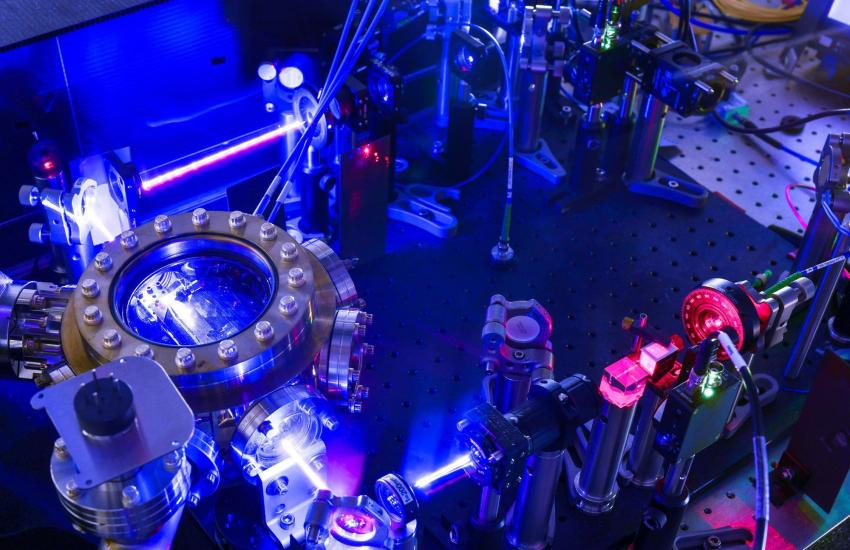
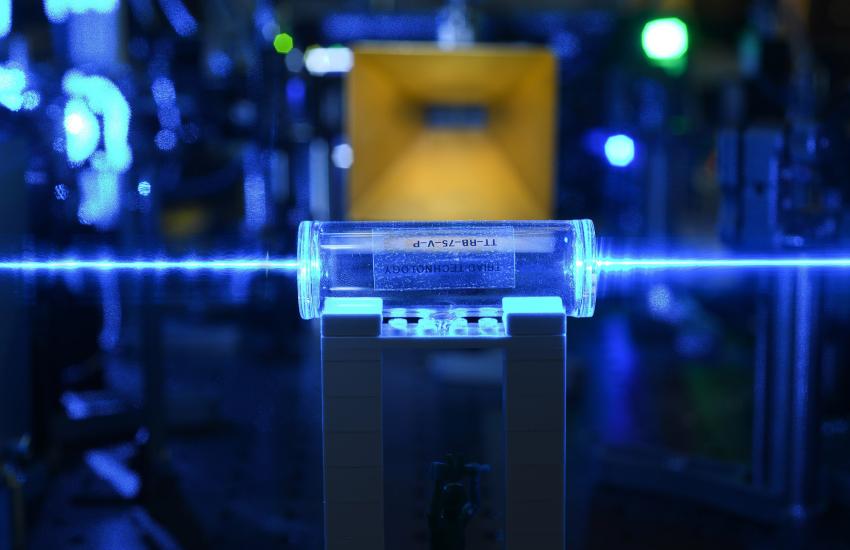
DEVCOM ARL team members are also exploring ways to enhance electric field sensors, underscoring the novel Rydberg atom sensor. This tool uses lasers to excite Rydberg atoms above a microwave circuit, enabling the sensor to exclusively focus on the part of the electromagnetic spectrum that officials are measuring. Furthermore, Rydberg atoms are highly sensitive to the circuit’s voltage, which allows users to use the tool as a sensitive probe for the plethora of signals in the radio frequency (RF) spectrum, according to Army officials. The Rydberg atom sensor operates on a completely different principle than a traditional antenna, marking a significant change. The novel method reads out the signals by using laser beams that interrogate the atomic system, rather than the traditional method, which reads out the signals via an RF resistor, per Fatemi.
Additionally, Rydberg atom sensors can use their atomic-based systems to self-calibrate. Built-in self-calibration forgoes the conventional way of relying on manufacturing tolerances of quartz oscillators, and instead, the advanced tool relies on the fundamental properties of the atom. The feature plays a major part in making these the most accurate sensors in the world, Fatemi added.
DEVCOM ARL officials do not expect Rydberg atom sensors to replace the traditional receivers, but rather to bolster them.
In addition, Army personnel prioritize the quantum computing space. Quantum-based computers can not only accomplish tasks more quickly, but they also compute fundamentally differently than conventional computers, per Sara Gamble, program manager for quantum information science at DEVCOM ARL. Furthermore, fostering this area can pave the way for an infusion of more accelerated, efficient and effective systems, while also integrating systems that think in a different way.
“[A quantum computer takes] you off of that curve of basically problem size versus time to solution of a classical system,” Gamble said. “It puts you in a different place for certain problems, but only certain problems, and many of which are of interest to the Army, to the Department of War and to our partners and other government agencies as well. If you can exponentially accelerate the time to solution versus how large those problems are, then you have an advantage that is not possible with these classical systems. So, I think that is what really needs to be stressed.”
“It is not a faster way to compute,” Gamble added. “It’s a different way to compute that puts you on a different trajectory with respect to how you can process and share the information that we gather.”
As for specific use cases regarding quantum computing that Army officials are interested in, Gamble said that they are focusing on optimization and logistics. By solving these complex optimization problems that traditional systems cannot carry out within a reasonable timeframe, quantum-based computers can help them identify which resources need to be where on the battlefield. Additionally, these capabilities can strengthen and protect the communication space. Quantum-based computers can still provide soldiers with essential information, even during situations when they know that the enemy has breached the communication lines, Gamble added. The systems do this while keeping the warfighters safe and ensuring that the mission goes on as planned.
DEVCOM ARL officials expect that they will likely never perfect these technologies, and they will always work to make improvements. And it’s hard to predict when the military might have access to advanced atomic clocks, electric field sensors and quantum computers.
“Quantum information is still a very new field when you look at it with respect to other areas of physics or science that have been around for hundreds of years,” Gamble said. “And I think what is most exciting for me is uncovering these application spaces that we don’t have solid understandings of now. So, I think quantum is a field in particular where it’s ripe for exploring these problems and then potentially finding spaces that are widely exploitable for Army problems.”
She stressed that partnerships are important for advancing the research, which is currently in its infancy. “It’s not necessarily that we have a quantum system, and we know this quantum system can do this, and this meets that need. We absolutely do that, but we also really focus on burgeoning technology where we know the general area where these systems could potentially have advantages for the warfighter, but it’s basic research, so we still don’t know exactly what that may look like down the line, and this is where the partnerships with academia are really important.”
The complicated and exact nature of the quantum field makes it a demanding research area. Teams working on these technologies need to consist of the right engineers and optical scientists who can mix their knowledge and expertise to generate solutions to these problems.
“Quantum technologies are very complex,” Fatemi said. “They require this intersection of material science, computer science and laser science and optical science and a whole bunch of fields that come together. It’s very interdisciplinary—building something like an atomic clock. It’s a very complicated beast, and to have exquisite performance, you need very high-performance lasers. You need to understand atom-atom interactions and all kinds of other interactions that we typically don’t pay attention to.”

Comments