
Animal-Inspired Robots May Soon Take Over World Markets
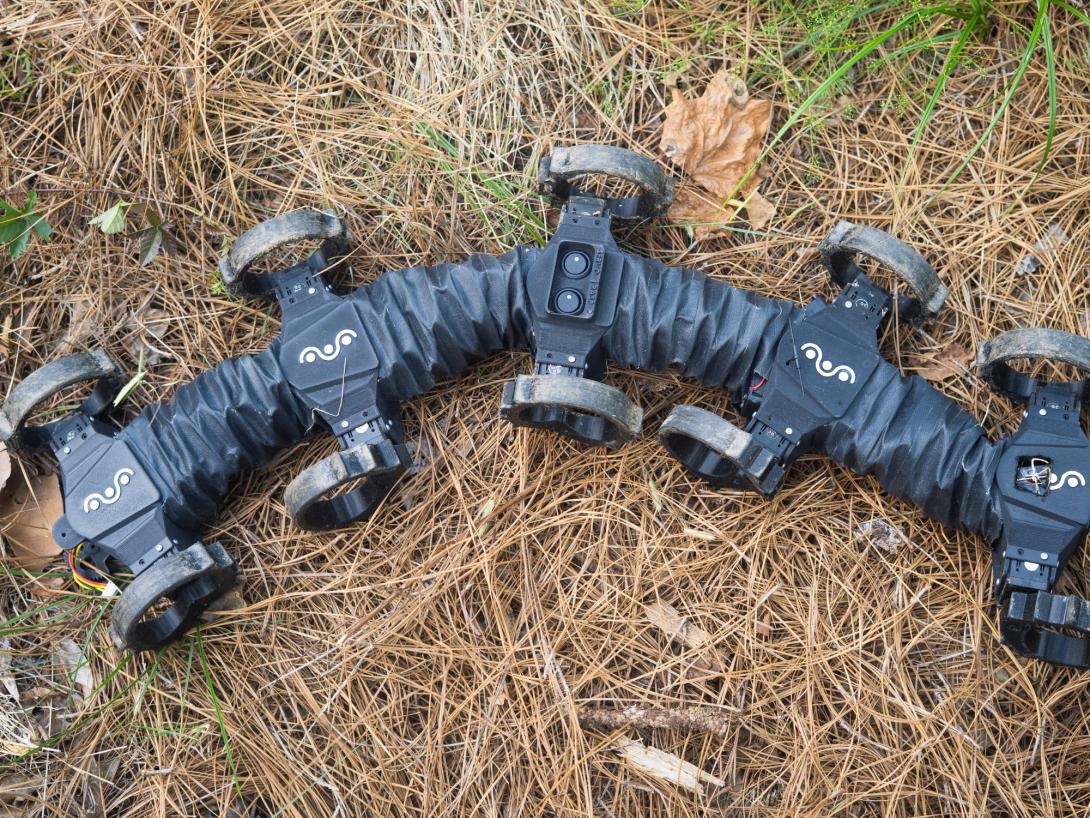

Ground Control Robotics (GCR) Inc., a startup company seeking to commercialize a centipede-like robot developed at Georgia Institute of Technology, may be on the verge of acquiring its first customers, according to Daniel Goldman, GCR co-founder and CEO.
The CRAB Lab specializes in the study of biomechanics, or the interaction between the animal body and the environment; soft matter and the fundamental physics of limb-ground interactions during locomotion; and robophysics, which uses robots to explore principles of locomotion. The research essentially sheds light on the ways animals and animal-inspired robots move across, through, over or around various environments.
About three years ago, Goldman, who is also the Dunn Family Professor in the Georgia Tech School of Physics and director of Complex Rheology and Biomechanics (CRAB) Lab, and his team spun off their research into the startup company. GCR is now poised for customers, the professor said, although he chose during a Zoom interview with SIGNAL Media not to disclose details too soon. “Basically, you can say that this company is looking to commercialize basic science discovery. Let’s say we are poised right on the edge of [acquiring] customers.”
SCUTTLE—Slithering Centipede-like Undulatory Terradynamically Tactical Legged Explorer—mimics the movement of a centipede. Its low profile makes it capable of maneuvering under vegetative canopies, or through pipes, crawl spaces and debris.
For legs, GCR has tried multiple designs. “Our most capable robots have `legs’ which don’t look or act like anything in biology,” Goldman said in a post-interview email. “Instead, you can think of them broadly as rotating asymmetric shapes. For example, we have a version of SCUTTLE in which the legs are the robotic c-legs made popular in the early 2000s,” he added.
The c-legs are modeled after designs funded by the Defense Advanced Research Projects Agency under the robot hexapod program, RHex, but GCR co-founder and Chief Technology Officer Daniel Soto discovered that making the C into an O gives the robot nice back and forth symmetry, Goldman reported. The rotational actuation of the C or O leads to much better performance than the pointy legs the researchers use for some other robot models.
Goldman suggested that SCUTTLE could be used for a wide variety of tasks and missions. “The company started basically looking to control weeds and pests in crop fields, and we think that’s still a very nice use case. But if you can have a robot that can basically go anywhere and get into any environment, your mind starts to open up to all sorts of interesting possibilities,” he said. “So, we’re currently in lots of discussion on those possibilities and building our business case to go to find the bridges to go to market.”
SCUTTLE is hitting the market at a time when multiple reports indicate that nature-inspired robotics are braced to largely conquer the worldwide robotics market. Microsoft’s CoPilot, an artificial intelligence (AI)-powered digital assistant, identified two reports suggesting this subset of the robotics market is already valued in the low billions and will see aggressive growth in the coming years.
Data Insights Market, for example, reported the 2025 market for biomimetic robots—robots that mimic biological systems, including animals, plants and humans—is valued at $2.5 billion and will expand to more than $10 billion by 2033. Segments that will benefit from such robots include military surveillance and reconnaissance, surgical robots and rehabilitation aids, agricultural crop monitoring and pest control, and entertainment.
Meanwhile, Business Research Insights reports that the market for quadruped robots—systems inspired by four-legged animals—will grow from more than $2 billion in 2025 to $9.42 billion in 2035. Potential missions include military and defense hazardous terrain navigation, industrial inspection and logistics, and search and rescue.
And Fact.MR finds that the global bio-inspired robotics market is currently valued at nearly $2.8 billion and will reach $19.5 billion in the next decade. The robust expansion is fueled by increasing demand across diverse sectors, including aerospace and defense for inspection and repair of complex systems; industrial automation for enhanced precision and adaptability; medical applications for minimally invasive surgeries and rehabilitation; and entertainment for immersive and interactive experiences, the report states. “The integration of biomimetic robots into these applications promises increased efficiency, reduced costs, and improved safety. Furthermore, ongoing research and development efforts are continuously pushing the boundaries of biomimetic robotics, leading to the creation of more sophisticated and versatile robots.”
Mostafa Hassanalian, associate professor in the Department of Engineering at New Mexico Institute of Mining and Technology, has developed a wide array of robotic systems inspired by nature, including micro drones based on dandelions and aerial vehicles using wings or other parts from deceased birds. While he has not yet commercialized any products, he said he believes the market is ripe. “The current market for animal-inspired robots is still emerging but growing steadily. There is increasing interest from both government and industry sectors due to their potential for efficient and adaptive operations in complex environments,” Hassanalian told SIGNAL Media in an email exchange. “I see the market expanding significantly in the coming years as more robust and cost-effective platforms are developed, particularly for specialized applications where conventional robots face limitations.”
Hassanalian cited Festo, a German automation company specializing in pneumatic and electrical control systems and factory process automation, as one business that has “already developed impressive bioinspired robotic systems, which shows that industry engagement in this field is increasing.” Festo is well known for its animal-inspired robots, including a gripping device that mimics a lizard’s bug-snatching tongue and systems based on kangaroos, bats, fish and jellyfish.
Conditions favorable to the market include rapid advances in robotics, artificial intelligence and materials science, which make the systems more capable and affordable, Hassanalian said. Additionally, there is a rising interest in bioinspired solutions for sustainability and efficiency.
He noted, however, that challenges do exist. “The main challenges to commercialization are the high development costs, regulatory considerations, and bridging the gap between research prototypes and reliable, scalable products. Ensuring durability, ease of use and affordability is also key for broader adoption.”
Fact.MR found that animal-inspired robots dominate the biomimetic marketplace with a 58.8 percent share. “Animal-inspired systems are gaining traction in defense, environmental monitoring, and agriculture, especially for tasks like terrain reconnaissance, pollination, and crop surveillance,” the report states.
Goldman noted the robotics market is largely limited to three types. “I think that the market is, right now, pretty dominated by humanoids and some of the quadrupeds, but really people are focused on the humanoids—and if you want to call them robots, self-driving cars. Not a whole lot of effort being put into things like our critters, so that’s where I think we have a real early advantage.”
Boston Dynamics has arguably been the top dog in quadruped and humanoid robot design and marketing for decades. The company’s products include Spot, which looks like a mechanical dog; Stretch, which is designed to efficiently move cases in warehouses, and Atlas, a humanoid machine. “Spot, our quadruped robot, is unlocking digital transformation for hundreds of customers. Stretch, a versatile case handling robot, is automating back-breaking warehouse tasks. And Atlas, the world’s most dynamic humanoid robot, is taking the first steps toward a commercial mobile manipulation robot,” the company’s website says.
A team of the company’s Fido-inspired machines recently performed a complex dance routine on the America’s Got Talent television show. The fact that one of the dogs lay down and seemingly slept through the audition seemed to garner more affection from the judges and audience. “I honestly think—I don’t mean this in a cruel way—it was weirdly better that one of them died,” executive producer and judge Simon Cowell said, shortly before the malfunctioning robot reawakened and pranced around looking undeservedly proud of itself.
The company made the quarterfinals before being eliminated. Boston Dynamics did not respond to questions from SIGNAL Media submitted via the company’s website.
Microsoft’s CoPilot identified businesses from multiple countries selling animal-mimicking drones and robots. They include:
- Unitree Robotics from China, which sells Go2, a robotic dog similar to Boston Dynamics’ Spot and the G1 humanoid robot
- Robugtix, Hong Kong, with the T8X robot spider
- Bionic Bird, Marseilles, France, with bird and insect-inspired drones
- ANYbotics AG, Zurich, Switzerland, offering quadruped robots
- Sanctuary Cognitive Systems Corporation, Vancouver, Canada, humanoid machines
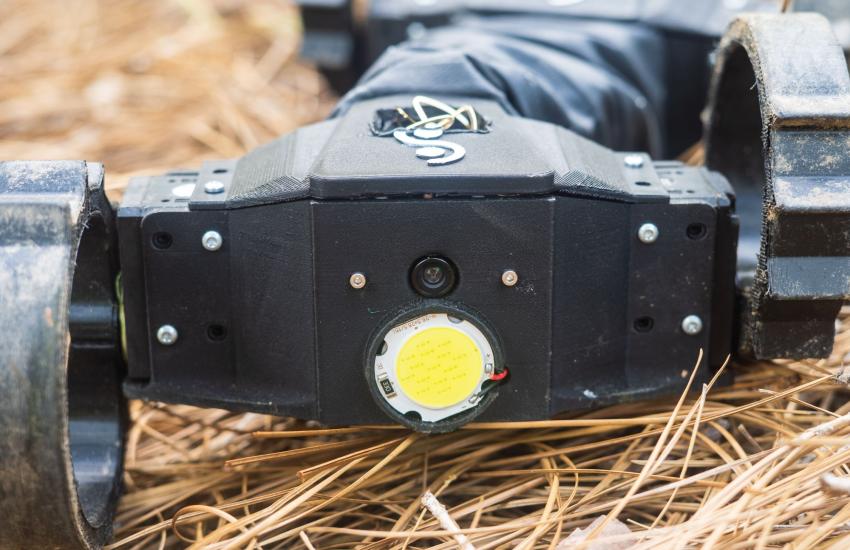
Goldman explained that basic research into biological organisms’ mobility has advanced robotics science. For example, large organisms such as dogs or kangaroos bounce when they run, but smaller animals—worms, centipedes, lizards or snakes—essentially “swim” on land. “We realized that there were common principles associated with the control of how you change the shape of your body, very broadly speaking, that could lead to very effective performance. It was really new basic science principles, biology and physics principles, about the character of locomotion.”
It also turns out that signal communications theory shares some basic principles with locomotion when legs are added to a long, skinny, snake-like body. “It’s funny that your magazine’s called SIGNAL because we noticed that our multi-legged robots were showing very capable progress over pretty nasty, rough terrain—even without much brain power. We realized there was a nice analogy from signal communication theory and robot locomotion. Redundancy of messages, encoding of messages, which is what all modern signal communication relies on, actually has a very nice connection to redundancy of limbs,” Goldman elaborated. “If you can become more efficient at coding those things, sequencing the limbs, you can get enormous benefits in performance.”
Goldman uses the term “mechanical intelligence,” which he said others call “passive dynamics,” where the body has a brain. “That was an idea which showed up in the balancing robots. If you take seriously that the organisms are doing a lot of their control and computation via the mechanics of their body and you look for those principles, then you can make really capable robots that don’t even need a whole lot of computer power.”
Hassanalian indicated that there may be much more for the world to see from biomimicking robots. “I believe animal/nature-inspired robotics has tremendous potential, and we are only at the beginning of seeing its impact in practical, real-world applications,” he concluded.


Comments