
Next-Gen Lab Uses Advanced AI and Wargaming To Evolve Warfighting Strategies
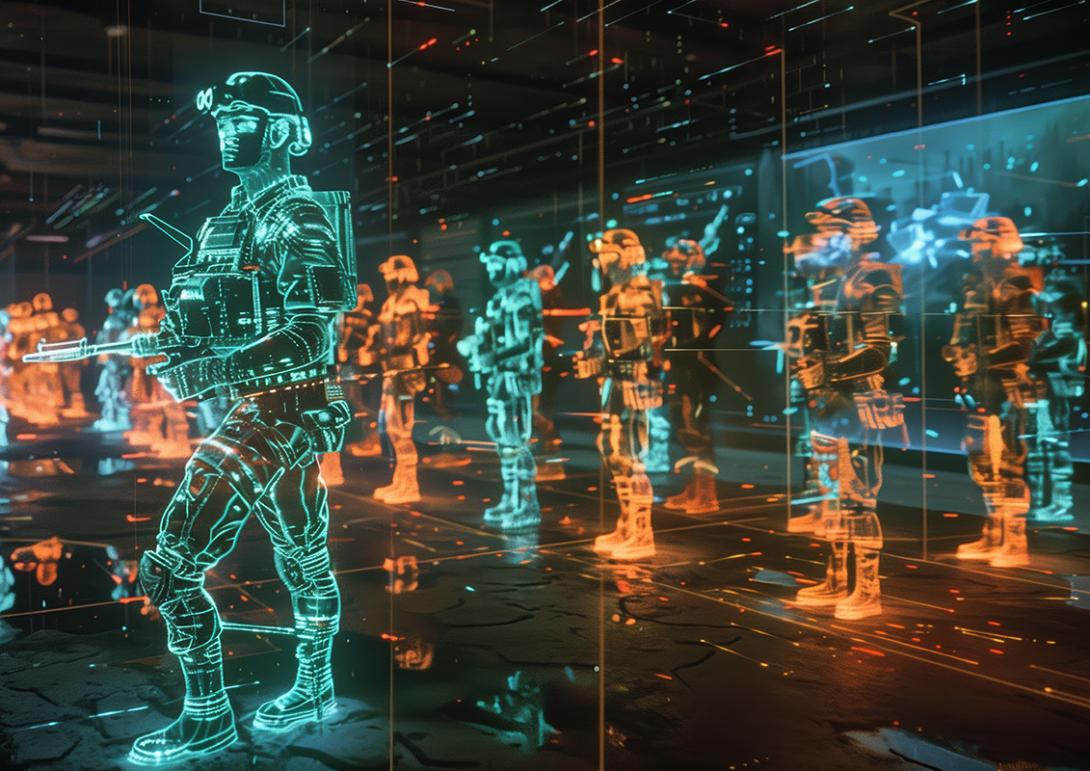

As the creation and implementation of artificial intelligence (AI)-based technologies in military operations become increasingly essential to winning the future fight, crews are working to leverage automated systems of all types to gain an advantage in this realm. Researchers at the new Generative Wargaming (GenWar) Lab at the Johns Hopkins Applied Physics Laboratory in Maryland are looking to propel advancement in this field through several avenues.
Firstly, they are using AI-based capabilities that engineers developed for simulated use cases to educate defense officials on the ways in which they can use these tools to support planning, analysis and operations research in their own environments. This will give them transparent analytic support in a timely manner, as per Kevin Mather, a group supervisor in the National Security Analysis Department at the Johns Hopkins Applied Physics Laboratory (APL) and leader in the GenWar Lab effort, and Kelly Diaz, a program manager in the National Security Analysis Department at the Johns Hopkins APL, where she focuses on using old and new technologies to solve national security problems.
Secondly, GenWar Lab developers are striving to incorporate the most up-to-date and optimal AI and large language model (LLM) systems into their wargames to ensure that their simulations are realistic and reflect the current landscape of the war arena. This capability provides Department of War officials with the opportunity to design, arrange and execute test runs to learn more about the modern battlefield; develop strategies and skills that they can use to maneuver through the modern battlefield; and gain insight into the tactics, techniques and procedures that adversaries are deploying in the modern battlefield. Ideally, recognizing the enemy’s patterns can help Pentagon leaders identify potential weaknesses in their own operations, better understand areas for improvement, and develop more effective defensive plans and technologies. Senior defense officials can also use this data to better predict the adversaries’ movements.
Early this new year, GenWar personnel will be taking significant strides to improve these AI and LLM systems. For instance, they are exploring and experimenting with the effectiveness of the networks when crews deploy them as blue and red cells during blue- and red-team simulations, Mather said. The goal here is to build adversaries into additional games. But as Mather warns, this process is complex and takes a lot of manpower, so contributors might not be able to complete it this month. He and his colleagues hope to accomplish this objective within the first couple of months of 2026.
“It’s a whole of [Johns Hopkins] Applied Physics Laboratory effort there,” Mather said during an interview with SIGNAL Media. There’s a lot of [personnel] cross-lab, cross-Applied Physics Laboratory, both equities and really smart people, working through that problem. It kind of gets to the underlying LLM and how to understand what comes out of them and how to compare that. So, one thing that I think you’ll see coming into the new year more and more is our work in understanding the ability of LLMs to play within wargames. The much harder question is how well they can actually replicate an adversary. The still hard, but slightly easier question is how well they can replicate us as human players in our attempt to replicate an adversary doing a red cell and that sort of stuff.”
“So, I think January-ish, but certainly into the new calendar year, that’s going to be a big push and something that we’ll continue investigating, and hopefully [we] have some cool stuff to show off,” Mather added.
Additionally, and similarly, researchers are searching for an answer to the question: how can they deploy and host these AI and LLM tools across various sponsors and networks? Each group and organization, especially in the Department of War, has specific needs and tasks that they are requesting autonomous systems to assist with. Because of this, Johns Hopkins Applied Physics Laboratory staff have found it challenging to customize these AI and LLM tools to each use case, Diaz suggested. This is a difficulty they seek to overcome this month.
GenWar Lab leaders also want to work with Department of War officials to continue to gather their feedback to gain additional information about the areas in which they are excelling and the areas in which they must improve. GenWar Lab contributors are already delivering to users, so they have begun the feedback process, and they are calling for it to continue, Mather said.
The GenWar Lab is integrating and adding to GenWar TTX and GenWar Sim, two development efforts that personnel have already established, Johns Hopkins APL officials stated in a press release. And GenWar Lab researchers predict that their entire body of work will address obstacles within the national security space and bolster it. Specifically, GenWar Sim workers created a tool that uses natural language through an LLM to generate adjudication outputs in a fraction of the time it took older methods to accomplish the same job. By using this technology during wargaming modeling and simulation exercises, team members can receive these outputs within about one minute. This marks a monumental improvement over traditional methods, which would take months to turn out these types of decisions. The novel practice will not replace the former, according to Diaz and Mather, as the former practice still provides users with notable value.
GenWar Sim is built on the Advanced Framework for Simulation, Integration and Modeling, and it enables wargame users to analyze the aftereffects of their actions in these data-driven environments, Johns Hopkins APL officials said.
“The three, six, nine, 12-month-long studies of modeling and simulation are a much different level of detail than what our tool provides, but the value of a tool like GenWar Sim is really to accelerate human learning by allowing everyone to have more informed and rigorous discussions,” Diaz explained.
This development assists in offsetting some disagreements that take place among leaders in wargames. Instead of having individuals who have decades of experience argue over the different ways to address a problem on the battlefield, they can now input the data and scenario into GenWar Sim and use its AI and LLM capabilities to produce more insight to help lead to a final decision, Diaz described.
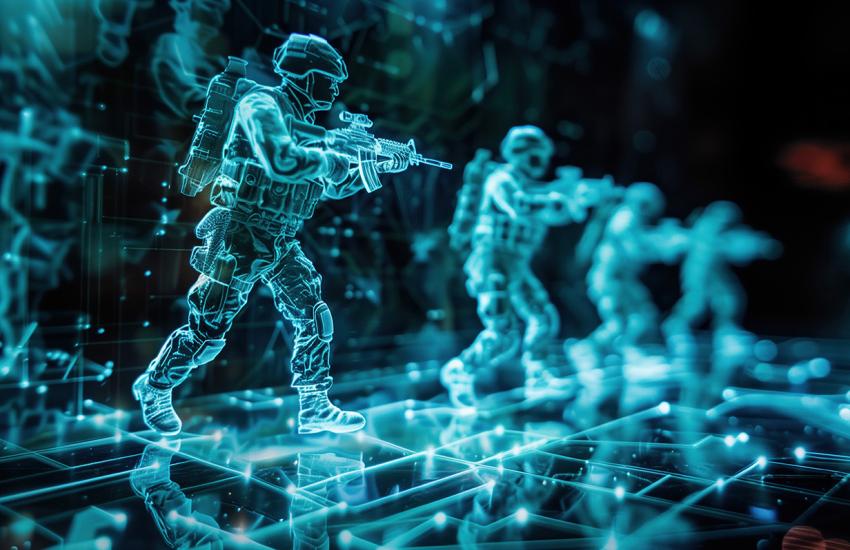
Furthermore, individuals associated with the GenWar Lab seek to establish a collaborative relationship between humans and AI in wargaming. The ability of warfighters to work together with AI to find the optimal way forward during a mission has become a major point of focus for researchers at the GenWar Lab. Consequently, they acknowledge that with this change in mindset, soldiers might need some time to learn more about and train on these advanced AI and LLM systems.
“[Human-machine teaming] is a very different approach, I think, than how we thought about using technology before,” Diaz said. “Some people, especially at the lab, with it being a technology lab, already worked that way, but usually the warfighter, who has an actual day job of driving a ship or manning some piece of artillery—that’s a new thing to think of using technology in that way.”
“Let’s demystify [an LLM] a little bit and tell you how you can really use it to benefit you and how you can understand where it might not be a great application, because that’s equally as important,” Diaz added.
“One application, like someone putting together plannings for how soldiers might employ on the battlefield, would be to take these concepts—both [GenWar] TTX and [GenWar] Sim and any future concepts in GenWar Lab—have their system, be able to put in all their initial plans, not just through what it is today, which is either PowerPoint or putting it in through the computer, but just by speaking English and saying [their plans],” Mather described.
“[This gives warfighters the ability to see] how that translates into either modeling and simulation or through a tabletop exercise and what a potential outcome might be and then saying that didn’t quite look right to me,” Mather added. “Let me rewind the clock and try something else. That’s the real power here.”
So far, commanders and soldiers are enjoying the developments and capabilities that GenWar Lab contributors are making possible. They appreciate having the ability to receive feedback almost instantaneously about a proposed solution instead of having to wait months in some cases, Mather noted. GenWar Lab officials also said participants are a bit hesitant about this development because of the possible dangers surrounding the AI and LLM space.
“There’s the feedback about the concept of what we’re doing, which I think people are very excited by but also cautious [about], because there are a lot of technological solutions,” Mather said. “Gen AI and LLMs have been in the news a lot, sometimes for good reasons and sometimes for not-as-good reasons. People are really excited about the potential advancements but also want to make sure they understand.”


Comments