
Quantum Emplacement for Defense Systems
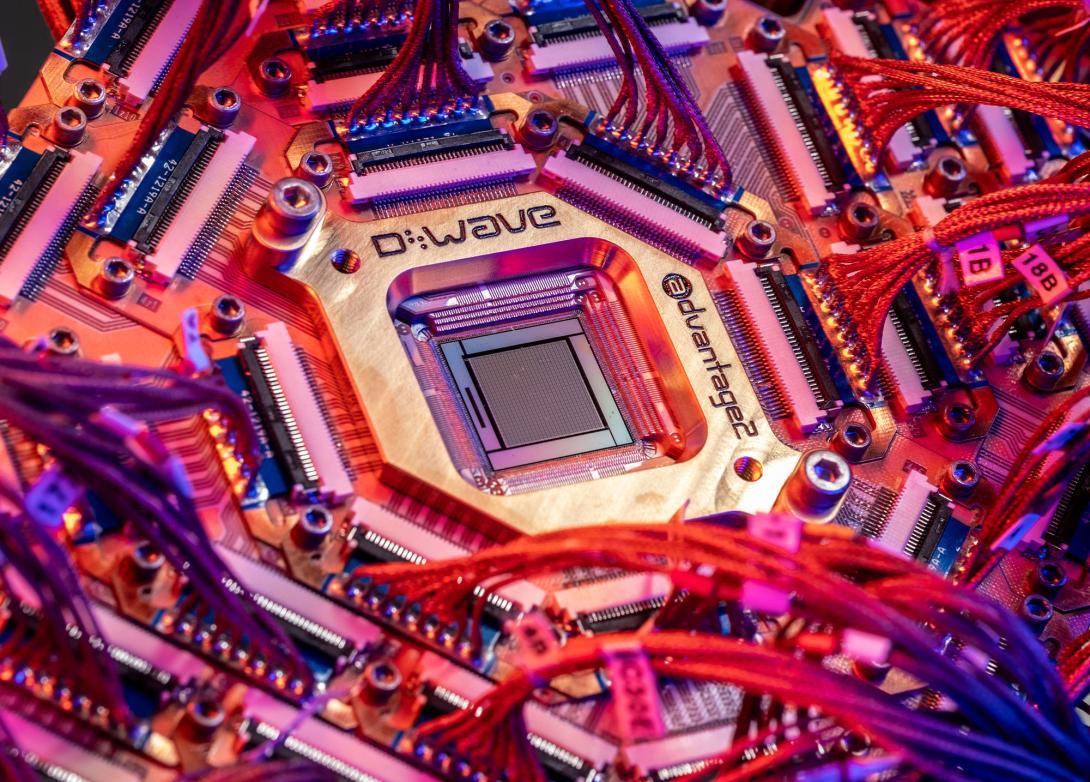

In January, three companies announced a collaboration to explore possible hybrid quantum solutions for the U.S. military.
One idea is for quantum emplacement, or the use of sensors and effectors paired with quantum computing methods to provide air and missile defense solutions.
Anduril, Davidson Technologies and D-Wave Quantum performed traditional missile defense simulations and compared them with simulations of potential hybrid quantum computing methods to see what quantum-based solutions could possibly provide.
D-Wave, the dual-platform quantum computing company based in Boca Raton, Florida, specializes in quantum annealing and gate-model systems, software and services. Huntsville, Alabama-based Davidson Technologies features missile defense and aerospace technologies, and Costa Mesa, California-based Anduril specializes in advanced autonomous systems.
Officials from Anduril and Davidson presented their findings at D-Wave’s annual user conference, called Qubits 2026, in Boca Raton, Florida, in January. The companies also issued a release about the collaboration.
“In an initial proof-of-concept that used Anduril’s defense simulations, Davidson’s mission-domain modeling and secure-computing expertise, and D-Wave’s quantum computing technology, the companies evaluated complex missile-defense planning scenarios,” the January 27 release stated.
The effort compared the performance of a classical-only approach to D-Wave’s Stride capability, looking at tracking quality, scalability and time-to-solution.
“The [simulation] demonstrated that while classical solvers performed effectively on smaller, less complex scenarios, the time to reach a solution increased significantly as problem size grew,” the companies said. “By comparison, as problem complexity scaled, D-Wave’s Stride hybrid solver extended its performance lead over classical-only approaches, delivering at least 10 times faster time-to-solution, a 9% to 12% improvement in threat mitigation, and the ability to intercept an additional 45–60 missiles.”

The simulation presented an attack scenario with 500 missiles.
Next, D-Wave, Davidson and Anduril plan to expand the collaboration by exploring other large-scale defense optimization challenges, including contested logistics, scalable and distributed manufacturing, cyber defense and courses-of-action generation, the companies said.
“Our collaboration with Anduril and Davidson marks an important milestone in applying quantum computing to U.S. national defense strategies,” said Alan Baratz, CEO of D-Wave in the release. “Our initial work together shows that annealing quantum computing can be put to use today for mission-critical applications, enabling faster, more informed decision-making for complex problems.”
“Quantum computing helps identify efficiencies to expedite execution in space, missile defense and joint force operations,” said Dale Moore, president and CEO of Davidson. “It rapidly evaluates millions of possible outcomes, determining the best course of action. We’re thrilled to collaboratively leverage this maturing technology and apply it to today’s national security challenges.”
“Anduril is constantly evaluating how we can apply emerging techniques to various defense challenges,” said Matthew Steckman, president and chief business officer at Anduril. “Our partnership with Davidson and D-Wave looks toward augmenting advanced technologies through quantum by first pressure-testing the technology against real defense problems.”

Comments