
Hundreds of Drone Builders Aim To Rise for DARPA’s Lift Challenge
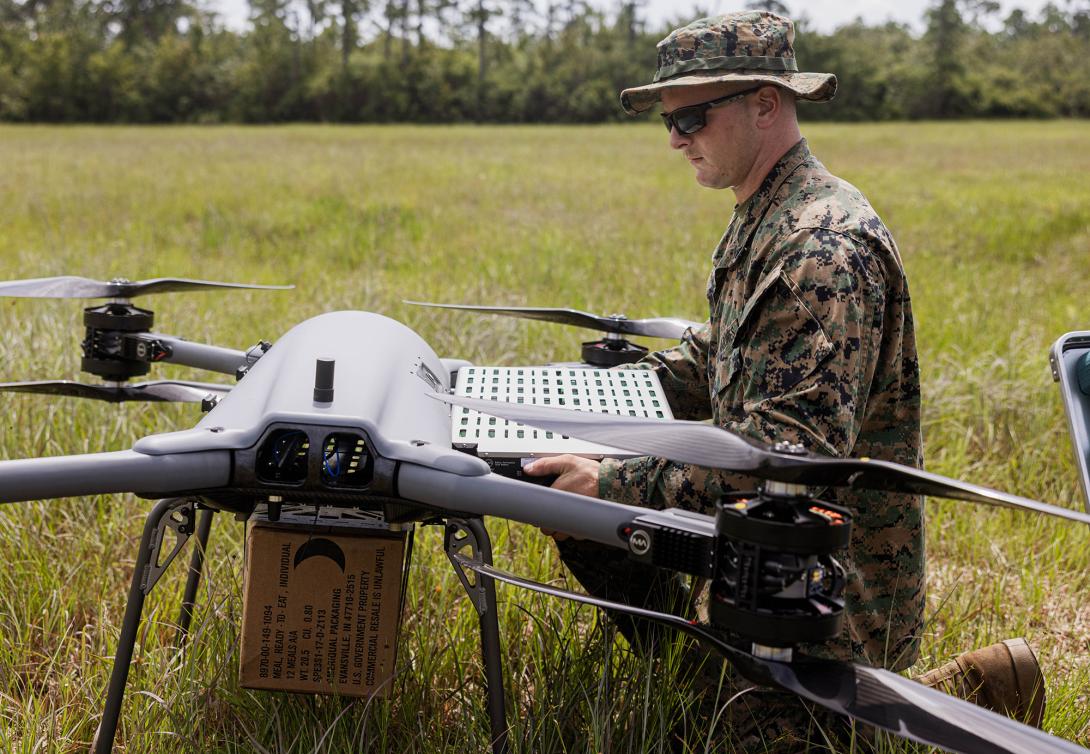
Hundreds of applicants hope to compete in the Defense Advanced Research Projects Agency’s (DARPA’s) Lift Challenge, which is designed to transform drone operations with a deceptively simple goal: make drones that carry far more than their own weight.
If competitors can demonstrate payload‑to‑weight ratios above 4:1 in a rigorous flight course this summer at Wright-Patterson Air Force Base (AFB), the result could ripple across military missions such as logistics, disaster response and commercial delivery—domains that have been constrained by today’s roughly 1:1 multirotor performance.
“Many problems could be solved if we just had a better payload‑to‑weight ratio,” Phillip Smith, the program manager overseeing the Lift Challenge, said in an interview with SIGNAL Media. Smith is at DARPA as a civilian but is also a lieutenant colonel in the U.S. Marine Corps Forces Reserve. He was an AV-8B Harrier pilot with a deployment on a Marine Expeditionary Unit with combat time and goes by the call sign “Donna.”
In practical terms, higher ratios let designers shrink airframes for the same payload, cutting energy requirements and costs, or buy more range by trading some payload for fuel or batteries. The military implications begin with small numbers that matter in the field. DARPA research suggested that 90–100 pounds is a common combat‑service-support payload band. Today, moving a 100‑pound payload often drives an approximately 100‑pound aircraft—expensive, specialized and logistically awkward. A 4:1 ratio would flip those economics: an aircraft weighing about 25 pounds could do the same job, letting units field more vehicles for the same procurement dollars while burning less fuel or battery mass per ton‑mile.
Scale the logic up, and designers might break out of bespoke aviation powertrains. If future vertical‑lift aircraft can sling 6,000–9,000 pounds with one‑quarter the size and power of today’s utility helicopters, there is a pathway toward high‑volume production engines—even categories that borrow from commercial-off-the-shelf automotive supply chains, driving down acquisition and sustainment costs.
“There’s a massive need on the military side and also on the civilian side, to really upscale, to improve our capabilities. We looked at a lot of different ways of doing that, a lot of different concepts of operations, and what we came down to was a lot of problems could be solved if we just had a better payload-to-weight ratio. That was our epiphany,” Smith said. “Payload-to-weight ratio does a bunch of things. For the same size payload, you can have a much, much smaller aircraft, which means now your combined total operating weight is lower. The operating cost comes down, and that’s across all scales, whether you’re trying to lift 10,000 pounds or 10 pounds.”
A convergence of new technologies makes this the right time to tackle such a dramatic improvement in lift capabilities for small unmanned aircraft in the 55-pound weight class, Smith indicated, highlighting the benefits of 3D printing and composite materials. “We have a lot of advanced composites that are widely available and widely available to the layperson. That allows somebody in their garage or a university student to produce something that previously was not [able to], and then that’s closely connected to the 3D-printing capabilities.”
In the past, he added, anyone wanting to develop the fundamental structure of a fixed wing, or the wing spar, would have to “use very crude materials, which “provided a lot of weight problems.” But times have changed. “Now you can make really exquisite architectures in 3D printing. And anybody can do that—university students, a guy in his garage, a small business. They can all explore and produce something at their level, which is pretty amazing.”
Power plants and drive trains have also come a long way. “There’s been a lot of work in the RC [radio control] world with smaller engines. They’re getting power-to-weight ratios that have been really amazing,” Smith reported. “We’d love to see some of those ideas.”
New modeling and simulation technologies play a role as well. Ten or 20 years ago, the program manager explained, someone wanting to create a brand new design and then model it before flying it or putting it in a wind tunnel would have to spend hundreds of thousands or even millions of dollars for the build or to get access to those capabilities. “Now a lot of those have been democratized. You can pay a small subscription fee and model your design at home, which is pretty amazing. And the same thing with flight control software,” he stated.
Amazing accomplishments that large companies achieved in previous decades, creating aircraft that weren’t supposed to fly but did, took massive numbers of software developers and testers, Smith elaborated. Now, commercially available technologies, such as Cube Orange autopilot, a small, open-source autopilot system for small drones, are readily available. “You can go onto internet repositories and just download flight control software that will work. And you have tools now where you can tweak that to your particular design. YouTube has guys who are making amazing aircraft at home.”
The application window started in January, and hundreds of potential competitors had already signed up two months prior to the May 1 deadline. The agency will announce official figures only after it completes document reviews and formally issues invitations next month. Those invitations will kick off phase three, which will culminate with the actual challenge August 2-9.
Teams must design an unmanned aircraft weighing 55 pounds or less (including fuel or power source), demonstrate vertical take-off and landing and complete a demanding five‑nautical‑mile circuit while lifting at least 110 pounds—with prizes from a $6.5 million purse awarded on measured performance. Live trials are scheduled for August 2–9, 2026, at the National Museum of the U.S. Air Force on Wright‑Patterson AFB.
Smith’s team deliberately chose to open the challenge to as many applicants as possible, including government and military teams, who normally would only be allowed to assist with a challenge rather than compete. “There are thousands, tens of thousands, of brilliant engineers that work in the government across all different types of organizations, and normally they are barred from this type of competition,” he asserted. “Just because you work for a government organization doesn’t mean your idea isn’t good and shouldn’t be demonstrated.”
DARPA does have one government partner: Naval Information Warfare Center—Carderock’s helicopter division, which provides modeling and simulation support and additional aviation expertise.
As with many other challenges, DARPA is not claiming ownership of competitors’ intellectual property (IP). Smith offered that IP concerns were a real impediment to broad participation—especially among small firms, universities and individual innovators who can’t justify “giving away the crown jewels” without a programmatic contract. By removing government IP claims, DARPA aims to maximize the funnel of ideas and increase the chance that a handful prove truly revolutionary.
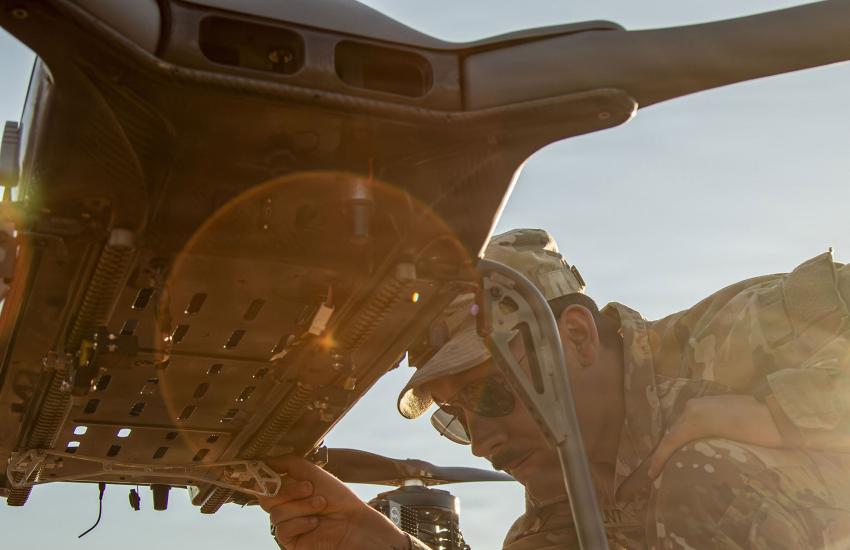
Flite Fest 2026, one of the largest U.S. grassroots radio-controlled aviation events, will co‑locate and coincide with the August Lift Challenge—a deliberate pairing intended to amplify unmanned aviation innovation and outreach.
Lift Challenge teams will compete across multiple flight windows to achieve an eligible score, with the highest score of each flight window submitted for review. A panel of DARPA experts will judge the final subjective winners for the competition.
Other than achieving the 4:1 ratio itself, Smith said the flight course will be the most demanding feature of the program. It’s a narrow, 100-foot-wide course by a little more than 1,000 feet long, and the landing zone has a 5-foot radius. It will require a lot of turns to push design features such as controllability and structural stiffness. “That all goes into design thoughts. And that’s what we wanted people to do, is wrestle with these things and try and figure out how to make it all happen.”
The team discussed the course extensively, consulting with aviation experts at DARPA and with other government organizations. “It’s very challenging. I have used the analogy of the 800-meter race in track and field. It’s not designed for either body type: the fast sprinters or the marathon runners. It’s right in the middle,” Smith offered. “And we did that on purpose because we didn’t want to bias a certain type of design. We know quadcopters and airplanes at the two sides of that spectrum. We wanted to see what people would do when it was right in the middle of those capabilities.”
Beyond hardware and rules, Smith suggested the most exciting opportunity is conceptual. For a century, vertical‑lift designs have been constrained by human cognitive and physical limits. With modern autonomy and flight‑control software, those constraints loosen. Designers can explore nontraditional stability regimes, radical geometries and highly dynamic maneuvers that would be unsafe or impossible with a person on board.
Between now and the finale, DARPA’s timeline stresses safety and seriousness. After the May 1 applications close, teams must submit a flight‑verification video by May 15. The concept paper focuses heavily on safety cases, separation distances and operational mitigations appropriate to a public venue. Teams that clear those wickets will receive a June 5 invitation.
If Lift’s ratios prove out in August—even short of the full 4:1—defense logisticians and acquisition leaders could see credible pathways to smaller, cheaper aircraft; resilient distributed resupply concepts; a wider supplier base; and faster innovation cycles.
As Smith suggested, the most important outcome may be the ability to break away from human-centered designs. He noted that vertical lift helicopter designs based on human controls have been stagnant, in part because humans have physical and cognitive limits.
“We have a real chance here at the DARPA Lift Challenge to break out of that human-centric mold, to rethink how aircraft are designed when there’s no human in them, to be unconstrained by that. That’s one of the most exciting things that I think we can do here, is to break that mold, break that box that we’ve designed vertical lift and helicopters in for the last couple of decades, or since Sikorsky flew the first helicopter,” he said, referring to Igor Sikorsky, who flew the VS-300 helicopter on September 14, 1939.

Comments