
Industry Advances Quantum Networking, Cloud and Application Development

In the midst of the quantum development era, more capabilities are emerging every day. Some of the latest advancements are enabling quantum computing networks, quantum computing in the cloud, and environments for the creation and validation of quantum applications.
IonQ, the American quantum company headquartered in College Park, Maryland, with locations in Basel, Switzerland; Toronto, Canada; Rome, New York, and Bothell, Washington, is planning to demonstrate a high-performance quantum network later this year. The quantum network could offer 50-100 times higher network speeds than traditional computer networks.
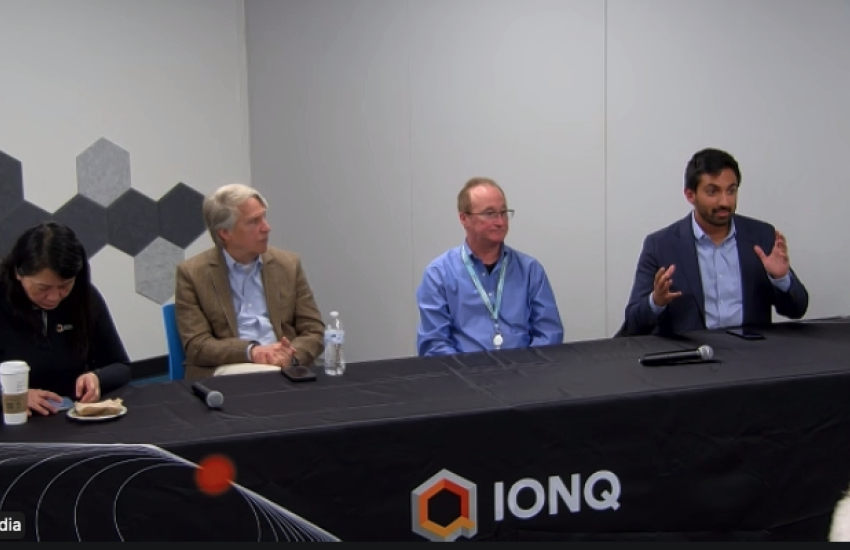
Four officials from IonQ spoke at a Griffiss Institute event on March 19, including Mihir Bhaskar, senior vice president for Global Research and Development; Masako Yamada, senior director of Applications Development; Denny Dahl, senior director for Field Engineering; and Curt Bujosa, technical program manager.
The Griffiss Institute is an advanced technology and science, technology, engineering and mathematics talent accelerator for the Defense Department. Their collaborative space, the Innovare Advancement Center, in Rome, New York, brings together academic, government and industry partners. The institute is working with companies like IonQ, along with some of the directorates of the Air Force Research Laboratory (AFRL) in Rome, across quantum and other advanced technologies.
“It’s kind of like being able to play with fire for the first time,” IonQ’s Dahl said. “And as a scientist, who would not love to do that. But there are other good reasons to do [quantum], including national security. If we can manipulate and precisely control these quantum states, there are things that we are going to be able to do that will give us a national security advantage. We would like that, and we’d like to make sure that nobody else gets it before us.”
Heather Hage, the president and CEO of the Griffiss Institute, introduced the IonQ panel during the event, which SIGNAL Media attended virtually. Hage noted that IonQ had “become one of the world’s leading voices in quantum computing, networking and sensing.”
The company powered up its first quantum system in 2017 and by 2021, offered the first quantum computing on all three major industry cloud platforms—Amazon Web Services, Microsoft Azure and Google Cloud.
Since then, IonQ has impressively grown its quantum infrastructure, part of which is located at Griffiss. Its largest effort is a quantum platform that will enable further R&D on quantum computing, networking, sensing, security and communications.
“What IonQ is now trying to put together is all of these pieces, quantum computing, quantum networking, quantum sensing, quantum security, into sort of a complete buffet of everything quantum that you could want,” Dahl stated.
The backbone of that platform is a quantum network being built in the new Quantum East lab at Griffiss that was expected to be operational at the end of March. Last year, the company constructed its first infrastructure at the facility—a trapped ion quantum computer—in the Quantum North lab. That lab also houses different quantum resources being built by the AFRL and other companies.
“The next system that we build will be the barium-based trapped ion quantum computer,” Bujosa reported. “That is currently being built in Bothell, Washington, outside of Seattle.”
That computer, and another barium-based one, will be shipped to Rome, New York, and rebuilt by the end of this year. At first, they will be connected to each other with optical fiber, Bujosa noted.
“To do that, you need to take the stationary-compute qubits and convert them to photon-based qubits,” he said. “And to do that, you need a quantum frequency down converter. But by the end of this year, we will have the quantum network all complete. We are just validating the performance right now.”
IonQ has two data centers with future plans for multiple data centers, connected in a ring architecture.
“The other quantum resources in the lab being worked on by AFRL, all of those potentially could be connected to the user nodes, and into the quantum network,” Bujosa shared. “That lab also happens to be right across the hall from the Sky Dome, and so potentially we could send the optical fiber over to the Sky Dome, connect to the optical ground station, a quantum ground station, and connect to drones using free space optical links—one day.”
As all this quantum infrastructure goes into place, the company is actively engaging with companies to explore end uses, Yamada noted.
“The first project that we are working on is with a very large bank,” she stated. “This is around a quantum key distribution. If you are a financial institution, keeping data safe is very important.”
IonQ is also working to develop quantum applications for AstraZeneca, the global pharmaceutical company. “We spun up a site at the AstraZeneca campus in Sweden so that we can work closely with customers and partners on the topics that matter to them the most,” Yamada shared. In addition, the company signed an agreement with a consortium of companies focused on regenerative medicine.
For the military, IonQ aims to deliver quantum solutions across land, sea, air and space domains.
Meanwhile, Boston-based Zapata Quantum is rolling out a series of tools to aid the development of quantum applications, said Jonathan Olson, Zapata Quantum’s vice president of quantum intellectual property and strategy, and Sumit Kapur, the company’s CEO, in an interview with SIGNAL Media.
Olson, who is also a patent attorney, explained that the company launched as a startup out of Harvard in 2017. The company began in quantum, but it pivoted to generative artificial intelligence in 2024. After a corporate restructuring, it returned to its roots in quantum computing.
“What Zapata has been really focused on the past few years is the idea of infrastructure in quantum,” Olson said.
Zapata Quantum was part of the Defense Advanced Projects Agency’s (DARPA’s) original Quantum Benchmarking program, the only company participating across all the technical areas of the multiyear program that advanced utility-scale quantum computer concepts. That experience gave them an understanding of what could be quantum-amenable applications and led to the company’s focus on hardware-agnostic quantum applications, Kapur explained.
“We are taking a look forward to understand what these systems are going to look like,” he said. “We have that perspective because of all the early work that we did with many of our commercial partners, and especially with DARPA. We could really see the weak points in the traditional software pipeline, and where the innovation is needed from a systematic level.”
In February, Zapata Quantum received patent protections in Canada, Europe, Israel and Australia for its quantum intermediate representation (QIR) solutions, after receiving an earlier U.S. patent.
The company sees a hybrid approach to quantum computing, with QIR solutions enabling such an environment.
“QIR is the kind of broadly applicable infrastructure that helps make hybrid quantum-classical computing practical at scale so applications can move from one-off demonstrations to repeatable deployment across an evolving hardware landscape,” Kapur said in a February 3 release.
Several companies have formed the so-called QIR Alliance, including Microsoft, NVIDIA, Quantinuum, Quantum Circuits Inc., and Rigetti Computing—as well as Oak Ridge National Laboratory—to promote a standardized and interoperable framework for quantum capabilities.
“In the future, everyone will be running quantum alongside classical,” Olson noted. “This is not a process where quantum just lives on its own in a vacuum. It is inextricably intertied with traditional computing.”
As part of its solutions, the company is looking at both quantum-native and quantum-mapping applications. As the name suggests, quantum-native applications involve actually using a quantum computer to solve a quantum physics problem, such as in quantum chemistry, pharmaceutical research or condensed matter physics. Meanwhile, quantum mapping sets a problem into quantum physics to derive a solution.
“Quantum maps are a problem that is not a quantum physics problem,” Kapur said. “But you are taking that problem and you are mapping it onto quantum physics in order to solve something.”
This could be in areas like networks, logistics, supply chain simulation or machine learning, for example. “We have done, I believe, some of the deepest, most foundational work in a variety of these high-value domains,” Kapur opined.
The idea now, the executives said, is to provide a series of development tools—a platform for end-to-end quantum application construction. This includes a quantum application intelligence dashboard that can help companies understand where in their business quantum can help, Olson said. In addition, the company’s quantum pilot offering utilizes artificial intelligence and quantum graphing to help develop algorithms and applications. They are also preparing an ontology of existing quantum algorithms and applications.
“We have a variety of tooling and applications that will allow you to do that and go all the way through to runtime, where you are actually deploying, evaluating, running these applications,” Kapur said. “This process going end-to-end is really unique.”
The platform also includes verification processes for quantum applications, a necessary step, given the nature of quantum computing.
“One of the great promises of quantum computing is the fact that you can solve a problem in a few minutes that would take a classical computer [much longer], but some of these problems are not verifiable,” Olson recognized. “In factoring, for instance, you can tell you have gotten the right answer. But if you are doing quantum chemistry, there is no simple way to verify that your answer is correct in the traditional sense. You actually have to demonstrate that your methodology is formally correct, with no errors with it.”
Lastly, the experts observed that there has been systemic underinvestment in quantum applications and algorithms, as companies tend to focus on engineering quantum computers and advancing Qubits, Olson and Kapur observed.
“Algorithms, to some degree, have lagged behind, but applications have lagged dramatically behind,” Olson noted.


Comments