
Filling in the Gaps: NATO Aiming To Solve Hybrid-Related Problems

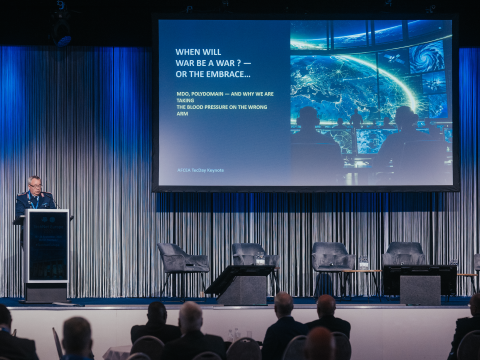
North Atlantic Treaty Organization (NATO) leaders are developing new tracking technologies and procedures and striving to gain a deeper understanding of sensors to improve their ability to predict and anticipate any suspicious movements their adversaries will make, Marco Criscuolo, director for strategy and policy in the Cyber and Digital Transformation Division at NATO’s headquarters in Brussels, announced Tuesday during a keynote address at TechNet Europe 2026 in Berlin.
The combination of these new tools and capabilities allows NATO officials to observe and follow processes that are notably repetitive, and if the enemy deviates from its routine, warfighters can respond in a timely manner. Criscuolo provided an example of a cargo ship and how it typically performs repeatable missions, which are ideal scenarios for deploying the new tracking tools and demonstrating their enhanced knowledge of sensors to better prepare for possible risks.
“A cargo vessel is very expensive to operate,” Criscuolo said during his speech. “Normally they load, they unload, and they go back and do it back and forth. The moment you see a cargo vessel doing that specific route, and then maybe you have very close-to-critical undersea infrastructures [that can see] something suspicious.”
He further explained that new infrastructure like this could be found in most military domains, in addition to at sea.
The development of novel tracking technologies and procedures, and the pursuit of understanding sensors, can be critical to learning about the ‘gray zone’ regarding the question of whether something is hybrid or non-hybrid.
Criscuolo said it’s important to categorize what is non-hybrid but still relevant from an operational perspective and what is hybrid because it’s connected to a specific campaign by adversaries; however, this classification is not black and white. The middle ground between non-hybrid and hybrid contains the gray zone. Learning more about this space is crucial in deciphering trends that leaders must see, according to Criscuolo.
During the keynote address, the director for strategy and policy in the Cyber and Digital Transformation Division also revealed another way the organization is working to ensure that personnel are prepared. They are implementing a digital transformation strategy that will deliver the right capability to warfighters to anticipate decisions supported by technology, per Criscuolo.
“It’s really about adding operational value to the soldiers on the field and, of course, being able to shorten the kill chain from connection to effect,” Criscuolo said.
One way NATO is chasing this objective is through its Mainsail project. Contributors released a prototype that consisted of expensive and inexpensive sensors to collect data, marking an unprecedented milestone.
“This is the first time we started to combine expensive technology with very cheap drones at sea, connecting data, fusing data, using artificial intelligence to correlate data, and of course, presenting decision-makers with a common operational feature.”
The digital transformation strategy is a long-term plan, and leaders expect to thoroughly address it by 2030, per Criscuolo.
TechNet Europe 2026, taking place in Berlin, is an international event organized by AFCEA Europe in cooperation with the AFCEA Bonn E.V. Chapter. SIGNAL Media is the official media of AFCEA International.



Comments