
Intelligence Illuminates the Complex Environment, Especially for Long-Range Kill Chains
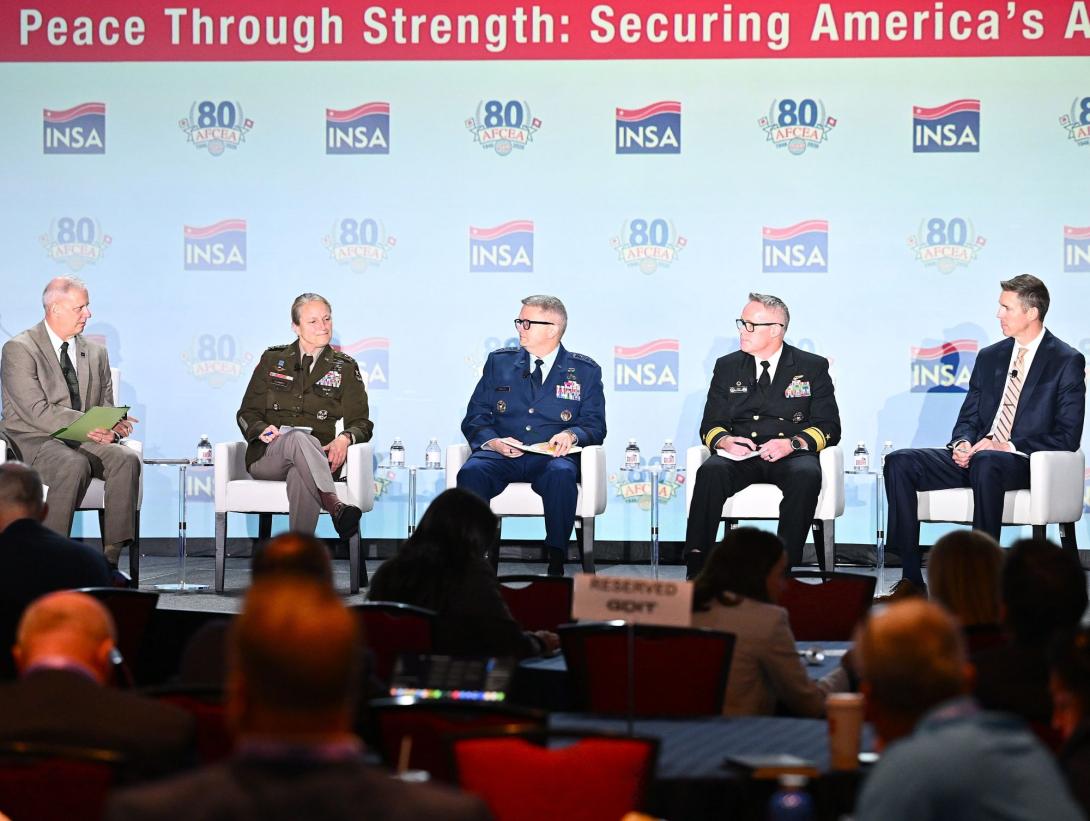
In a world of increasing adversarial capabilities, where U.S. dominance is not assured in a contested environment, the nation’s military intelligence leaders are working on how to provide what is needed.
Notably, several leaders in the intelligence community are focusing heavily on the kind of information, intelligence and processes needed for the long-range kill chain—the U.S. military’s ability to shoot a target from a long range, well outside of the line of sight.
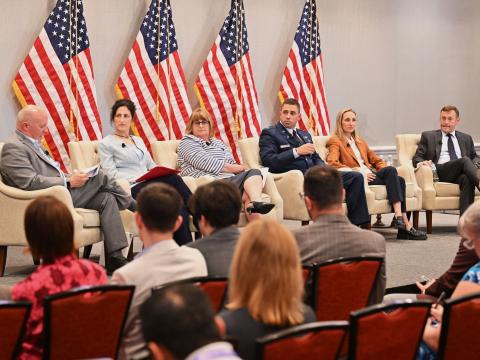
This necessitates robust intelligence in the data-gathering and decision-making processes and throughout the kill chain, the leaders said, speaking with Ret. Lt. Gen. Scott Berrier, USA, former director of the Defense Intelligence Agency, and now senior vice president, Intelligence and National Security, Booz Allen Hamilton, at AFCEA International and the Intelligence and National Security Alliance’s 2026 Intelligence & National Security Summit, August 26.
For Lt. Gen. Max Pearson, USAF, deputy chief of staff for intelligence, U.S. Air Force, the service’s separation of the intelligence role, the A2, from the communications, cyber and information technology role, the A6, has allowed him to focus exclusively on intelligence, he said.
And the deputy chief confirmed that the A2 office is spending considerable time on the long-range kill chain challenge.
“Our focus is on fulfilling intel's role in the long-range kill chain,” he stated. “And working to develop the capabilities that can establish and maintain custody of strategic global targets at speed and scale to support the long-range kill chain. What that focus has meant is primarily working with IC agencies, working with joint partners, and especially the joint staff.”
With those partners, the A2 office is running a series of experiments, stacking digital tools to automate targeting.
“Those tools broadly serve to execute predictive sensor queuing,” Pearson said. “Then we are leveraging live sensors to run these experiments, running that take through automated target recognition (ATR) algorithms, and then feeding those ATR detections into automated transmission capabilities.”
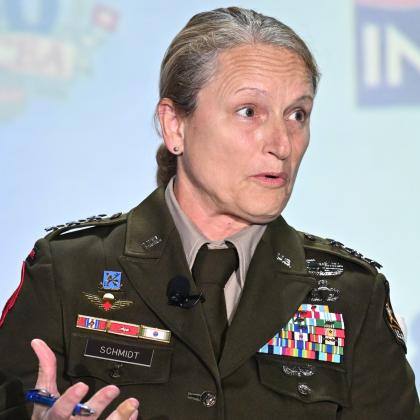
For the Army’s land warfare, the G-2 office is focusing on its intelligence support of targeting, said Lt. Gen. Michelle Schmidt, USA, deputy chief of staff, G-2, U.S. Army.
“My first [priority] is improving our intel support to targeting, writ large,” the Army intel deputy chief said. “Whether that is the technical targeting that we do at the brigade or division, to coordinate global targeting and work with the joint force, it is doing what we can to accelerate that kill chain, compress the kill chain.”
Here, artificial intelligence (AI)-based target recognition solutions are needed for their kill-chain solutions.
“That does take AI,” she said. “It takes a lot of target recognition. It is the idea that we do need to see. We need to understand. We need to decide. We need to act much faster, much faster than any adversary that we may face.”
The Army’s intelligence efforts are also going toward keeping soldiers safe, now and in the future, with regard to drone swarms and advanced adversarial weapons.
“It is ensuring that our soldiers are protected, can survive in [a denied] environment,” Schmidt said. “Ensuring that we are putting the right intelligence support behind our counter-UAS efforts, for example, our counter-space efforts, our ability to defend ourselves against incoming ballistic missiles, and really looking at protection as it applies from what I would say from support to ultimately to a foxhole somewhere.”
The other intelligence priority is making sure the Army’s intelligence platforms and software are performing well.
“So that we are investing in the right things and they are interoperable,” Schmidt confirmed. “Whether that is integrating across our intelligence functions or intelligent operations, or making sure we get the right equipment and the software to our soldiers . . . with the bottom line of getting the right data to the right place at the right time.”
Notably, the U.S. Coast Guard has been busy lately, tasked with efforts in addition to its traditional mission sets, said Steve Griffin, assistant commandant for intelligence, CG-2, U.S. Coast Guard.
“It has been really interesting, particularly in the last year, and the change in terms of what the Coast Guard has gone through,” Griffin noted. “But the Coast Guard has been asked to do a lot of things that are outside the traditional mission . . . Since October, we have been called on to help secure the Southern Border.”
And like the Army, the Coast Guard is “taking a hard look at force protection” of Coast Guard forces as they expand operations, especially outside of the United States. This intelligence work involves counterterrorism, global force posture and dark tanker operations.
“You have probably all seen this on the news, about how we get after anomalous activity and vessels that are operating outside of regulatory controls,” Griffin said. “Those are just a couple examples of things that force us to flex as the threat has continued to materialize and change, particularly in the gray zone, with obfuscation, or different ways in which international cartels are changing their operations. For us, it has been a brave new world over the last nine or 12 months.”
My first [priority] is improving our intel support to targeting, writ large.
Their intelligence priorities also reflect the Coast Guard’s expanded operations in the Pacific and the Arctic, Griffin offered.
Meanwhile, for Rear Adm. Mike Brookes, USN, commander, Office of Naval Intelligence, his focus is on intelligence officers and sailors, their training and tools—including data-centric tools.
“It is making sure that they are trained appropriately,” Brookes said. “And these days it is giving them the tools that they need specifically to deal with the data that we collect, to be able to take that data and turn that into intelligence.”
The rear admiral also considers how the development of the Navy’s systems is shaped by intelligence of adversarial risk. “How do we develop platforms and weapons systems, with a huge emphasis on how we do internal support acquisition, so that when we build a ship or when we build equipment systems it's threat-informed,” he shared.
For fleet operations and maritime security, the commander makes sure that the Navy has in-depth knowledge and a distinct understanding of adversary weapon systems.
“It is also in-depth knowledge about how they are going to fight, their tactics they teach and perceive, how they are going to take those weapon systems and deploy them,” he clarified. “It looks a little bit like improving our targeting processes to keep up with the pace of power and . . . those long-range kill chains and be able to execute at a greater pace and greater scale.”
Another of the commander’s priorities for naval intelligence is to leverage solutions for the massive amount of maritime data the Navy has to develop actionable intelligence.
“[It is] to have the tools to be able to handle the data and turn data into intelligence,” Brookes noted. “I think probably that is one of my biggest priorities.”
The Navy is also looking at how AI tools can be used safely in its networks and sensors, as well as how to improve its processes. This includes better tools to support acoustic intelligence. And from industry, naval intelligence needs “help wrangling data.”
The 2026 Intelligence & National Security Summit is co-hosted by AFCEA International and INSA. SIGNAL Media is the official media of AFCEA International.

Comments