
A German Perspective: Industry and Research Must-Haves for Military Readiness in the AI Era
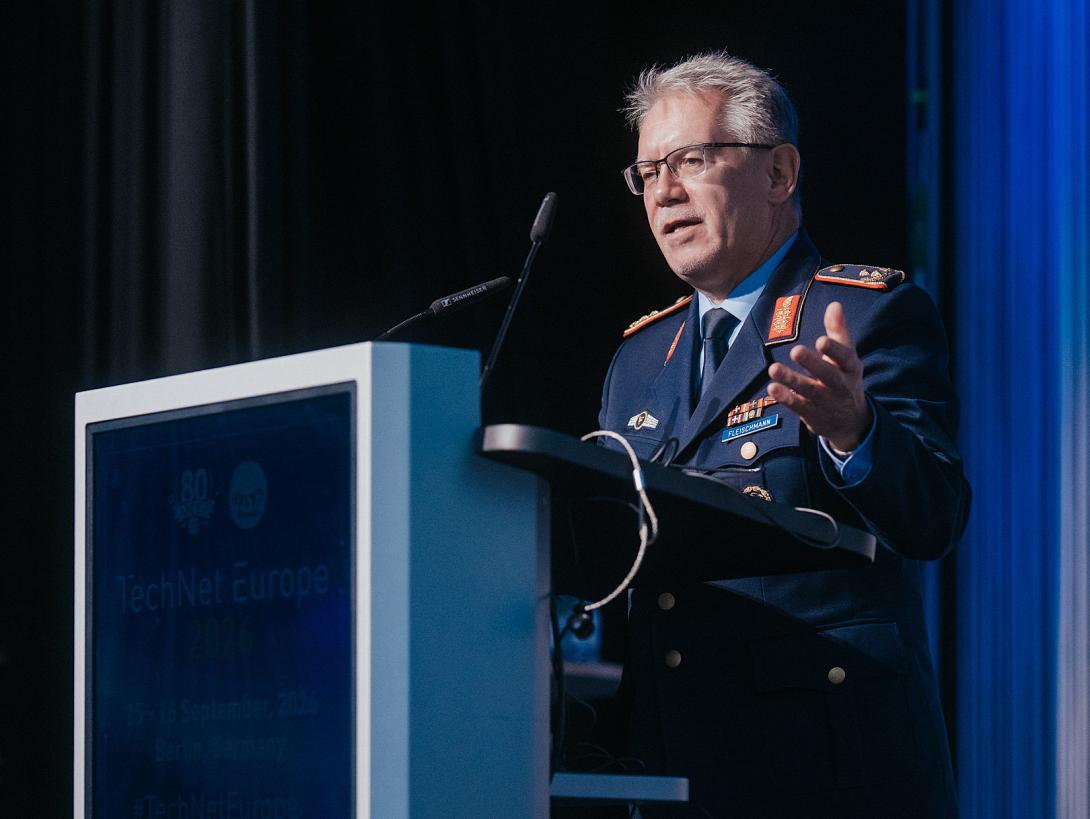
One German Air Force major general laid out the framework and offered suggestions that industry leaders and researchers should use—especially in the artificial intelligence (AI) era—to play their part in assisting the country’s armed forces to prepare for the fight. The blueprint consists of four pillars: interoperability by design, resilience by design, trust by design and responsibility by design, Maj. Gen. Armin Fleischmann, DEU AF, commander of the Cyber and Information Domain (CID) Support Forces and deputy chief of staff of the Capabilities CID Command at the Ministry of Defence in Germany, announced during a presentation at TechNet Europe 2026 in Berlin.
The first concept of ‘interoperability by design’ is essential. Fleischmann stressed that personnel in the private sector and in academia must share data and solutions with their NATO and European partners. Developing innovative technologies is not enough—the creators need to get these tools into the hands of the individuals who need them.
“A technically excellent but isolated system creates limited operational value,” Fleischmann warned.
The ‘resilience by design’ bullet point focuses on the need to produce systems that can still function regardless of where operators utilize them. These capabilities should remain effective in denied, degraded, intermittent and limited (DDIL) environments, areas where the positional data is unreliable and parts of the infrastructure might be compromised. Fleischmann said, “Graceful degradation is not a secondary feature; it’s an operational requirement.”
During the keynote address, the commander of the CID Support Forces apprised attendees of the need for ‘trust by design.’ Industry leaders and researchers must seek out architectures that are secure, data that is traceable, testing procedures that are robust and a level of explainability appropriate to the mission.
“Trust means knowing where a system performs reliably, where its limits lie and when a human must intervene,” Fleischmann said.
The last pillar zeroes in on ‘responsibility by design.’ Despite the widespread deployment and integration of AI, technical development still needs to preserve clear human authority and abide by existing legal and political limitations, Fleischmann argued.
“The objective is not maximum automation,” Fleischmann assured. “The objective is responsible operational advantage.”

A technically excellent but isolated system creates limited operational value.
Fleischmann concluded his speech by reiterating the importance of these four pillars, but he also stressed that they cannot always wait for the ideal time, circumstances or solution to get ready for the fight. They must remain prepared.
“These requirements point to a broader idea of deterrence,” Fleischmann said. “It’s not only the ability to impose costs but also to deny an adversary the effect it seeks. If institutions remain connected and the leaders can still see, decide and act, hybrid pressure loses much of its strategy memory.”
“Germany already faces persistent hybrid pressure,” Fleischmann added. “We must assess every incident carefully and avoid premature confusion, but we cannot make preparedness dependent on finding the perfect label for the situation. Our task is to protect our freedom of action before a crisis, to enable Germany’s role as NATO’s strategic hub and to defend our society when required. The Bundeswehr cannot do this alone. The government cannot do it alone. Industry and research cannot do it alone. But together, we can make ambiguity ineffective. AI can compress time. Humans retain responsibility and preparedness cannot wait for the name to change.”
TechNet Europe 2026, taking place in Berlin, is an international event organized by AFCEA Europe in cooperation with the AFCEA Bonn E.V. Chapter. SIGNAL Media is the official media of AFCEA International.



Comments