
Shifting Away From Effect-Based Thinking: ‘War Is Not Billiards’
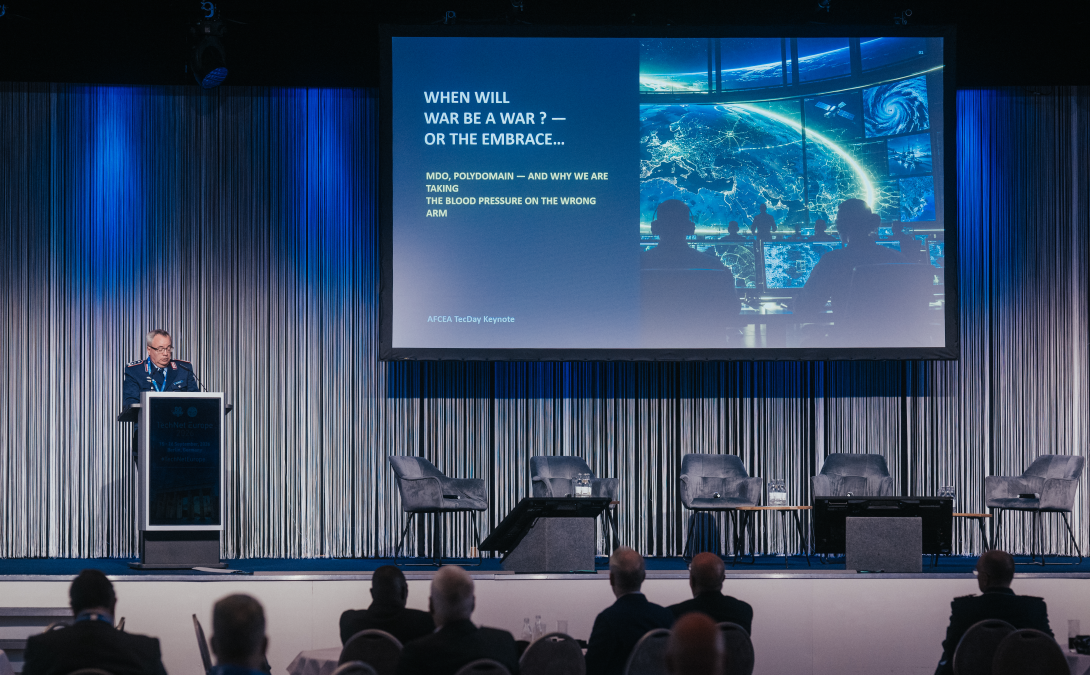
Military leaders across the world must engage in operations with a multidimensional mindset that moves away from the traditional linear thinking still seen on the battlefield. Col. Sönke Marahrens (GS), a German Cyber Force official and branch head of the German Center for Digitization of the Armed Forces, calls this mindset consequence-based thinking.
Commanders who ground themselves in this consequence-based thinking will see adversaries as adaptive systems, something effect-based thinking fails to do. Analyzing the fight through this mindset will prepare defense leaders to understand that the enemy will zig when they are expected to zag and perform actions that are out of the traditional order, a capability that was not practical through effect-based thinking.
“The enemy will react, evade, circumvent and learn, and its actual reaction—I do not know at the planning stage,” Marahrens said during a keynote address at TechNet Europe 2026. “I will discover it in execution. The consequence emerges in the interaction, not in the planning phase.”
Effects-based thinking is not good enough to win on a battleground where adversaries can strike in a number of ways, according to Marahrens. If commanders have this mindset, they will view enemies as inflexible and set-in-stone objects. During the speech, Marahrens compared this line of thinking to hitting a pool ball. A player hits the cue ball, the cue ball then hits the target ball and ideally, the target ball falls into the pocket.
“Effect-based thinking treats the effect as a plannable causal chain,” Marahrens said. “Employ asset A, achieve effect B and reach end state C. That works as long as the target is an object, a bridge, a radar and a server.”
However, the modern-day fight is not often fought in this way, and Marahrens made sure to include in his presentation that “war is not billiards.” Adversaries can take several different avenues adversaries when attacking or organizing their forces, and effect-based thinking does not capture this critical component.
Marahrens delivered the speech to individuals in all walks of life, including the government, military, academia and industry. He addressed the private sector directly and applauded its role in developing capabilities, and he wants the innovation to multiply.
“Many in this room built precisely that connectivity, so let me say, the technology is not the problem,” Marahrens stressed. “You are doing a great job for the warfighter and for me. The problem is what we misstated for building connectivity as a predictability machine for central headquarters—more prediction and more synchronization from the top. If real value lies elsewhere, connectivity can expand the option space of the technical leader. More options and more means for the men and women on the ground, so they can act at the very place where the consequences emerge. This is fundamentally a different architectural goal.”

. . . connectivity can expand the option space of the technical leader. More options and more means for the men and women on the ground, so they can act at the very place where the consequences emerge. This is fundamentally a different architectural goal.
He urged the private sector to hold onto this objective and return at the end with artificial intelligence.
Later in the presentation, Marahrens addressed another topic. He strongly advocated against the addition of a sixth domain: the cognitive domain. Marahrens argued that the cognitive influence in war has an impact so profound that it cannot be limited to a single domain.
“Cognition is not a domain and cannot be one,” Marahrens said. “A domain is a category of jurisdiction and targeting. Cognition, in a thorough causation sense, is the overarching level under which all domains operate in the first place. Every decision and every domain is a cognitive act. War starts in the brain and ends in the brain.”
TechNet Europe 2026, taking place in Berlin, is an international event organized by AFCEA Europe in cooperation with the AFCEA Bonn E.V. Chapter. SIGNAL Media is the official media of AFCEA International.




Comments