
President's Commentary: Defeating the Tyranny Imposed by Distance
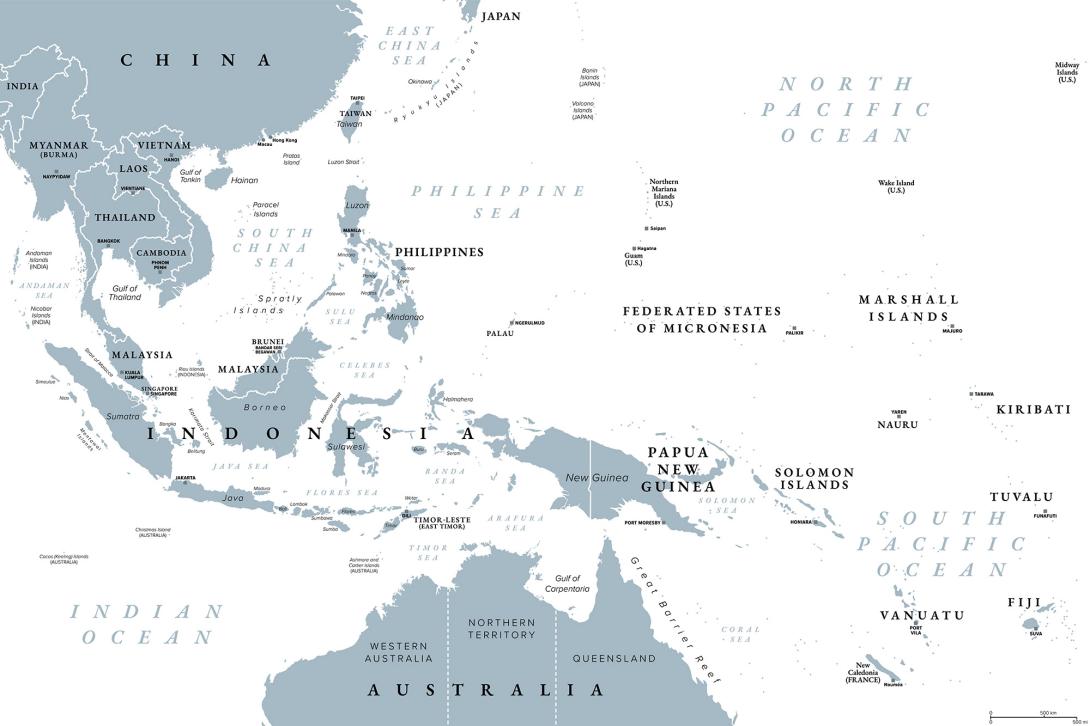
For generations, military commanders have faced the Indo-Pacific’s so-called tyranny of distance, which challenges deployments, logistics, targeting, and command, control and communications.
That metaphorical tyranny has grown since the People’s Republic of China and other potential adversaries have been deploying long-range precision weapons, space-based sensors and cyber tools to disrupt fuel, munitions and maintenance. In the cyber arena, Chinese hacker groups Volt Typhoon and Salt Typhoon present the most ominous example of this disruption tactic. By accessing critical U.S. and allied networks and systems, these groups were poised to wreak havoc on our ability to respond in case China attacks Taiwan.
The new national security strategy emphasizes the value of the Indo-Pacific region, especially the first island chain, which includes South Korea, Taiwan, Japan and others and is considered critical to regional security. The strategy calls for keeping the Indo-Pacific free and open, preserving freedom of navigation in all crucial sea lanes and maintaining secure and reliable supply chains and access to critical materials.
The United States is addressing the distance challenge on multiple fronts. For example, the joint force is implementing Combined Joint All-Domain Command and Control (CJADC2), a data network that connects tactical links, resilient satellite communications and partner networks to maintain operations when communications are contested. And new cloud-enabled gateways and over-the-horizon mesh networking demonstrate that interoperable command and control across services and allies is now possible.
International partners and allies are integral to combating tyranny of distance challenges. The Mission Partner Environment transforms coalition operations across the Pacific and provides the secure, real-time information-sharing backbone that allows multinational forces to function as a coherent whole. U.S. Indo-Pacific Command is streamlining dozens of country-specific networks to a single, integrated mission network.
The United States and the Republic of Korea (ROK) alliance is one of the most long-standing in the region, and the ROK/U.S. Combined Forces Command is arguably one of the most mature combined warfighting commands. In a December lecture, Gen. Xavier Brunson, commander of United Nations Command, Combined Forces Command and United States Forces Korea, highlighted the advantages of U.S. and allied forces already positioned inside the first island chain. “Korea is not a side chapter in American strategy. If you put the peninsula in the first chapter, the geometry of the region and the value of our alliances becomes impossible to ignore.”
The U.S. State Department also announced in December that the Quad countries—Australia, India, Japan and the United States—concluded a field training exercise with the Indo-Pacific Logistics Network, which is designed to allow sharing of logistics capabilities supporting civilian response to large-scale natural disasters, but may also offer insights for military deterrence against regional aggression.
Meanwhile, the U.S.–Japan alliance is transforming U.S. Forces Japan into a joint force headquarters reporting to the commander of U.S. Indo-Pacific Command. The new U.S. Forces Japan will assume primary responsibility for coordinating U.S. security activities in and around Japan and may gain authorities over some U.S. assets and personnel in Japan.
And AUKUS Pillar II, a cooperative effort between Australia, the United Kingdom and the United States, advances capabilities in areas such as autonomy, undersea systems, quantum and hypersonics, which will be most effective when integrated with CJADC2 and allied logistics networks.
Integrated deterrence and the evolution of joint warfighting heavily emphasize the capabilities required to mitigate the tyranny of distance. Senior officers stress that adversaries are designing strategies to “sense, shoot and disrupt farther,” and the United States must match them with expanded maneuver, resilient sustainment and integrated air-and-missile defense.
The United States stands to benefit when our international friends and allies continue to innovate in key technologies, such as cybersecurity, artificial intelligence and quantum computing. Strategic partnerships foster deeper collaboration, regional strength and deterrence.
Distance remains constant, but when we move forward with our partners and allies, the tyranny of that distance can be overcome.



Comments