
Project Dynamis Is Rewriting How Marines Fight and Share Data
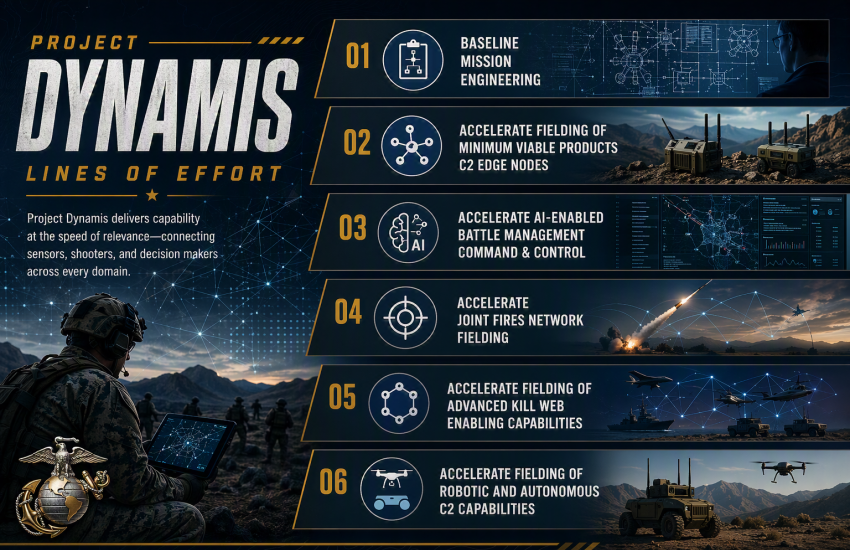
It has been about 11 months since the U.S. Marine Corps (USMC) launched Project Dynamis. Today, the initiative is accelerating artificial intelligence-driven command and control and transforming land forces into the next generation of warfighting.
“I honestly, at this point, believe that this project is going to ... lead to some of the most significant technological advances in modern Marine Corps history when it comes to really harnessing the power of what artificial intelligence can do when it comes to battle management and control,” said Col. Arlon Smith, project director.
On September 10, 2025, USMC Assistant Commandant Gen. Christopher Mahoney signed a memorandum formally establishing Project Dynamis to rapidly modernize the service’s combined Joint All-Domain Command and Control (CJADC2).
The move was to happen in collaboration with the team leading the Department of the Navy’s Project Overmatch, an initiative launched in 2020 by retired Adm. Michael Gilday, 32nd chief of naval operations.
While much of Project Overmatch has been kept under wraps, reports noted the Navy’s request for almost $140 million for fiscal year 2025 and over $700 million for its five-year spending plan. The aim is to enhance coordination across military assets and personnel by prioritizing CJADC2.
The establishment of the Marine Corps’ portfolio acquisition executive in April provides “jet fuel” for Project Dynamis, according to a Breaking Defense report.
The Navy’s Vice Adm. Seiko Okano, who has led the Project Overmatch program, has been integral in helping shape Project Dynamis, Smith said in an interview with SIGNAL Media.
“I talked with the Navy about what they were working on, and I realized there [were] a couple of commonalities,” Smith offered. “One of the commonalities was taking advantage of the new high compute edge nodes.”
With new, carry-on-size servers with ultra-high compute capabilities, Smith and his team are looking to make large black proprietary hardware-software combo boxes a thing of the past.
“The new model was you have one box with a really high compute, and then you take a virtualized version of all the other software and put it onto one box, and these would be ruggedized boxes,” Smith said. The boxes could be used in all weather conditions, he added.
The Pentagon’s third offset strategy, which was championed by then-Deputy Secretary Robert Work, was heavily focused on CJADC2 and a common data layer, Smith explained. Upon discussions with the Army, Smith learned of the service’s partnership with Anduril for a dual-use solution called the Lattice Mesh. The capability is a decentralized mesh networking system that distributes data across services, domains and platforms over long distances.
Through the platform, operators have access to critical information in “remote, degraded and low-bandwidth environments at the tactical edge,” according to Anduril’s website.
The Marine Corps Warfighting Lab, along with the Navy, has also been iterating on that capability, Smith said.
Additionally, Smith found that the Maven Smart System (MSS) was also being used by both branches, allowing access to agentic workflows and backend compute ecosystems.
The USMC announced its service-wide implementation of Palantir’s MSS last year.
“Lattice Edge Data Mesh, Maven Smart Systems and edge nodes, that really set the conditions for the beginning of this project,” Smith said. “What we did that was a little unique is that we immediately partnered with industry,” which the Army was also doing.
“We fell in on some exercises that were already planned and we showed up with our hardware and our software and plugged into the exercise, and we began to use operationally realistic environments and missions.”
Within the artillery firing mission, for example, Smith and his team tested data transfers from special forces teams who identified targets that could then be pulled up on a computer for additional information.
“We get details, we get weapons quality data, and then we send it to the firing line,” he offered.
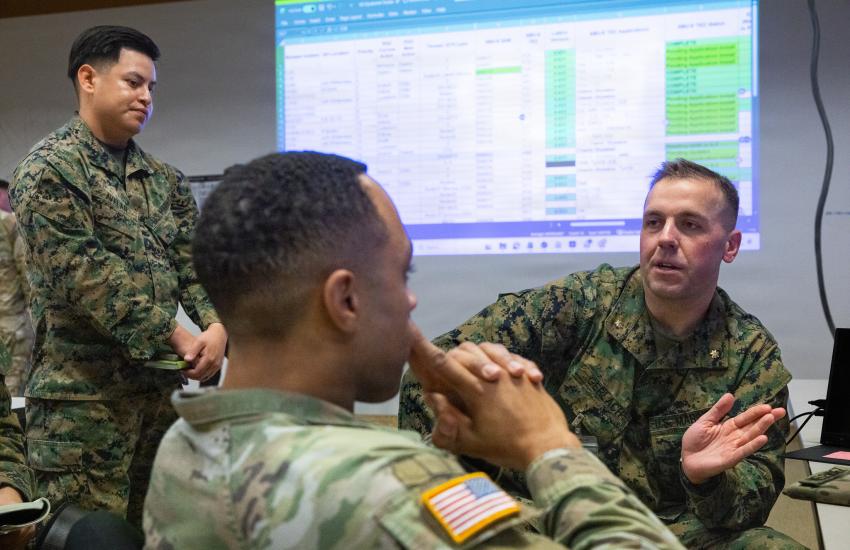
“We started iterating on those problems with the hardware and software with the engineers, world-class, highly paid engineers from these top vendors sitting side-by-side with the Marine sergeant who’s the warfighting experienced operator on our program of record software on this new data mesh architecture, and we began iterating,” Smith outlined.
The process has been repeated for seven sprints, all of which have consisted of 10- to 15-day-long exercises and tests to identify data challenges. Between each sprint, the Project Dynamis team works with vendors to resolve issues before the next run.
“What’s been so powerful about this is we have not been doing this by ourselves,” Smith noted. “A lot of what we’ve been doing is actually in partnership with the Army at Fort Carson, so we have Marines going to an infantry division-scale exercise, maneuver elements in the field, aircraft in the air, live fire ranges are hot, and we have Marines in the mix in a warfighting scenario iterating side-by-side.”
The Navy has also been brought into the game, Smith said, with a real ship being part of each event, incorporating real edge nodes and synthetic data to plug in and add further complexity to the task.
“It’s been a case study of what the vision was to have an inherently joint capability that was built based on warfighter requirements, actually facing the problem head-on and working through it and developing the capability that we actually need,” he continued.
The process is a large-scale shift from a legacy model of developing capabilities in a conference room with long documents over multiyear periods, only to be given to vendors to be developed in three to five years.
“We have turned that on its head because of the speed at which this is moving, and we’ve been doing it side-by-side together,” he said.
Another vendor working within Project Dynamis is Roon Technologies, which the Army selected for logistics command and control, an area Smith admitted the USMC has been behind on.
“We have continued some work with Roon Technologies building on work that the Marine Corps Warfighting Lab had done with them and work that our deputy commandant for installations and logistics had done,” Smith said. “It’s been very exciting to see the rapid progress because a lot of this new software is also cloud native and a lot of the new companies are also Maven Smart System native, so these things really work together in a really powerful way.”
The advanced tools also give Marines a chance to work with more modern and agile systems, Smith noted.
“A lot of what we’ve had hasn’t been modern, so the Marines go to an exercise and they use that, but then they go home at night, and they log on to an iPad Pro and then log on to an iPhone 17 Air, and they’re interacting with cutting-edge technologies,” Smith explained. “Then they go back to the exercise, and they’re back to the black screen with the green letters. So, what we have done is brought what they’re used to seeing in their personal life to the battlefield, and a lot of this new stuff is exactly what they envisioned when they were a young Marine signing up to be an intel analyst or to be a fires coordinator.”
Looking ahead, Smith and the Project Dynamis team will expand their software and hardware baselines, along with their general architecture, to more theater events with allies and partners.
“One of the things we’ve been working on ... it’s novel for the Marine Corps, is working with unclassified encrypted communications,” Smith shared.
Having received a lot of feedback from commanders in the field, Smith noted the need for a full portfolio of capabilities for data communications.
“We’re always going to need the exquisite, highly classified data sources; there’s no place for that,” he stated.
Additionally, there is a growing need for communications capabilities for secure connections with nontraditional mission partners with host-nation law enforcement. The capability would allow for information sharing, such as location data and messages, within an unclassified but secure environment.
“That’s one of the things we’re working on that is new and that really opens a whole new gateway of opportunities to be able to share both voice and data communications with mission partners moving forward,” Smith said.
Comments