
Reflections on Artificial Intelligence
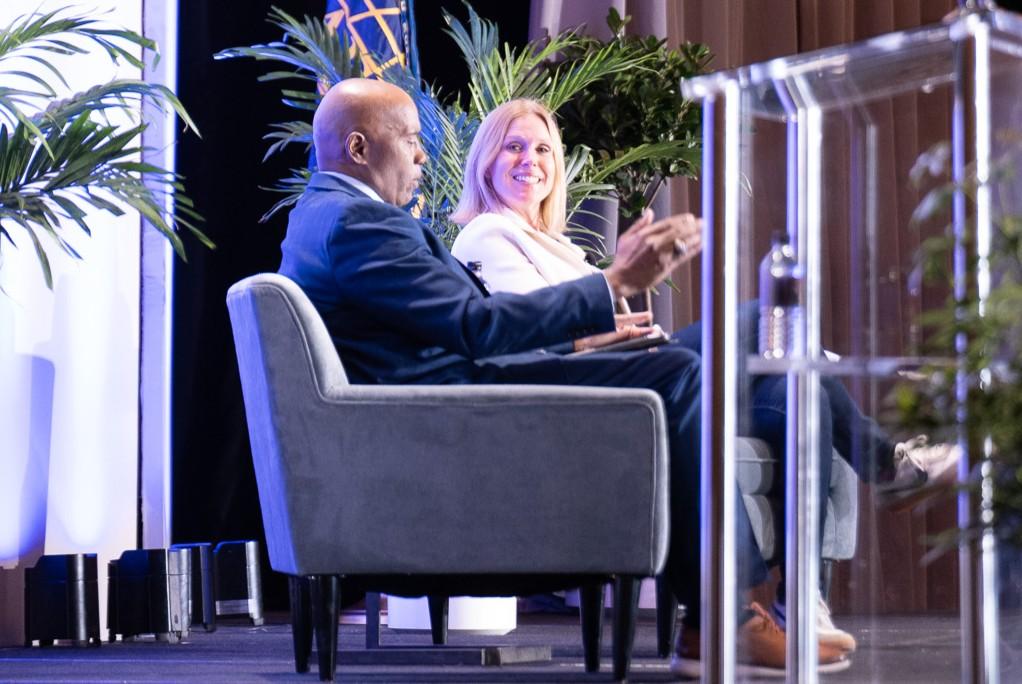
While the United States is several years into the latest artificial intelligence (AI) technology revolution, the success of AI has not been fully realized, said Lauren Knausenberger, former chief information officer, Department of the Air Force, speaking with Col. Michael Black, USAF (Ret.), vice president, Defense, AFCEA International, during a fireside chat at the Rocky Mountain Cyberspace Symposium (RMCS) 2026, held in Colorado Springs, February 2-5.
While the use of AI is rapidly growing, “AI is everywhere. We see how AI is everywhere in today's dialogue,” Black noted. The jury is still out as to where AI is truly delivering value for the military and industry.
“When it comes to getting value out of companies, 90% of companies actually fail to get their ROI [return on investment] out of their AI projects,” Knausenberger noted. “I have done a lot of studying on this because it actually impacts all of the places that I sit. You feel like you are making progress leveraging an LLM, but there is a lot of what I have heard referred to in different places as ‘AI slop,’ and this even comes up in the startup community.”
For a couple of years after leaving the Department of the Air Force in mid-2023, Knausenberger had been an executive vice president and the chief innovation officer for Science Applications International Corporation (SAIC). She announced in November 2025 that she would leave SAIC to pursue other opportunities.
Knausenberger also sits on the board as a director of EnerSys, a stored energy solution company. She has seen firsthand how the public energy company and SAIC went through their AI integration processes.
Knausenberger emphasized that the most successful AI ventures are ones that are focused, scoped efforts.
At SAIC, they were working on both internal AI initiatives for their Fortune 500 company as well as doing a variety of external AI-related projects, both for the government and other private companies, she said.
“I’m also a board member for a public energy company who is going through its own AI transformation, and that looks surprisingly a lot like the same types of systems that we see,” Knausenberger said. “Energy and industrial companies have a lot of the same challenges [as DOD]. You have factories, you sometimes have newer Internet of Things devices and completely disconnected systems. So, the biggest things that I am seeing out there are that the best AI projects still are the very focused AI projects.”
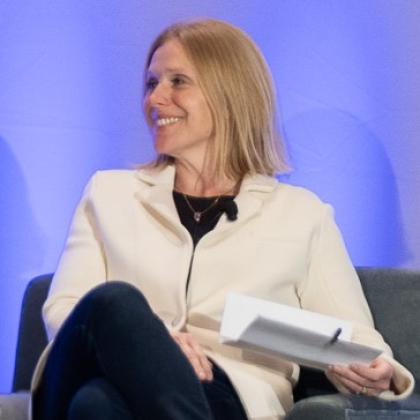
The best AI projects still are the very focused AI projects.
For everyday life, people are using large language models, such as ChatGPT, Claude.AI and Google Gemini, more and more, Knausenberger said.
“I use it all the time,” she said. “I regularly bounce ideas with Gemini. My favorite used to be ChatGPT, and for a long time, I think that was like far and above, ahead of the other models. And now, Claude.AI is another great one.”
Notably, she is finding AI tools especially helpful in the health management of her family.
“I will tell you, from a personal perspective, I have been blown away by the ability to leverage GPT for medical use cases, and maybe this is probably bad advice, but I pretty much talk to GPT before I talk to doctors,” she laughed. “No, I do both. I talk to the doctors. Always validate, always validate. But I've actually had two situations now with my kids where GPT was able to diagnose something before a doctor. In one case, it was able to find something on an X-ray a few years before a doctor could see it. These are things that are not hype. This is something that you can use today. Again, for a very, very specific use case, but very exciting.”
And while the military’s use of AI has been rocky of late, Knausenberger advised that it could be especially effective in knowledge management, with leaders across different offices within the same organization.
The Rocky Mountain Cyber Symposium is co-hosted by the AFCEA Rocky Mountain Chapter and AFCEA International. SIGNAL Media is the official media of AFCEA International.

Comments