
A Framework To Discuss IT Investment
What appears to be a simple question typically results in complex conversations full of trade-offs. Some leaders prefer to fund robust existing capabilities to enable day-to-day critical functions. Others prefer investing in multiple contingency options to strengthen information technology (IT) resiliency to combat potential service interruptions. Either way, funding for IT investments is never unlimited, necessitating conversations to identify an ideal way ahead.
How local IT personnel can frame this conversation to leadership is almost as challenging. These necessary conversations for bolstering command and control (C2) capabilities often do not occur due to the complexity of the discussion. What follows is a high-level framework that proved helpful for conversations between one Air Force Communications Squadron and leadership of a joint base.
The Framework:
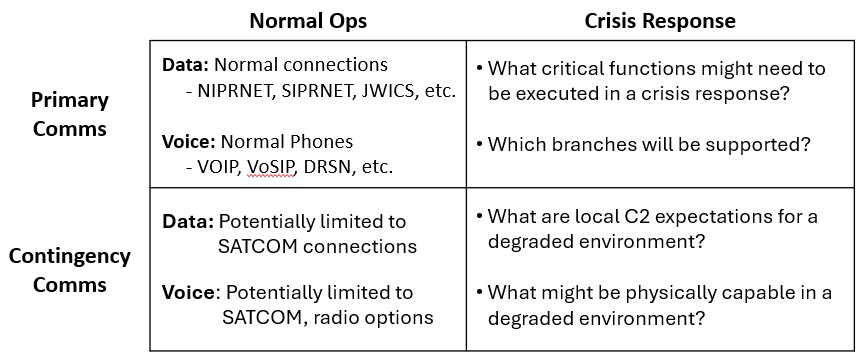
The following framework orients leadership toward two lines of thought:
Normal operations vs. crisis response
Normal ops represents whatever the local installation considers “normal” day-to-day ops requirements. Perhaps this solely consists of in-garrison activities. Perhaps this features an expeditionary or a more mobile environment. Either way, the odds are that personnel will primarily operate in this setting.
Crisis response represents what an installation must prepare for to respond to emergency operations. This could include spinning up a combat response to kinetic events or responding to a local natural disaster. In either situation, all will benefit from proactively addressing various items that will be highlighted shortly.
Primary communications vs. contingency communications
Primary comms represent the existing data and voice capabilities that enable mission execution. Installation leaders ideally already comprehend the tools that exist in ordinary settings. Options to invest in these capabilities are typically easier to discuss, as personnel can visualize what exists to enable C2 on a day-to-day basis.
Contingency comms represent alternate options when the primary means of communications are unavailable. Identifying how an installation will operate in a severely degraded environment often presents uncomfortable realities and, therefore, can be ignored until it is too late.
This framework highlights how the vast majority of operations typically exist in the upper left quadrant. Investing here is an appealing option to lessen complaints about outdated computers and/or slow internet speeds (see the viral Air Force post Fix Our Computers). Any funds allocated to fixing these immediate frustrations, though, will inevitably involve a trade-off with investing in the other quadrants. This may be the preferred approach as long as leadership’s intent for C2 is achieved and everyone remains on the same page.
These capability trade-offs and risks must be communicated to installation leaders, though, when discussing how to invest in IT capabilities.
The Conversation
Initiating a conversation about investing in IT capabilities often represents the hardest part of this puzzle. With the majority of daily actions consisting of normal ops, typically, only planners or strategists want to discuss the other three quads. This is understandable, as having to discuss what might happen during a crisis and/or when primary comms are down is not enjoyable. In addition, many people prefer to simply buy the current shiny object and reverse-engineer what it will be used for, rather than identifying the critical functions that need to be accomplished. The following section outlines some potential talking points that may facilitate these necessary conversations for the other quads.
Crisis Response:
• What are the installation’s requirements when responding to a crisis? For example, C2 might largely be conducted via a more mobile approach, such as Tactical Operations Centers. In that case, leaders may prefer to focus on connecting assets to Wi-Fi (commercial or military) so that service members can access unclassified data and enable reconstitution.
• Will there be a significant influx of personnel to the installation? If so, whether these personnel will be permanent or transitory will likely necessitate different IT requirements. In addition, if visitors require access to a proprietary network that the installation does not currently support, leadership should be educated on what proactive/reactive options exist.
• What branches will need connectivity? The previous item somewhat covers this point, but placing extra emphasis on proactive decisions is invaluable. Everyone’s lives will be much easier if, for example, we proactively identify that a government agency is likely to show up expecting support.
• Will there be an outflux of personnel to a different installation? If so, perhaps leadership should focus on normal ops and only maintain minimal contingency capabilities. On a very related note, if comms/Signal technicians are projected to largely rotate off the installation, leadership may avoid implementing robust contingency capabilities if no one will be available to operate them.
Contingency Comms:
• Leaders must comprehend potential limitations in a degraded environment. Physics remains undefeated. If fiber connections to a base are cut, for example, then satellite communications (SATCOM) and radio line-of-sight may be the only options until normal connectivity is restored. Many personnel maintain the mindset that normal capabilities, such as websites, shared drives, etc., will be accessible in a contingency. Site isolation represents an extreme example, but installation leadership must communicate the level of risk they will tolerate.
• What are the local C2 expectations in a contingency environment? For example, if there is to be one primary command center, leaders should know how many computers will be able to operate over the projected SATCOM link. Alternatively, if key leaders will remain dispersed across the base, communications fly-away kits may be desired for units to access and transmit data. Either situation involves reduced bandwidth; however, it highlights subsequent discussions, such as whether an installation should operate a data-intensive common operating picture (COP) that most people may not be able to access in a contingency setting.
• In addition to funding, manpower dedicated to contingency communications options directly takes away from normal ops. The example of establishing comms fly-away kits as a contingency option is perhaps the easiest to visualize: who would maintain those kits? Will the local comms/Signal unit dedicate technicians, or will personnel from each unit be identified to operate the kit? How will leaders confirm personnel are trained on how to use the kits? Who is funding the inevitable tech refreshes to ensure the kits remain operational?
• Power and HVAC requirements. While this seems like an extremely obvious point, leaders often benefit from the reminder of how IT systems require both power and some degree of climate control. Even if contingency capabilities feature a minimal footprint dispersed across the installation, power is still required to transmit data and enable C2.
What Would You Say You Do Here
It is worth briefly re-emphasizing the importance of understanding units’ critical missions or functions to identify appropriate IT investments. Conducting a full mission decomposition is typically not necessary. Executing a compressed joint planning process or a service-specific review is often adequate. Any military planning tool that identifies a problem statement and drives a conversation is ideal.
Conducting these conversations will also spotlight the commander’s intent based on what is predominantly discussed. Perhaps leadership’s primary focus is on day-to-day ops; perhaps the primary focus is on preparing for crisis response; or perhaps the leader wants to posture the installation for every potential scenario. Technical leaders can then outline a proposed way ahead to show how much funding and manpower would be needed to achieve the desired expectations. Once a leader sees the anticipated bill and decides what investments are palatable, then a way ahead can be executed.
What Does Right Look Like?
The right answer is that installation leaders understand the critical functions to execute their mission and subsequently clearly communicate their C2 expectations. This may sound like a cop-out, but what looks right for one installation is likely not the right answer for another. Once technical leaders receive a commander’s intent, they can then invest both funding and manpower to maximize IT capabilities. Purchasing many copies of the latest technology just because it’s the current buzzword is not the right answer.
The Pentagon has made significant strides in the last 15 years to connect people to its data. We even advocate the mindset to “treat and secure data as a strategic product” (2024 DoD IT Advancement Strategy).
Just a decade ago, most personnel could only access their data by entering a government facility, sitting down at a desk and logging into a desktop. The seemingly endless number of modern possibilities to access data, and therefore execute C2, increases the importance of everyone operating on the same page.
Lt Col Chris Foltz is a planner in the Air Force’s Integrated Capabilities Command (Provisional). He thanks leaders of the 673d Communications Squadron for brainstorming this framework. The views, and any shortcomings of this framework, are his and do not represent the views of the DOD or its components. Any puns about ensuring leaders plan to plan and clearly communicate intent for communications are intended.


Comments