
What the Navy’s New Hedge Strategy Means for Industry
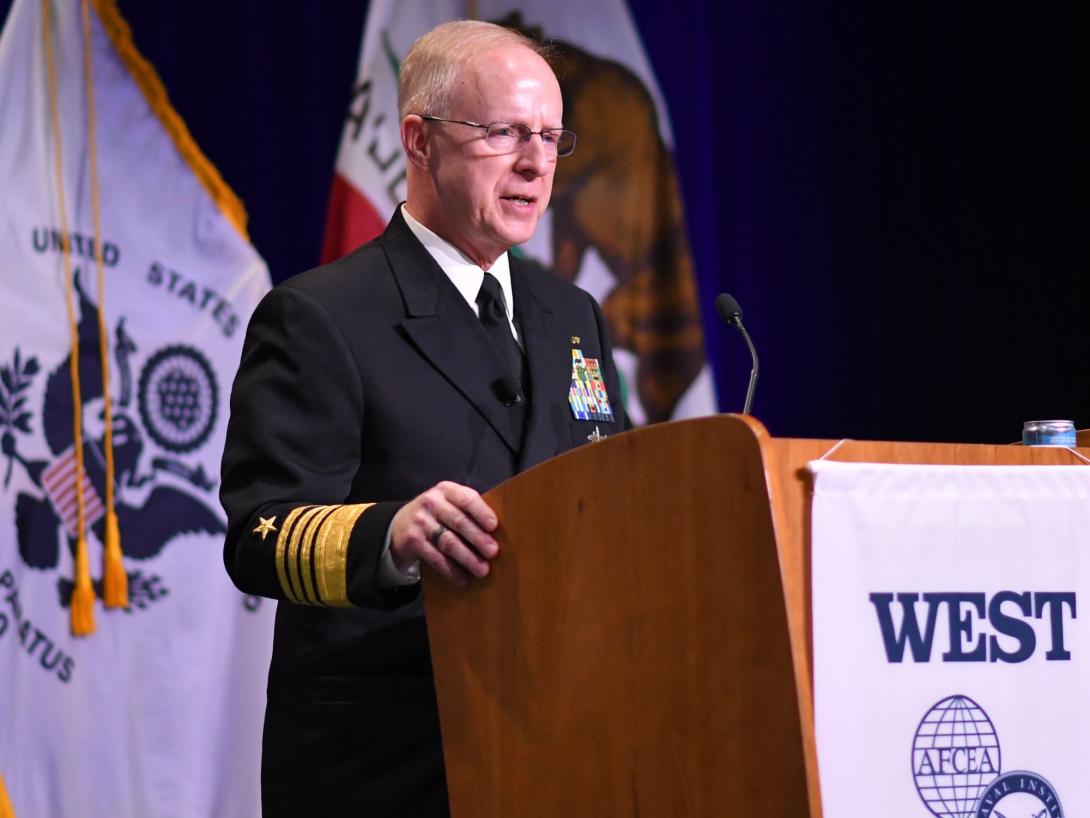
Having unveiled the U.S. Navy Fighting Instructions just hours prior to kicking off WEST 2026, the branch’s 34th Chief of Naval Operations Adm. Daryl Caudle spoke in depth about what the framework means for industry and innovation.
At its core, the Fighting Instructions lay out the new Hedge Strategy, which enables the Navy to invest in innovation and readiness for the future fight.
“Today, we find ourselves operating in an era with other great powers, an era in which the speed of decision ruthlessly punishes delay,” Caudle said during his opening keynote speech, which quickly turned into a standing-room-only hall at the San Diego Convention Center.
“It’s in these complex times that we must evolve the strategy once more, rapidly responding to new leadership direction, increasingly sophisticated threats and systemic industrial-based challenges.”
Noting the recently announced Golden Fleet initiative, Caudle said the alignment across the nation’s leadership emphasizes the guarantee of peace.
“The U.S. Navy Fighting Instructions is our Navy’s answer to the daunting question that will define modern warfare for decades to come, and that is, ‘How do we ensure we can fight and win across the spectrum of conflict under conditions we cannot predict, against adversaries who are increasingly capable, innovative and aggressive … simultaneously in key areas of vital national interest around the world?’”
Delivered through a classified Navy campaign plan, the Hedge Strategy consists of five key components:
- Posturing the fleet to win through the Global Maritime Response Plan and the combat surge-ready certifications.
- Investing in cost-effective innovation and tailored offsets, including supply chain resilience, force resilience, maritime operations centers decision advantage and autonomous systems.
- Working in close partnership with friends, allies and industry members.
- Aligning with the Navy Warfighting Concept, the Navy Deterrence Concept and Force Design 2045.
- Adopting the Enhanced Mission Command Framework, or EMCF.
Additionally, the Hedge Strategy’s force components include tailored offsets and tailored forces, which are “scalable formations that manage risk, expand mass, force multiply, improve response options and preserve our combat advantage,” Caudle explained.
Along with tailored certifications, tailored forces will allow the Navy to remain resilient against threats.
Tailored offsets, however, include capabilities such as attritable and easily replenishable unmanned surface vessels, unmanned undersea systems, mine warfare and cost-effective counter drone defense.
“Together, these tailored capabilities will amplify and complement the main battle force through lethal outputs that are scalable, deployable, adaptable and, perhaps most importantly, cost effective,” Caudle said. “It’s in this line of effort … where I expect you, our industry partners, traditional and nontraditional vendors alike, to move fast, iterate aggressively and help us scale these packages at speed.”
The message seemingly resonated with WEST attendees, who spoke on what the new framework means for their operations.
According to Rear Adm. Mark Kenny, USN (Ret.), who has previously served alongside Caudle, the CNO is looking for industry to further invest in research and development of new capabilities, which will then lead to longer-term contracts with the department.
“Part of the Hedge [Strategy] is to use industry, the innovation and speed of industry to provide capability at a much sooner timeline,” Kenny told SIGNAL Media following Caudle’s remarks. Kenny currently serves as the senior vice president of strategy, technology and business development at Ultra Maritime.
Through his morning keynote, Caudle rallied industry to innovate at speed.
“[Caudle] and Secretary Hegseth have gone to war on the acquisition process to allow [industry] to move quicker,” Kenny said.
As the world's premier maritime force, we must be eyes wide open and acknowledge that deterrence is an infinite game.
For Welton Chase, retired Army general officer and Cisco senior executive leader, the CNO’s speech was very powerful.
“Very clear instructions about what industry can bring to help the Navy stay formidable,” he added, also highlighting the sense of urgency that particularly stood out during the remarks.
Echoing both statements was MANTECH’s Duncan “Duke” Ingraham, who appreciated Caudle’s emphasis on efficiency and the speed to market approach.
During the Q&A portion of his keynote session, Caudle responded to an inquiry about the Navy’s artificial intelligence (AI) strategy. While the Fighting Instructions include information about software-defined warfare and AI integration, the framework also highlights the lack of AI integration into the fleet.
“The fact that the Navy remains the only service without an AI strategy supports this point in the Fighting Instructions, and its AI task forces are led by junior officers,” the attendee said. “As CNO, how will you scale AI capabilities in the fleet?”
While Caudle recognized a dated yet still valid AI strategy in existence, he spoke on his dissatisfaction of where the Navy is on its AI journey. “We’re not there yet,” he responded, extensively noting the potential of AI capabilities for increased efficiency and readiness. “We’re going to get there. I’m behind it.”
“The emphasis on AI with some of the decision-making systems, clearly, is where this industry is headed,” said Appian’s Ahson Wardak. “[We’re] really excited to contribute from an industry perspective and also the joint perspective,” he told SIGNAL Media, also noting the critical role played by international allies, many of whom were in attendance at WEST 2026.
“From our joint and combined forces across the globe to our industry partners at home, every one of us has a critical part to play. The U.S. Navy Fighting Instructions aren’t just guidance for the fleet, they’re a clear and bright demand signal to our industry and allied partners about the capabilities we must build, scale, integrate and sustain,” Caudle said in his closing comments.
“I think those that will win in this environment are those that will embrace innovation,” Kenny added from the exhibitor floor. “[They] will embrace the investment, will embrace the ability to deliver rapidly and not be burdened about how things were done in the past.”
WEST 2026 is co-hosted by the U.S. Naval Institute and AFCEA International. SIGNAL Media is the official media of AFCEA International.

Comments