
AI Education for America’s Youth

The launch of generative artificial intelligence (AI) tools has accelerated the need for early education in AI literacy and readiness. Efforts by industry, academia and nonprofit organizations within the United States are enhancing access to resources. Meanwhile, younger generations are being tasked with matching their critical thinking skill sets with those of intelligence analysts.
In April 2025, President Donald Trump signed an executive order to advance AI education for American youth. As of September 8, 2025, 141 companies nationwide have taken a pledge to invest in the initiative. “Specifically, over the next 4 years, we pledge to make available resources for youth, parents and teachers through funding and grants, educational materials and curricula, technology and tools, teacher professional development programs, workforce development resources and/or technical expertise and mentorship,” the pledge reads.
The administration has also established the White House Task Force on AI Education, an effort to promote the export of the American AI tech stack, according to Booz Allen's Joe Rohner, who leads the company’s AI education efforts and is senior vice president of Navy Marine Corps technology.
“We need to make sure that these frontier models are built with integrity, with ethics, that we know what’s going on in the code, that there’s no malware, there’s no data poisoning,” Rohner said, applauding the presidential executive orders in positioning the United States as a leader in the technology space.
“AI is probably, in the long run, the biggest threat vector in terms of where national security and families and communities converge, because AI is becoming an arbitrator of information for all of us,” said Anthony Vinci, former chief technology officer and associate director for capabilities at the National Geospatial-Intelligence Agency.
Vinci is currently an adjunct senior fellow with the Technology and National Security Program at the Center for a New American Security, or CNAS, and the CEO and co-founder of AI company, Vico. Most recently, Vinci authored a book titled The Fourth Intelligence Revolution: The Future of Espionage and the Battle to Save America.
Misinformation and disinformation continue to threaten the general public, including America’s youth. For adversarial nations, AI is the golden ticket to heightened mistrust and cynicism, Vinci explained.
“We as adults already have a baseline of knowledge and education, but children are just learning whatever they’re taught, and so they’re left in this defenseless state, and the school systems have not caught up with this quite yet,” Vinci explained in an interview with SIGNAL Media. “When you bring AI into it, it just gets even harder.”
Enter initiatives like aiEDU, a 2019-founded nonprofit organization committed to advancing AI literacy and readiness across the American education system.
“We don’t sell technology to schools. We’re not the AI implementation project,” said aiEDU CEO Alex Kotran. “Our work is really, ‘How do you support school transformation and systems change in service of preparing students to thrive in a world where AI is ubiquitous?’”
While AI was already a broadly discussed topic among most industries before, November 30, 2022, marked a pivotal moment.
“ChatGPT comes out and everything flips over on its head, because now you have, slowly but surely, every single teacher and administrator intersecting with this,” Kotran said. Within a couple of months, AI startups and businesses began saturating the market.
Through its free and available resources, aiEDU offers educators curriculums on AI literacy. “We design it so that a school leader or local organization could go to our website and they would have everything they need to get started,” Kotran stated.
The nonprofit has received funding from various industry leaders, including OpenAI, Nvidia, Salesforce, Google.org and Microsoft, but one consistent supporter from its inception has been prominent defense contractor Booz Allen Hamilton.
“Booz Allen Hamilton knew where the country was headed,” Kotran said, noting the company’s early investment in AI capabilities. “They had insight into our vision of the future of education, the future of work.”
For Booz Allen Hamilton, AI is seen as a horizontal skill, said Jinnyn Jacob, who currently leads the company’s TechXplore initiative, which trains 1 million students on AI. Additionally, she leads the company’s global philanthropic partnerships.
“It’s not just a tech skill, this is really a life skill and it’s shaping everything,” she told SIGNAL Media in an interview. Even more so, AI skills are at the edge of national security decision-making, Jacob stated.
The passive use of AI capabilities is not enough, she continued, noting a rising trend in students’ use of AI with a lack of critical thinking and true understanding of its potential. “For us, a lot of that is empowering students with skills, but it’s also helping young people to actually know how to ask the right questions. Can they challenge bias? Do they know how to protect data? Can they spot misinformation? And can they use AI in a way that can reinforce human judgment and relationships, and not replace them, which we find is a spot of concern,” Jacob said.
Investment in AI literacy is therefore paramount in creating the next thoughtful and responsible leaders, she added.
Echoing Kotran’s and Jacob’s statements, Vinci also stressed the importance of critical thinking. Taking it a step further, Vinci encourages kids to think like spies.
“Some of these skills are the skills of philosophers,” he said, noting parallels with intelligence analysts’ skill sets. “The number one thing in philosophy is essentially to question everything and everyone, and we don’t do this in the education system right now. I think most children are taught to accept the truth as what the teacher says, and there’s a balance here.”
While the notion of respect toward educators should not be lost, students should be encouraged to question information they receive. Schools are beginning to embrace this, he said, with students being taught to cross-check information across online resources.
“Another one is triangulating information,” Vinci said, highlighting a core intelligence analyst skill set of never trusting a source. The method uses multiple data sources to gather information on a single topic.
Additionally, Vinci noted the significance of operational testing to verify information. “Test yourself and your own biases, and especially in a world where your biases can be very innate ... you may not realize you’re getting them, especially if you’re being educated by an AI [tool],” he said.
The issue is equally, if not more important, for students within military communities, an area that Booz Allen Hamilton is also focused on.
“We’re realizing that they have their own unique challenge sets. They are more often targeted ... for things like phishing attempts,” Jacob explained. Empowering those communities to ensure there is knowledge of concepts like deepfakes and AI-powered disinformation is critical. While the company does work on enhancing tech skills, ethics and security are also of significance, Jacob noted.
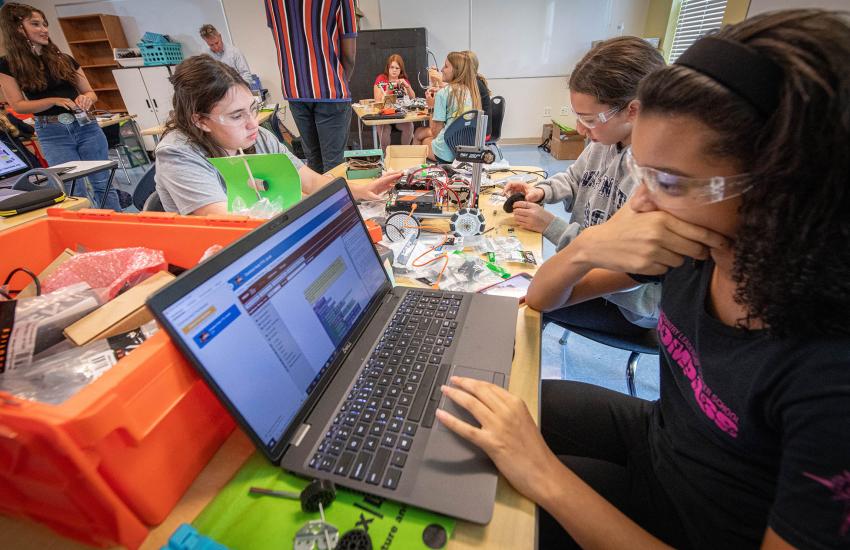
Although the K-12 education sector is small, supporting it is a direct investment in the future, Kotran said. “Preparing students for the future is unambiguously good, and I think it’s a rare area of agreement,” he continued. Notably, bills for AI education have been supported by both sides of the political aisle.
Still, the nonprofit does not specifically push for educators to strongly encourage AI use among students, Kotran said. Although AI tutoring is a growing market, there is controversy surrounding children getting educated solely by AI tools.
One such example is Alpha School, a private school system and AI program that educates students one on one. “The model is you do two hours of AI-empowered education in front of the computer ... and they use the rest of the time to do project-based learning and exploration,” Kotran explained.
The jury is still out on whether this learning model is successful, he added, as some parents reportedly criticized the system.
“There’s research that it actually undermines metacognitive development,” Kotran added, stating the importance of a productive struggle to meet a goal.
On the other side of the coin are schools taking the opposite approach of returning to pen-and-paper operations. “They’re reading the classics; they’re having debates,” Kotran said.
“I have this prediction that in 10 years, kids from low-income communities are going to have all the AI bells and whistles. If we don’t do our jobs right, under-resourced kids are going to get all the AI and all the widgets, and wealthy kids are going to have human-teacher-centered learning,” with the addition of AI-enabled tools for a highly personalized and engaging education experience, he added.
The vision for human-centered education resonates with most people, Kotran said, and his organization is hoping that industry members like Booz Allen Hamilton will help further the work being done.
For the military community, specifically, Kotran sees a lot of potential for progress. “If you look at the STEM movement, this was born out of military geopolitical competition with the USSR post Sputnik,” he said. “I think the military community can be a really powerful force for change in education.”


Comments