
Autonomous Systems May Take Man Out of Minefields for U.S. Navy
Militaries around the world are dramatically expanding the use of artificial intelligence (AI) and autonomous systems, in part because they replace humans for dull and dangerous missions or tasks. Now the U.S. Navy sees the potential for autonomous systems to replace human warfighters in countering mines at sea, according to Capt. David Chase, USN (Ret.), deputy director for the Expeditionary Warfare Division in the Office of Chief of Naval Operations (OPNAV).
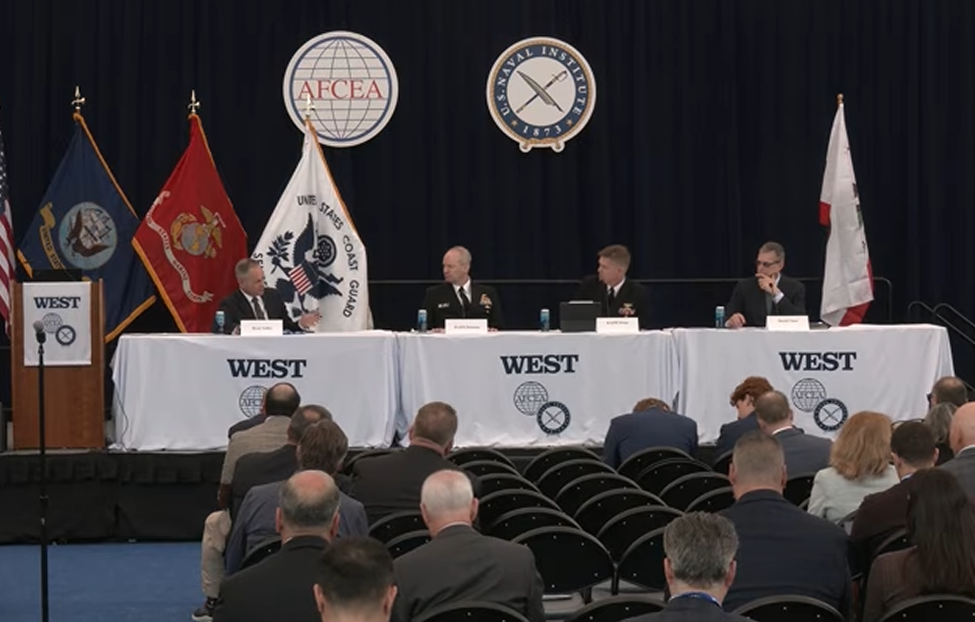
Chase made the comments on February 10 during a panel discussion at WEST 2026 hosted in San Diego by AFCEA International and the U.S. Naval Institute. The panel was called Designing the Fleet to Meet the Mission and included Rear Adm. Mark Behning, director for OPNAV’s Undersea Warfare Division, and Rear Adm. Michael Wosje, who directs OPNAV’s Air Warfare Division.
Chase asserted that countering mines is just as important as his division’s other two priorities, maintaining 31 Amphibious Ready Ships and procuring the Medium Landing Ship.
“Mine warfare is, frankly, no less important than the first two priorities I discussed. The mission is benefiting significantly from improvements in cutting-edge underwater unmanned technology, especially acoustic and optical sensors, computing power and AI and machine learning to improve mine detection and reduce our post-mission analysis time,” he said. “We're procuring 24 MCM [mine countermeasures] mission packages for the Independence variant, Internal Combat Ship and our Expeditionary MCM companies.”
The first three mission packages for the Littoral Combat Ship arrived in Fifth Fleet last summer, allowing the Navy to retire the venerable MCM-1 Avenger class of ships in Bahrain, he noted. “And we’re working diligently on the Seventh Fleet challenge to be able to replace those MCMs as well in the next couple of years.”
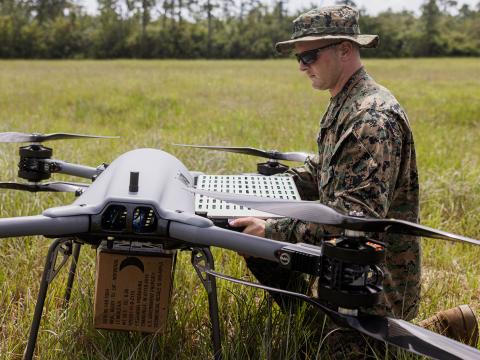
The MCM mission package exemplifies the close cooperation between government and industry and the Navy's first operational deployment of an unmanned surface vehicle, the MCM USV, using robotic, unmanned and autonomous platforms, vehicles and systems, he added. “We are actually at the point where we are removing the man from the minefield.”
All three panelists expressed interest in AI and autonomous systems. Behning pointed out that the SSN-(X) next-generation submarine, which is now being designed, will be the Navy’s first opportunity to build a vessel from the beginning with AI in mind, rather than adding it to existing platforms, such as the Virginia class subs, which pose some limits for modernization. In posing a series of rhetorical questions, he suggested new technologies may help in designing a vessel that requires less maintenance time and offers increased speed, mobility and lethality along with other benefits. Virginia class vessels, he noted, were not built with autonomy or robotic systems in mind. “This will be a ship that we go design from the ground up. What does that mean? What do we do with power? What do we do with payload capacity? What do we do with interface standards? How do we handle the data?”
In response to an audience member's question, all three agreed that deploying autonomous systems in the vast Indo-Pacific region poses more challenges than in a relatively small country like Ukraine. Behning said that from an undersea warfare perspective, such systems should be deployable from a submarine and could be a mix of low-cost, expendable systems and more expensive platforms that would need to return to the sub. Either way, they would primarily extend the capabilities of the manned vessels.
Larger systems not deployed from a submarine would face more challenges in the vast and harsh Indo-Pacific environments. “The undersea domain is a harsh domain, right? It’s from the pressures, the depths, the temperatures, the currents, the tides, the nets, the fishing activity, the bio following, you name it. That is a lot to ask of a vehicle to be out there for an extended period of time, and self-heal and self-operate and make sure it knows what it's doing,” he said. “The lack of persistent comms, the lack of persistent navigation add to that complexity, and really drives the need for a very exquisite, reliable autonomy that you can do, and we're working through that.”
We are actually at the point where we are removing the man from the minefield.
However, the undersea division is learning from its counterparts. “It is a challenging environment, in the undersea more specifically, but we’re learning a lot from the air and the surface and what's happening there, and how you maintain them, but that is a key piece that makes those larger ones a little more challenging right now.”
Wosje added to the discussion of communications challenges in the Indo-Pacific. “There are no bombs without the comms, which is all the networking capability to stitch the autonomous systems together, both manned and unmanned platforms, is super critical as part of this effort,” he said. “I think you hit the nail on the head, and you heard CNO [chief of naval operations] talk about it this morning. People get a little bit focused on the war in Ukraine, but you’re talking about kilometers, not thousands of nautical miles. The geography and the geometry make a difference there.”
Chase added that Indo-Pacific distance is “our biggest challenge,” and noted that his division has been working with Indo-Pacific Command and Pacific Fleet to define the doctrine, organization, training, material, leadership and education, personnel, and facilities for such systems.
“When I mentioned mines earlier, we need to develop the means to get those mines where they need to be. Same thing with one-way attack. Those are critical systems, and it will be game-changing systems,” Chase said, adding that the Landing Ship Medium will be able to move people, parts, ordinance and other equipment wherever it needs to be in the theater. “We’re probably a decade away, but it is a resource to be able to get some of the things that I mentioned in the theater and able to affect the war fight.”
WEST 2026 is co-hosted by the U.S. Naval Institute and AFCEA International. SIGNAL Media is the official media of AFCEA International.
Comments