
Assured Command and Control Will Underpin 'Everything' the Marines Will Do
The U.S. Marine Corps is preparing its “inside forces” to perform multidomain operations in the Western Pacific, improving global logistics, expanding information warfare and looking at the future of its aviation.
However, the key to these types of operations all goes back to assured command and control (C2), say Marine Corps leaders. Assured C2 is especially important for the service’s dispersed amphibious forces, who then operate from land and multiple other domains.
“You really start this from assured command and control,” explained Lt. Gen. Roger B. Turner, USMC, commander, III Marine Expeditionary Force. “It is really the first question you have to solve right off the bat. And I think we have made great progress in addressing C2 in the communications-degraded, denied environment and in this highly contested environment. We have good systems that give us real value as an assured C2 element operating from the land.”
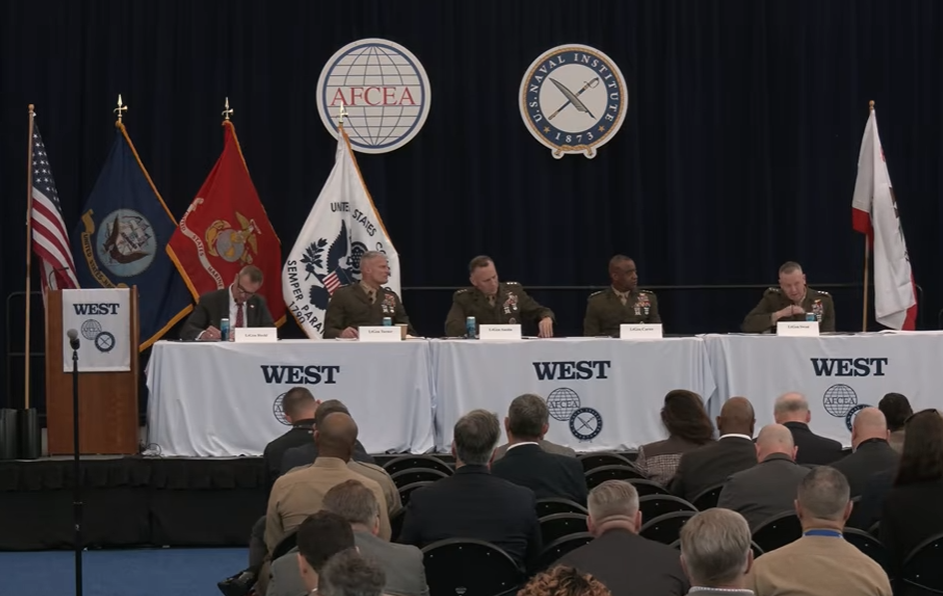
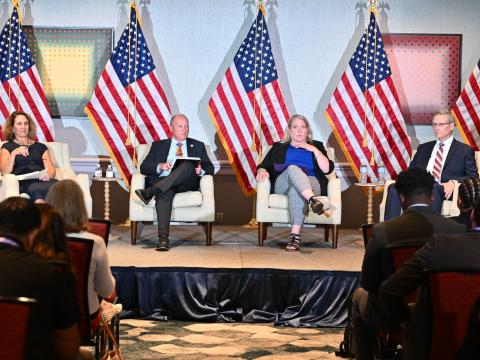
Turner spoke at AFCEA International and the U.S. Naval Institute’s combined WEST 2026 conference today, held February 9-12, in San Diego.
He presented, along with Lt. Gen. Karsten S. Heckl, USMC (Ret.), former deputy commandant, Combat Development and Integration, and former commanding general, Marine Corps Combat Development Command; Lt. Gen. Eric E. Austin, USMC, commanding general, Marine Corps Combat Development Command, and deputy commandant for Combat Development and Integration; and Lt. Gen. William H. Swan, USMC, deputy commandant, Aviation, U.S. Marine Corps.
Also joining the conversation was Lt. Gen. Melvin (Jerry) Carter, USMC, deputy commandant for information (DCI), Headquarters, U.S. Marine Corps, who was just confirmed as the director's advisor for Military Affairs, Office of the Director of National Intelligence (ODNI).
“The most transformative [thing] to the way that we intend to fight is some of the exquisite command and control capabilities,” Austin stated. “They are going to enable us to communicate across all elements of the Marine Air Ground Task Force in real time, at speed, with the analytics to help us make decisions faster and more coherently.”
“Everything will ride on the information domain,” added Heckl. “I think it's all becoming glaringly obvious to each and every one of us.”
Austin praised the service for changing “for the better,” with C2, which is enabling leaders to make well-informed decisions with analytic underpinnings aligned with the service’s strategic guidance.
The Marine Corps is also benefiting from its commitments to aviation C2 and air domain awareness.
“The investments we have made in air domain awareness and counter air, that was something that we focused on many years ago and made some really difficult choices as a service,” Turner explained. “But now we are fielding probably the best expeditionary aviation C2 capability in the joint force, and the joint force is thirsty for it.”
The III MEF commander noted that the joint forces, with their almost constant demand for the expeditionary aviation C2, will continue to look to the MEFs to develop air domain awareness assets.
The Marines will also continue to improve air defense capabilities, using two newer tools, the Marine Air Defense Integrated System (MADIS)—the counter unmanned aerial system—and the Medium-Range Intercept Capability (MRIC), a state-of-the-art missile system that detects, tracks, identifies and defeats enemy cruise missiles and other manned and unmanned aerial threats—and the expeditionary radar system known as G/ATOR, the Ground/Air Task Oriented Radar.
“As we field MADIS, as we field MRIC, along with the really deep investments we made in the G/ATOR program 20 years ago are really coming to fruition,” Turner said.
Such an underpinning of assured C2 capabilities and air defense is needed for the Marines’ dispersed operations in the Indo-Pacific, especially when it comes to the People’s Republic of China and its military, the leaders warned.
“I think it is important that we go back to where we started, and it is really about the PRC’s force design,” Turner stated. “They developed a world-class, counter-intervention force with world-class capability and the capacity to hold the U.S. joint force at range.”
What China did not plan for, however, was the United States' asymmetric force design approach.
“I don't think that their force design accounted for the contribution of forces that are already deployed in the first island chain, to be able to project power from key maritime terrain, onto the surface, into the air and into space and cyberspace,” Turner said. “That creates a tactical and operational and strategic dilemma for them.”
The Marine Corps will continue to work with its allies and partners in the region, which is also a key part of the United States’ approach.
“They also didn't account for meaningful contributions from our partners and allies,” Turner specified. “I think they were accounting for token contributions. But what we're seeing with our overlaid approach with our partners and allies, particularly in the first island chain, is really meaningful contributions from all of our partners and allies.”
To succeed in the future, the Marines do need to expand their information warfare, the DCI noted.
“I would argue, when you look at the battlefield today, and what you are looking at when it comes to the Russia/Ukraine conflict, information is a vital part of how we are going to fight in the future,” Carter emphasized. “My job is really to press the Marine Corps and drag them into the 21st Century. We have a long ways to go. We are certainly not where we want to be.”
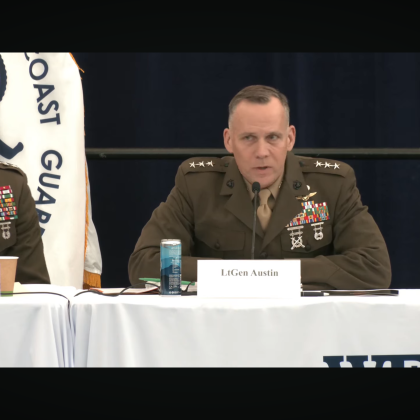
The most transformative [thing] to the way that we intend to fight is some of the exquisite command and control capabilities.
The service has stood up several “MIGs,” or Marine Expeditionary Force Information Groups, after introducing the concept in November 2024. The MIGs are designed to integrate information warfare and conduct information activities across echelons to synchronize command and control, fires, and intelligence, driving the multidomain effects for the Marine Expeditionary Forces.
The MEFs, Turner said, are already seeing benefits from the MIG's operations in the Indo-Pacific. “The investments we made many years ago in the MIGs and all of the capabilities and capacities across the information domain and across trade craft, those capabilities are really providing profound impacts,” Turner shared.
Carter noted that information warfare would continue to be part of the conversation as the Marine Corps continues to evolve, with leaders at Camp LeJeune, North Carolina, currently considering how to implement information warfare further in force design.
“We stood the MIGs up, but is that far enough?” Carter questioned. “And then, what are we doing to modernize for the information fight . . . I would argue that it is time to rethink how we fight. When you talk about the physical space and speed, how fast aircraft goes around the world, or a carrier transits the ocean, that is one thing. But think about what speed looks like in the information space... And so, we are exploring some of those things, certainly down in Carolina MAGTF [Marine Air-Ground Task Force].”
Additionally, Swan shared the February 10 release of the service’s 2026 Aviation Plan (AVPLAN), which aims to have “concrete, data-driven implementation,” and use of artificial intelligence (AI) and machine learning (ML) to generate decisive advantage through superior, high-speed decision-making.
Active integration of AI and ML is a focus of the AVPLAN, Swan said, and is something they hope will help to modernize aviation readiness.
Finally, the generals encouraged technology companies to reach out to the Marine Corps Warfighting Laboratory, or look out for available commercial solutions openings, or CSOs.
“We are fielding capabilities that were PowerPoint-deep a few years ago, and fielding in partnership with many industry partners, with the Fleet Marine Force, and the United States Navy, in a meaningful way,” Austin stated.
Lastly, the challenge the Marine Corps really needs help with—one that keeps the generals up all night—is logistics. The service needs industry solutions to help manage and execute global logistics in a contested environment.
“It is time to accelerate, for obvious reasons,” Austin said. “We have to scale, and we have to continue to learn to adapt.”
WEST 2026 is co-hosted by the U.S. Naval Institute and AFCEA International. SIGNAL Media is the official media of AFCEA International.
Comments