
Education First for Future Warfighter Success
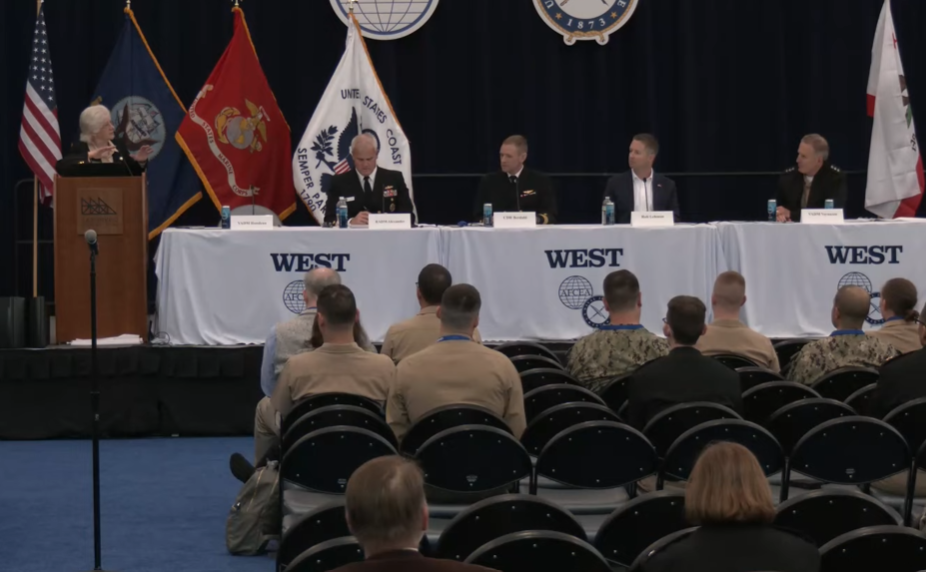
Centers for higher education must be more aligned with operational commanders for students to gain real-world operational experience. So agreed subject matter experts at the annual WEST 2026 conference in San Diego.
“If learning and education are foundational . . . what, in your opinion, would be the most important thing to do in the education world to be able to fight and win and have the warfighters that we need at the edge of the fight?” asked session moderator and president of the Naval Postgraduate School (NPS), Vice Adm. Ann Rondeau, USN (Ret.).
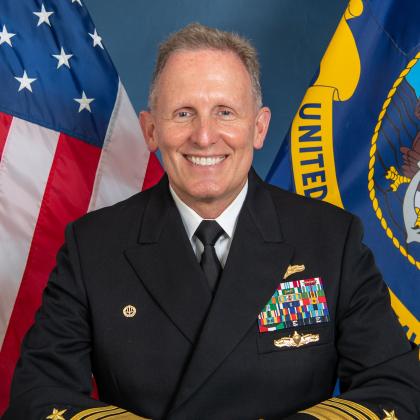
“I think there needs to be a tighter shot circle between the education institutions and the warfighters,” said Vice Adm. Michael Vernazza, commander of the Naval Information Forces.
Vernazza recently spoke with SIGNAL Media for an episode of the podcast edition of Disruptive by Design.
The closer collaboration between educational institutions and warfighters would require investment in wargaming and logistics battle command training, he said. “If you network all of these capabilities in a live, virtual, constructive training environment, you’ll have students at [Naval Postgraduate School] who are studying these topics in depth, being able to inform our warfighting development centers, being able to inform our [Maritime Operation Centers] and be able to grind on these problem sets day in and day out. Where the East Coast is sleeping, Hawaii is awake.”
Investments in such training programs at the highest classification levels possible would “pay dividends,” the vice admiral said, but the initiative would be costly, he acknowledged.
Fellow panelist, Rear Adm. Christopher Alexander, agreed with Vernazza.
“We need to figure out a way to tie our centers for higher education with our operational commanders,” he said, “. . . so that our students are working on real-world operational problems.”
Alexander currently serves as special assistant to the commander, Naval Surface Forces/Naval Surface Force, U.S. Pacific Fleet, U.S. Navy.
“I think cross-pollination and exposure to industry is incredibly powerful,” added co-founder and chief commercial officer of Saronic Technologies, Rob Lehman. “It can’t just be the people who you’re on contract with . . . you should be getting exposed to other players . . . so that you’re seeing what is out there.”
Lehman also spoke about the potential of wargaming.
“If NPS or someone else can create a tactical sandbox where sailors, students or in the fleet can go run these scenarios that they’re facing, and instead of griping about their commander’s decision-making behind the scenes, they can go, show how they would do it differently see what those results are. It’s hugely powerful,” he said. The trick, Lehman pointed out, is to ensure such activities are not forced and instead empower thought leadership and innovation.
I think there needs to be a tighter shot circle between the education institutions and the warfighters.
On the other hand, panelist and Ph.D. candidate at NPS, Cmdr. Jens Berdahl, spoke about flexibility.
“I think the things that we can do that won’t cost more money [are] funding flexibility and organizational flexibility,” he said. “If I have an idea, but it’s not close to October, I shouldn’t have to let that idea die because it’s waiting on money, and I’m in a one-year program.”
Some institutions are finding unique ways for necessary funding, he said, offering the Rapid Capabilities Office as an example.
“I think partnerships like NPS Foundation with NPS is an interesting and great model where funding requirements are smoothed out, and organizations are allowed to be flexible within these working spaces.”
Such efforts would allow for ideas to blossom and set the stage for further success, Berdahl said.
WEST 2026 is co-hosted by the U.S. Naval Institute and AFCEA International. SIGNAL Media is the official media of AFCEA International.

Comments