
J6s Find the Pieces to the Puzzle
If peace is achieved after Russia's four-year bloody invasion of Ukraine, what is needed from a network and communications standpoint by peacekeeping troops?
For U.S. European Command (EUCOM) Deputy J6 Col. James Austin, USAF, this probability keeps him up at night.
J6s and deputy J6s are leaders who are responsible for command, control, communications and compute, essentially chief information officers managing information technology, cybersecurity, data management, technology integration, secure communications and information-sharing.
Given that this is on a joint level, these duties are more complex and happen within a command or area of responsibility with other U.S. military services, allies and partners.
“If peace breaks out, [NATO] is going to send in some type of a coalition of the willing to monitor the peace, but on what network?” Austin asked. “Where is that system that is going to bring those sensors in so that we can ensure that peace? I am going to need that tomorrow, if they sign it today. And I can't produce it overnight because the defense industrial base doesn't have a warehouse full of things that I haven't told them I need for a network that I haven't designed completely yet.”
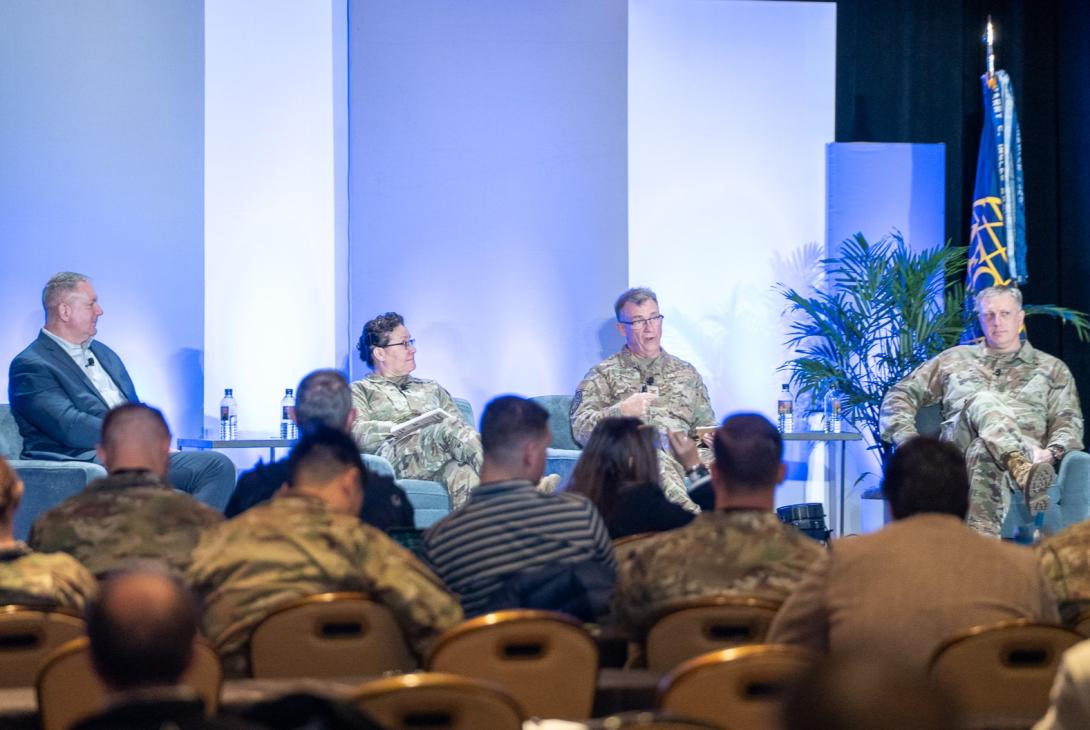
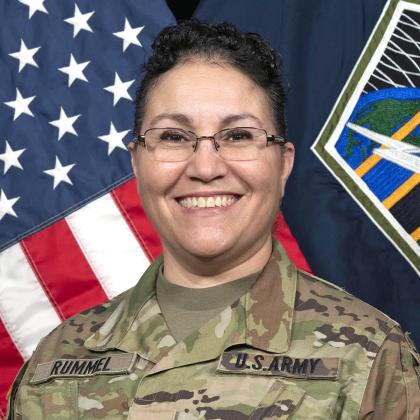
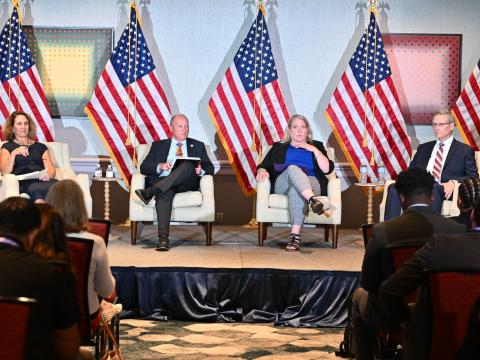
Austin spoke February 4 at the Rocky Mountain Cyberspace Symposium, along with Brig. Gen. Christine Rummel, USAR, director, Cyberspace Operations, North American Aerospace Defense Command (NORAD)/U.S. Northern Command (NORTHCOM); and Col. Michael McFeeters, USAF, deputy J6, U.S. Transportation Command (TRANSCOM).
Brig. Gen. Rob Lyman, USAF (Ret.), founder and president of Officium Forge, the former assistant deputy chief of staff for Cyber Effects Operations, moderated the discussion.
Some NATO partners and allies have already started to stand up headquarters and appoint leaders for such a network scenario, Austin shared.
“And while it is not my burden to do wholly as EUCOM or as the U.S., it is something I lose sleep over as I'm trying to think through what's next.”
His team did build out an air component battle network in 2021, after the then-U.S. Air Forces in Europe and Air Forces Africa (USAFE) commander, Gen. Jeffrey Harrigian, pushed for a more permanent, enduring network for the NATO area of responsibility, instead of networks that take eight months to build and get torn down after a two-week exercise.
USAFE relies on that network every day, Austin noted, and it enables the major command to present a better quality air picture—Link 16 quality—back into NATO.
“If peace breaks out tomorrow, please pray for me, as I’d only have eight hours,” he said.
The United States’ budgetary woes and continuing resolutions do limit what EUCOM and the J6 office can do, Austin continued.
“One of the things we struggle with, obviously, is that we are just coming out of the CR [continuing resolution] and trying to execute on a timeline when we don’t control the money timeline,” Austin explained. “It does interfere with us as we are trying to increase the burden-sharing of our NATO partners and allies. If I cannot go out and engage with them, and they bought a lot of foreign military sales, multibillions of dollars of equipment coming in, there's a lack of serious system integration.”
For Gen. Rummel in NORTHCOM/NORAD, the technology needs to abound across the two commands’ complex mission sets. NORAD, with bilateral partner, Canada, involves aerospace and maritime warning, aerospace control and defense of North America.
“In the last year, NORTHCOM has had additional mission sets: counter-unmanned aerial vehicles, Golden Dome [and] TITUS, territorial integrity of the United States, aka southern border," Rummel stated. "We also have Golden Dome of America, that, I wouldn't say is in the infancy stages, since a lot of the capabilities in Golden Dome were already in place. It is just accelerating those.”
Technologies, especially networked sensors, are needed by NORTHCOM for its TITUS mission.
“It is not sustainable to have 10,000 troops on the southern border, so how do we put sensors there?” she noted. “And how do we take those sensors and have them feed into an operational picture that not only we see but customs and border patrol see, who are side by side with the military on the border.”
In addition, NORTHCOM’s civil authority responsibilities require secure communications.
“We have defense support to civil authorities,” Rummel explained. “There's a lot of different title authorities, interagency partners, state, local, tribal and territorial partners. And then we also have a very unique mission that not many know about, which is the assessor. That means that if there is somebody who is in an aircraft flying and they are not in communications with the tower, you have four minutes to make a decision on whether you are going to shoot that aircraft down, and you would be surprised at how often those things pop up.”
Commanders and all assessors in the NORTHCOM headquarters have to have multiple means of being connected.
“You do not want to be unavailable when that decision has to be made,” Rummel stated.
It is not sustainable to have 10,000 troops on the southern border, so how do we put sensors there?
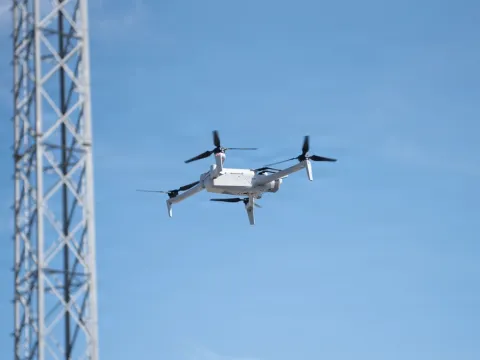
Rummel said she is optimistic about certain capability advancements, related to Falcon Peak, an experiment series hosted by NORTHCOM/NORAD, testing counter-unmanned aerial vehicle capabilities.
“What we have found in the last year is there has been a speeding up of capability, not necessarily development, but testing, with Falcon Peak,” Rummel explained. “We have rapidly been able to say, ‘This is what we want,’ or ‘This is what we don't want,’ ‘This is what works.’ And then deploy some of those things to the southern border or to the National Capital Region.
NORTHCOM has also streamlined its process for vendors to show their capabilities.
“It is now automated online,” Rummel cited, encouraging industry to visit the website, NORTHCOM.mil, under the “work with us” tab.
Meanwhile, at TRANSCOM, the technology needs reflect the command’s increase in unique mission activities in its transportation and logistics combat support, McFeeters shared.
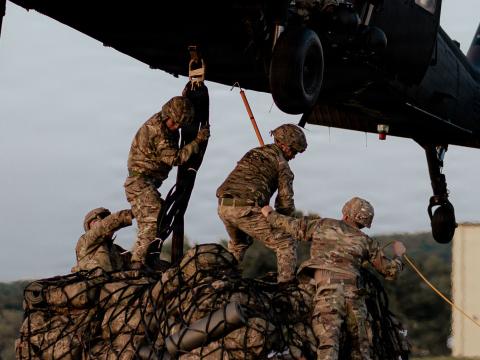
“TRANSCOM is unique,” he said. “We are really a support team command in a lot of ways. There is a combat command functional or geographic that we are now working with and supporting, and we are spread pretty thin right now. All the way from presidential moves, all the way down to nuclear moves, and then major force rotations, and then helping set the theaters, whether we're talking about CENTCOM, EUCOM, SOUTHCOM or the Indo-Pacific. We stay hopping.”
The colonel had been the J39 at the command in his prior role, pulling together “a lot of the non-kinetics” effects, including information operations and offensive and defensive cyber operations. In his role as deputy J6, he is working to operationally align these activities.
The command also pulls in a fair amount of private sector capabilities to complete its TRANSCOM activities, he continued.
“Some of our missions are actually done almost entirely on the backs and in partnership with industry,” McFeeters stated. “If you look at our sustainment line, that is almost all done via white tail, aircraft and platforms. So, our challenge really is, how do we stay connected, both at speed and securely with industry partners? How do we maneuver in that space?”
One area that still needs work—and technological solutions from industry—is connections to TRANSCOM’s maritime industry partners.
“Where that gets challenging is when certain platforms are underway,” he stated. “For instance, a lot of our maritime industry partners right as they get ready to set sail through the band. When that kicked off a couple of years ago, we had a hard time getting all the way down to the bridge of a ship that was underway and being able to communicate securely. We have made some progress in that space, but that is something that we are still challenged with.”
The Rocky Mountain Cyber Symposium is co-hosted by the AFCEA Rocky Mountain Chapter and AFCEA International. SIGNAL Media is the official media of AFCEA International.
Comments