
Space Development Agency Selects Lockheed, Rocket Lab, Northrop and L3Harris for Missile Warning and Tracking Capabilities
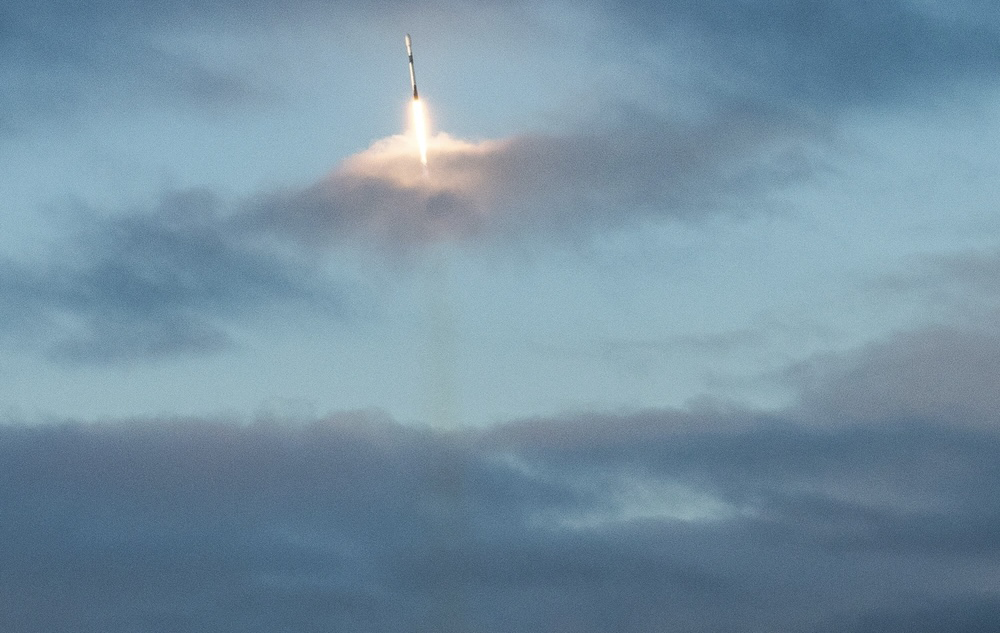
The Space Development Agency (SDA) announced on December 19 four awards to procure 72 satellites for its Tranche 3 Tracking Layer constellation. The launch is part of the Proliferated Warfighter Space Architecture (PWSA), the U.S. military’s rapid plan to proliferate hundreds of smaller, lower-cost satellites in a resilient, networked system. The PWSA will provide a foundation for secure communication, joint all-domain command and control, missile tracking and defense.
This latest $3.5 billion effort will add both infrared missile warning and missile tracking sensors, along with missile warning, tracking and defense sensors to the PWSA in low-Earth orbit.
“The Tracking Layer of Tranche 3, once integrated with the PWSA Transport Layer, will significantly increase the coverage and accuracy needed to close kill chains against advanced adversary threats,” explained Gurpartap “GP” Sandhoo, the agency’s acting director.
This crucial tracking layer will add to the PWSA’s transport layer, a mesh communication network that will provide mission data directly to tactical data links, such as Link-16. Over the last year, the agency has been testing its existing Tranche 0 satellite connections over Link-16.
The SDA designed the Tranche 3 constellation’s mix of missile-warning and missile-tracking capabilities to pace evolving threats, such as hypersonic missiles. While some of these spacecraft will only provide missile warning and tracking, other vehicles will have payloads capable of generating tracks for fires.
“The Tracking Layer initiates the PWSA’s proliferation of missile defense sensing, or fire control, in support of Homeland Defense and Theater Defense,” the agency noted. “The PWSA is integrated into the U.S. Space Force’s holistic hybrid missile warning/missile tracking/missile defense architecture to support joint force operations and ensure warfighting success across all domains.”
The December 19 awards come in the form of firm-fixed-price other transaction authority (OTA) agreements, a procurement vehicle designed to bring in capabilities quickly. OTAs are a specific authority granted by Congress, are not considered contracts and are not subject to the provisions of the Federal Acquisition Regulation.
Under the OTAs, the four companies will manufacture and operate the spacecraft.
Sunnyvale, California-based Lockheed Martin will provide 18 vehicles with missile warning, tracking and defense sensors—the fires control feature—under a total potential agreement valued at $1.1 billion.
Rocket Lab, USA, based in Long Beach, California, will supply 18 space vehicles, also with missile warning, tracking and fires sensors, with a total potential value of $805 million.
For infrared missile warning and missile tracking, Northrop Grumman, of Redondo Beach, California, will provide 18 space vehicles, with a total potential value of $764 million. L3Harris Technologies will also provide 18 spacecraft with infrared missile warning and missile tracking, with a potential total of $843 million. L3Harris is in Fort Wayne, Indiana.
The constellation will be organized across eight orbital planes and integrate with the other spacecraft in earlier tranches of the PWSA, the agency noted.
“Each Tracking Layer SV [space vehicle] will be interoperable with all PWSA SVs, for example, Transport Layer SVs, and will operate in an integrated fashion through a common ground system,” the agency stated in the release. “Each [Tranche 1 and 2] SV is equipped with an IR mission payload, optical communication terminals, and Ka-band communications payloads as well as an S-band backup telemetry, tracking, and command system.”
The agency expects this Tranche 3 Tracking Layer to launch in fiscal year 2029.
“The addition of these satellites will achieve near-continuous global coverage for missile warning and tracking, along with payloads capable of generating fire control quality tracks for missile defense,” Sandhoo noted. “This is a prime example of spiral development: the ability to rapidly integrate the next generation of technologies, and to proliferate the most impactful capabilities for increased capacity and lethality.”




Comments