
DISA Requests Integrative Solutions, Delivers Acquisition Reform
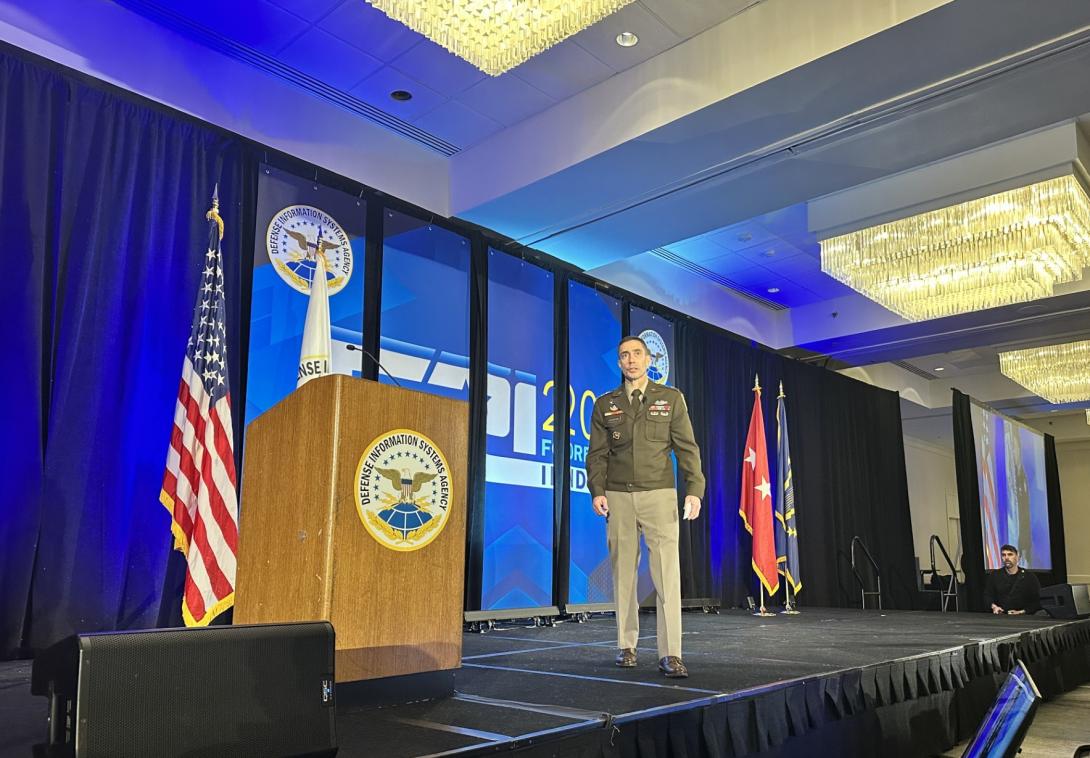
The Defense Information Systems Agency (DISA) is not looking for isolated capabilities; it is seeking out industry solutions that can adapt as the operational landscape evolves.
“When we talk about the complexity of the mission space, we have to work together to design integrated systems that are going to solve the problem,” said Lt. Gen. Paul Stanton, USA, DISA director, at DISA Forecast to Industry 2026. “Context matters. Understanding how the system is going to be employed in the context of supporting the war fight is critically important.”
At this year’s Forecast to Industry event, DISA leaders urged competing companies to collaborate, combine capabilities and propose unified solutions. They also demonstrated how each of DISA’s portfolio acquisition executives (PAEs) is working together to build integrated architectures across the agency.
PAE Mission Partner Environment (MPE), the agency’s newest PAE, focuses on supporting the coalition information environment, transitioning from a network-centric approach to a data-centric approach to enable seamless and secure information-sharing between the United States and its global partners. DISA appointed Nicholas Creswell to lead PAE MPE in March.
Caroline Bean, director of DISA’s PAE Command, Control, Communications Enterprise (C3E), said all of DISA’s PAEs brainstorm how the capabilities they acquire individually can aid PAE MPE’s mission, and they tested integration techniques at exercise Olympus Fires.
“Each of us understands what the vision and what the objective is, and how coalition information environment is supposed to work,” Bean said.
Within the past year, PAE C3E has worked a lot on the Defense Enterprise Office Solution (DEOS), which is the Pentagon’s enterprise cloud-based communications platform for both classified and unclassified information. Bean said it has been a lesson in deciding which capability features are not necessary and figuring out how to integrate with coalition partners who do not use the Microsoft 365-based platform.
Bean’s business systems portfolio is looking at how to easily access data and share information within just PAE C3E as well. Her team has worked to make the capabilities, talent and resources across PAE C3E visible so when one project requires a pivot, she can find a solution quickly.
Speed and teamwork were key themes among DISA leaders at Forecast to Industry 2026.
To accelerate and strengthen acquisition, PAE C3E is leveraging a software acquisition pathway that involves continuous authorization to operate, rapid prototyping and direct feedback from warfighters, Bean said.
“I need to get developers next to the user community. I want them sitting side by side with the operators and the decision-makers and the users and our warfighters, so that way, we are building to their capability and to their operational needs,” Bean said.
DISA is implementing acquisition reform to get operationally relevant capabilities to warfighters faster. Brian Leyda, DISA’s procurement services executive, said the agency is streamlining the acquisition process with less reviews and oral presentations of solutions instead of written proposals.
“I want to see less of the multiple 100-page proposals that go on a shelf after we review them,” Leyda said.

I need to get developers next to the user community. I want them sitting side by side with the operators and the decision-makers and the users and our warfighters, so that way, we are building to their capability and to their operational needs.
DISA is also transitioning to a multiphase procurement where only a handful of companies are advised to continue to the second phase in the selection process. The rest of the companies are advised not to move forward. Leyda said this gives companies the opportunity to decide what they want to do with their bid and proposal costs before they invest all their energy in a contract they are not likely to win.
Leyda also said he appreciates feedback from industry.
“I recognize that we are doing things a lot different and a lot better than we've done in the past,” Leyda said. “I also recognize that there are other agencies that are doing things better than we are doing right now. I just want to know what you guys are seeing and what's working.”
Stanton said DISA’s acquisition reform is critical as the threat landscape rapidly changes.
“The historic process of transactional contracting is not going to work in the modernized battlefield where speed, scope and scale are key considerations,” Stanton said. “We can't operate at the pace of writing a new tasking order. Our acquisition team is on the ops [operations] center floor for a reason, because they have to very rapidly communicate with you, and in a 24/7 cycle, make modifications to the weapon system. That requires a relationship between our agency and your company that is different than what it has been previously.”

Comments