
Intel Community Revolutionizes System Development and Acquisition Strategies
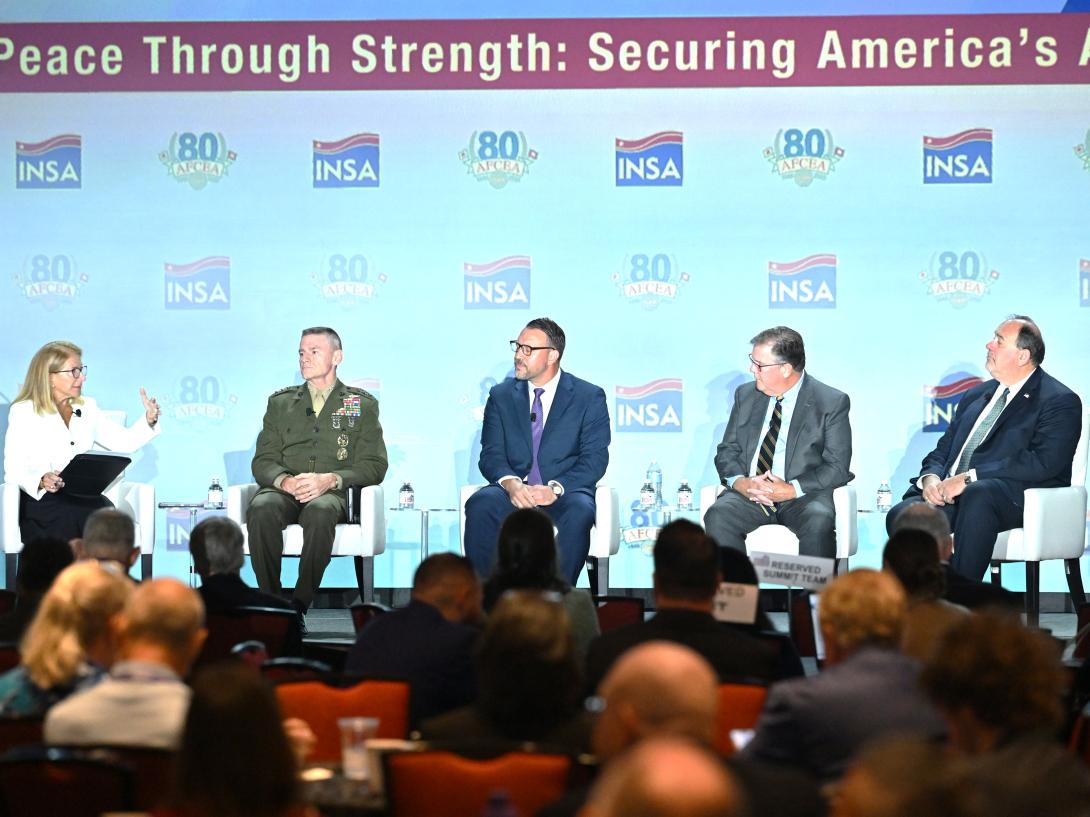
The National Reconnaissance Office (NRO) and the National Geospatial-Intelligence Agency (NGA) are starting to produce and pursue systems that are proliferated and quick, announced William Adkins, principal deputy director at the NRO, and Walter Trynock, director of strategic initiatives at the NGA.
Firstly, Adkins said he wants to see extensive integration of proliferated systems into NRO operations regarding resiliency, coverage and persistence. The movement will not result in the complete replacement of traditional platforms, but rather, combining proliferated systems with existing tools is a big part of the NRO’s strategy for the future, according to Adkins. Changing its architecture, through a transition such as leveraging proliferated programs, will provide more data, which subsequently requires the additional application of artificial intelligence (AI).
“What that ultimately means is that we’re getting more data,” Adkins said during a panel at the 2026 Intelligence & National Security Summit in Bethesda, Maryland. “The haystacks are getting bigger. We’re trying to find more needles in bigger haystacks, and we all don’t have enough humans to go through all this, so we have to figure out how do we leverage tools like AI to be able to get through that data at speed and at scale to support our customers.”
Adkins made sure to give the private sector the credit he said it deserves regarding the emergence of proliferated capabilities.
“I don’t think it is often fully appreciated, the ability of the NRO to proliferate its architecture is fundamentally enabled by commercial investments. Whether that's launch, spacecraft vessels, components and things like that that were married together by government engineers who saw the value of what’s going on in the commercial world and what was out there available to buy at scale and marry that up with government-specific payloads and integrate those together to enable the proliferation at a price point and a performance point that was feasible and affordable,” Adkins said.
Secondly, the NGA is rapidly overhauling its acquisition strategy by favoring agile platforms and moving away from traditional monolithic programs. Up to this point, agency officials have seen success with the shift in the unclassified space, Trynock said during the same panel. One way the NGA is propelling this effort forward is by establishing a team that focuses on seeking technologies that work quickly and integrating these capabilities into its system, which is an improvement on the traditional process that the director of strategic initiatives at the NGA called “rigid.” Despite the early benefits stemming from this novel change, the job is not done.
“It’s great that it works in the unclassified space, but how do we make it transition to the classified space?” Trynock asked. “Also, [we need to] think about those processes as part of the acquisition but also take advantage of capabilities that we all have, and today, we have over 200 terabytes of the data lake that you can utilize—real-life commercial data to test your capabilities and test your algorithms and learn in a rather real operational environment.”

We’re trying to find more needles in bigger haystacks, and we all don’t have enough humans to go through all this, so we have to figure out how do we leverage tools like AI to be able to get through that data at speed and at scale to support our customers.
Implementing a shift of this magnitude can be easier said than done, but Trynock explained that these transformations can help the agency advance forward. “Those are some things that we’re destined to that allow us to get past our legacy approaches and start to move toward what the administration is telling us—to move quickly and move rapidly and do so with commercial,” he added.
Furthermore, the NGA is striving to expand its space-based constellation. The framework will have at least 10,000 commercial satellites of all forms and fashions by the end of the decade, a sharp increase from the 1,300 commercial satellites that are in the NGA’s space-based constellation today, Trynock estimated. This effort will support the aforementioned objective of prioritizing tools that are agile.
“I would argue that that presents a great opportunity for us to think about how we get information out there far more quickly and leverage capabilities that many in the audience bring today to move at a faster speed in one week and help support us to get there quicker,” Trynock said.
The 2026 Intelligence & National Security Summit is co-hosted by AFCEA International and INSA. SIGNAL Media is the official media of AFCEA International.


Comments