
UT San Antonio Students and More To Be Trained in AI Security
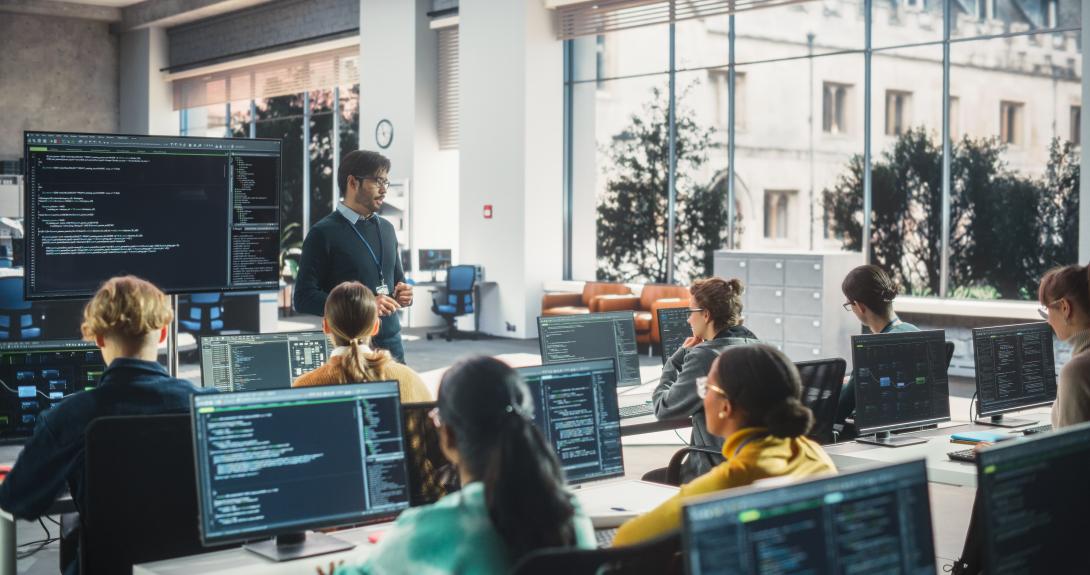
Artificial intelligence has advanced to creating and automating code faster, but security risks are still a threat and could increase if students’ skills are not updated. Nishant Vishwamitra is an assistant professor in the Department of Information Systems and Cybersecurity at the University of Texas (UT) San Antonio. He will be leading UT San Antonio students toward a safer future in artificial intelligence (AI). With an award of $500,000 from the National Science Foundation, Vishwamitra is initiating a training program for students before they enter the workforce.
The program will specifically train students to identify security risks found in AI-generated code through the online learning platform, OpenSecCoder. While most software code today is written with help from AI, Vishwamitra told UT San Antonio Today, “ . . . those tools frequently produce insecure code.” His solution involves training students to identify and rectify errors in code written by AI. Currently, there is no open platform, lab or curriculum for this training.
In collaboration with the University at Buffalo, the project is expected to reach 1,000 undergraduate and graduate students combined each year. According to Vishwamitra for UT San Antonio Today, here’s what students can expect from a training lab:
Students begin by selecting a topic and choosing the corresponding lab. This opens an interface that includes step‑by‑step instructions; a coding agent, which serves as the AI tool; a terminal for executing commands; and a debugger for identifying vulnerabilities. As students work through more labs, they gain experience using AI to support secure software development.
Agentic AI and Program Goals
Vishwamitra’s program focuses mainly on agentic AI training. Traditional AI chatbots respond to individual requests, while agentic AI autonomously carries out many steps in pursuit of a larger assigned task.
Rather than immediately trusting code written by AI, the goal of the program is to leave students with a critical eye. Students will walk away with critical thinking skills, specifically trained to measure and compare AI tools. This means students will actively engage with the tool, rather than completely offloading tasks to the technology. Through this approach, coding scripts in any field won’t lose out on security because students will be trained to evaluate the work.
The program will contain various labs that mirror professional settings. Students will have their pick of labs, capstone projects and even summer workshops. Many labs won’t require programming experience, and these resources will be available to students in other universities through an open-source MIT license.
“One aspect of the project that I think is especially important is that AI development is no longer confined to computer science, Vishwamitra told SIGNAL Media. “AI coding tools are increasingly being used across business, health care, engineering, education and other fields, so AI security is becoming a cross-disciplinary issue as well.”
“With OpenSecCoder, we want to move beyond simply teaching students how to use AI tools,” he added. “Our goal is to help students from both technical and nontechnical backgrounds critically evaluate AI-generated software, recognize security risks and understand how to mitigate them through hands-on learning."
AI-Adept Workforce, No Matter the Field
“Ultimately, we’d like security to stop being a specialist’s job,” Vishwamitra said. “If workers across every field can tell when an AI tool has handed them something unsafe, that changes the national security picture in a real way.”
Jim Dubinsky of Virginia Tech echoes Vishwamitra, in this case through the eyes of a liberal arts field. Although Virginia Tech is a university famed for its engineering program, Dubinsky, a veteran and an English professor, has remained close and in tune with the world of technology.
“Over my entire career, since the time I was an undergraduate at Wake Forest till today, people were saying that English literature and writing were not really going to be productive, and they're going to just go away because the sciences or the math, they're going to take over,” he said. “If your teachers are informed and they teach students the tools that exist, what we have to offer, which is really, again, going back to critical thinking—if you are willing to do the work, how to use these tools to assist you in that process, the field could actually grow and become even stronger."


Comments