
AI Brings Speed to Law Enforcement


In federal and military law enforcement, artificial intelligence (AI) is adding automation and lightening workloads, but more than anything, it is bringing speed to investigations.
Given the public trust, law enforcement must leverage AI responsibly, and organizations are taking careful, measured approaches.
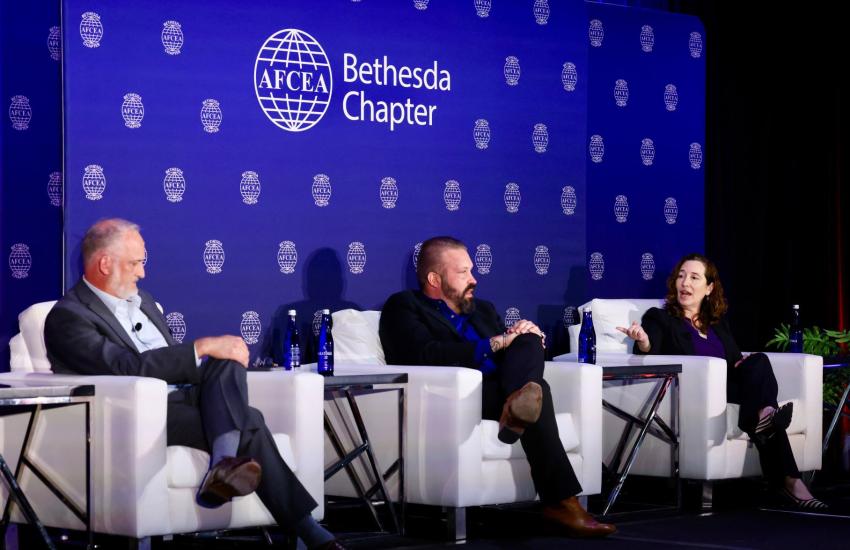
A year ago, most establishments were just beginning to consider AI, including large language models, generative AI and automatic processes. Today, there are scores of AI use cases across various organizations, according to officials who spoke at AFCEA Bethesda’s LEAPS conference in Washington, D.C., May 14.
For example, the FBI’s CJIS division, the Criminal Justice Information Services, now located in West Virginia, currently has 28 AI use cases, including data summarization, research assistance, coding and writing assistance, explained Timothy Ferguson, the assistant director of CJIS.
“What does AI do for us; it allows us to code faster, to deploy tools quicker out to the field, and to be able to parse voluminous data. And all this is baked into our cybersecurity, making sure that our systems are secure,” Ferguson said.
For the National Threat Operations Center, for example, they developed algorithms that have aided threat examiners in threat detection and processes.
“Thanks to the introduction of artificial intelligence into that process, once a call is transcribed for the examiner, their notes are summarized, then they are receiving alerts on their desktop to tell them when something within that form is a potential tag for a specific threat,” Ferguson noted. “All those things that make our folks more efficient.”
For Jason Richards, the former assistant director of the FBI’s Information Technology Applications and Data Division, AI helps officials and agents process information across large datasets and find connections.
“When I think about AI, it’s math, it’s relationships between words, and trying to eliminate false positives and false negatives,” Richards said. “We want to find the right folks to follow and the right folks to leave alone, and we do not have resources to follow everyone. I think it is really important we get that message across.”
Richards emphasized that AI was one tool of many as part of investigating that can help confirm activities or suspects.
“AI, when it is used properly, can help corroborate,” he said. “As we find other pieces of evidence that you either confirm or deny, that could really help us.”
AI tools, especially for sorting through photographs and videos, would be a differentiator, said Sean Ryan, assistant director of the FBI’s Operational Technology Division.
“I think the benefit for that is the speed of the AI results,” he said. “And we are very cautious in the use of that, with a review board on the team and approvals within the agency. ... An example of that is the Boston Marathon bombing. We had tens of thousands of digital images and videos. Being able to utilize AI for something like that now would definitely speed up potential leads for investigators.”
The bureau has even added a chief AI officer, who is Katie Noyes, an intelligence community veteran who started as an Army military intelligence officer and later was an intelligence subject matter expert with the Navy’s Space and Naval Warfare Systems Center.
The Chief AI Office works closely with the bureau’s chief data officer and the chief technology officer, which are all under the same branch.
Noyes’ vision for the FBI’s AI journey is to make sure AI actually helps agents and officials. The Chief AI Office is working to deliver AI solutions for investigations, intelligence and business operations, Noyes shared.
“Our goal is to deliver AI capabilities at mission speed in a responsible way that doesn’t harm our investigations,” she stated. “We have to continue to build all trust. And I’m from the Army. I grew up there, and I think about it as combat, combat support and combat service support. We are looking at delivering things for the folks that are closest to the mission. But we also have to ensure that we put data scientists and computer scientists out into our field offices and within our mission operations. So, we can go from mission up, then from my program, looking enterprise down.”
Because the bureau has to be careful with AI, protect personal data and prepare investigatory-level information, AI tools usually are bespoke or fit for specific FBI mission purposes—such as for biometrics—fingerprints—for FBI or governmental use.
They can see that commercial AI offerings “are way ahead” of what the government has at times, she said.
“But then we come back to reality, which is grounded in investigative workflows and how we can apply the tools in response to the way we need,” Noyes cautioned. “What about an AI system deployed in our unclassified network. You can understand we have sensitive data, and we need it to stay within our boundary, within our environment. But the challenge is, when you take a commercial product, perhaps that commercial product is designed to make the decision for the user on whether it should go out to the internet.”
Any commercial AI tools for the FBI, and the greater intelligence community, must also have guardrails or systematic controls in place, the chief AI officer advised.
AI “hallucinations,” when the tools come back with unrealistic, fabricated or irrelevant information, continue to be an issue, she added.
In addition, Noyes noted that harnessing AI effectively takes three things: compute power, good data and advanced AI tools and services. “The challenge for us is tackling all three of those,” she noted.
Meanwhile, Virginia’s largest and the nation’s 33rd biggest police department, the Fairfax County Police Department, is already using many commercial AI law enforcement tools, such as Peregrine, Kling AI, BriefCam, Axon and Flock Safety, shared Kevin Davis, chief of the Fairfax County Police Department.
Axon’s Body Camera 4 tool, a sophisticated communication tool, for example, translates 52 different languages in real-time and offers a voice-enabled policy chat, in case officers have questions. Another part of the tool, voice-to-text, is improving policing and report writing, Davis said.
“I was a little skeptical,” the chief shared. “I’ve been doing this for 34 years, and I remember notepads stuffed in your back pocket, and you had to figure it out two hours after you took the call. But now it makes police officers better communicators. They know that the more effectively they communicate on the scene, the more questions they ask, the more detailed their questions are, when they get back to their car, they literally press a button that generates a police report, and they know the reports are going to be more complete and accurate.”
Davis did worry that the AI tools would only appeal to the younger generation, that the veteran cops would not embrace it. When the senior police officers saw that the AI tools were effective, had user-friendly interfaces and made police work better, “we knew that we were on to something,” he stated.
When they saw early success, however, they took a measured, careful approach when employing and speaking to stakeholders about the various AI tools. “It furthers investigations in a remarkable way, but we had to tell the story differently,” the chief said.
He recommended building on initial successes, engaging leaders and finding bipartisan support.
“What I have found helpful is to find ways to pilot, find ways to research and develop, find ways to introduce it into your business model with a little bit of political coverage, and then once you start achieving successes, celebrate those successes in the community,” Davis stated.
For example, AI tools—along with traditional police methods—were used to help locate and safely recover vulnerable missing persons and help resolve domestic violence situations more quickly. These early successes resonated with their advocacy community as well as with AI skeptics.
“And, ‘Oh, by the way, it does help us catch bad guys as well,’” he said. “Telling the story where people on both sides of the aisle can nod their heads and say, ‘Yes, I can get behind that,’ is really the story of success in Fairfax County. ... I think there is a cadence and a method to the madness that gets AI off the ground in a way that we’re not fighting constantly to prove the point.”
![AI tools, especially for sorting through photographs and videos, would be a differentiator, “Being able to utilize AI for something like [the Boston Marathon bombing] now would definitely speed up potential leads for investigators,” says Sean Ryan (c), assistant director of the FBI’s Operational Technology Division, speaking with Col. Jeff Glover (l) and Perry Tarrant. Credit: Lisa Nipp Photography](/sites/default/files/styles/image_caption/public/2026-06/F2_AIlawpic2_JUL26RyanPanel.jpg?itok=GBgDxm4W)
In addition, the Department of Homeland Security’s Customs and Border Protection (CBP) is leveraging AI in many instances, reported the CBP’s Jay Alalasundaram, senior executive service, deputy assistant commissioner for Software Applications and Services and chief software officer, Office of Information Technology.
“At CBP, we have been investing in artificial intelligence for a long time, with data-driven decision-making that forms the backbone of CBP’s enforcement actions,” Alalasundaram noted. “We have embedded AI in everything we do now.”
As the chief software officer is pursuing an enterprise software strategy for the CBP—providing mission-aligned software that is scalable for the entire department, he noted—“AI-centric solutions” are at the heart of this effort.
“We are actively injecting AI in every minute detail of our software developer life cycle, helping developers write code, test and deploy code faster and more securely,” Alalasundaram said.
He attested that the AI-powered assistance was already accelerating their coding velocity and script quality, and that they had saved thousands of hours with AI-coding.
“11,000 hours in just 30 days,” shared Alalasundaram. “It is unbelievable. It has translated into an estimated saving of over $700,000 on our return of investment.”
They are bringing in AI to help streamline their cyber mission by embedding cyber AI tools in cyber scans for applications.
The CBP is also using AI in tactical operations. “It increases the efficiency of examinations,” he offered. Officers are using specific AI applications, including voice-to-text, which allows them to verbally enter examination information via mobile devices. A virtual assistant large language model is also enhancing user efficiency, improving workflows.
Additionally, the CBP is employing AI and machine learning for compound detection, checking packages and vessel equipment and summarizing equipment information for CBP officials when vessels declare their intent to enter into United States waters, Alalasundaram said.
Another AI tool utilizes large X-ray and imaging systems for cargo and vehicles to stop the flow of fentanyl, weapons and contraband.
“We are building AI models into AI review processes to automatically flag anomalies in cargo,” Alalasundaram stated. “These cargo scans serve as a powerful tool for officers so they can make AI-enabled decisions.”
None of the AI efforts could be done without the cloud. As such, the organization is pursuing a cloud management journey to meet the mission demands, with intent to optimize its cloud portfolio.
“We believe strongly [in that], not just as a hosting environment, but as a strategic enabler for agility, scalability, resilience and innovation,” he said. “We have been actively modernizing our portfolio by moving legacy applications, or almost 90% of our applications.
By the end of 2027, they hope to move more than 40 petabytes of on-premise data to the cloud. “So, we are focused on that,” Alalasundaram shared.
“When officers and agents can access data faster, collaborate more effectively across systems and utilize mobile and edge-enabled technology at the point of action, they can make better decisions, reduce friction and enhance both security and efficiency,” he stressed.

Comments