
U.S. Navy: Trading Time for Impact Through AI Capabilities


Building upon a 2025 Department of War memo on leveraging generative artificial intelligence (GenAI), the Department of the Navy (DON) is working to enhance the use of the capability across its workforce. Through repetition and proximity, the maritime service aims to cut inefficiency and exchange time for impact.
In early spring, the department’s Office of the Chief Information Officer released its memorandum on AI use, titled Accelerating AI Adoption, Free Training Resources and Measuring Time Savings Across the Department of the Navy.
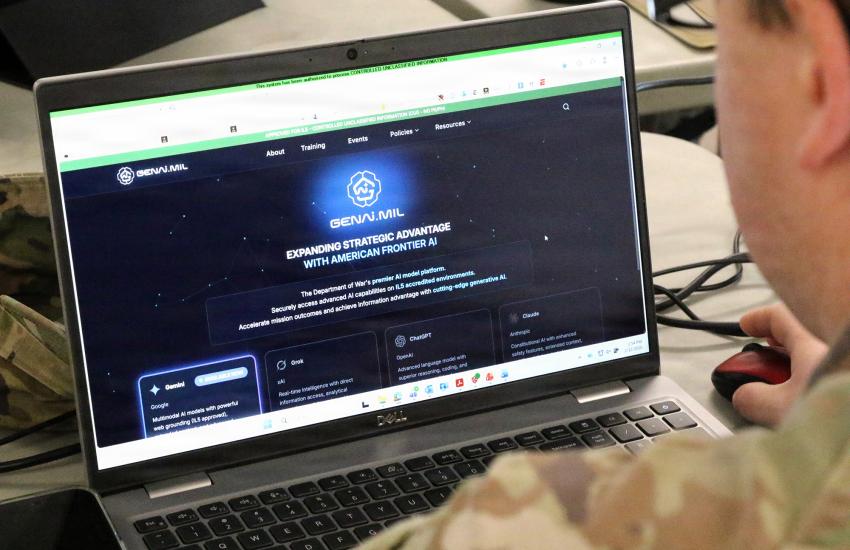
The free training resources highlighted within the memo include a lecture series at the Naval Postgraduate School, as well as those outside the organization, such as GenAI.mil, LinkedIn Learning, Google Skills and Microsoft Copilot. “Courses cover a range of skills from basic proficiency that all personnel should have to include advanced technical knowledge/skills,” the memo reads.
The Pentagon launched its GenAI.mil tool through Google Cloud’s Gemini for Government in December 2025, following a July presidential order to achieve AI technological superiority. In February of this year, OpenAI for Government announced the addition of a custom ChatGPT product to the department-wide platform.
The memo, signed by DON Chief Data and AI Officer Stuart Wagner and DON Chief Technology Officer Justin Fanelli, highlights opportunities within mission execution through time saved.
“It is clear to people how much small teams can accomplish,” Fanelli said in an interview with SIGNAL Media. “I think we are realistically taking collective action to embarrass the status quo and show how much better we can be.”
Across the board, the DON is working to be more data-driven, Fanelli stated.
At an individual level, the memo aims to further drive the use of GenAI across sailors, marines and civilians. “[We’re] making sure that people know there’s training, they can get better, they can hone their skills, and they can actually quantify the impact it’s making for them,” he said.
The impact created individually can then be substantially amplified organizationally for a cumulative benefit to the community and larger ecosystem.
The idea is for personnel to learn by doing, Fanelli emphasized. “You might figure out new opportunities, but almost definitely you’re going to save some time,” he noted. “We just asked people, if you are saving time on a regular basis, let’s mark that down, let’s extrapolate that or scale that to how much time you save ... and then let’s make sure that you’re not just letting that slip by, make sure that you are reinvesting that divested time.”
Although time saved is measured, the priority lies in achieving results.
Fanelli also mentioned new organizational data challenges and hackathons for increased efficiency and effectiveness in team environments.
“Similarly, we’re looking at that for acquisition pretty hardcore, certainly on the logistics side, on readiness,” he said. “The evolution is human-machine teaming at the organizational level for leap-ahead type automations, function streamlining or something even more ambitious.”
Recently, for example, Fanelli attended a data challenge that looked at optimizing inefficient or manual processes into automated forecasting. The goal was to enhance use of data to detect waste and produce outcomes.
“They weren’t just talking about or making PowerPoints on the future, they were creating the future through use of AI domain expertise,” Fanelli stated.
The results were impressive, he said, noting high interest across participants and the group of senior leader judges. “You have a community there who is leaning really hard into being smarter with data to produce outcomes ... I think the results are bearing out how effective that is already.”
Challenges like these highlight the effectiveness of small groups with great access to data, he added. “It was a ton of traction in a short period.”
Additionally, the memo notes the launch of a DON CIO team-run AI efficiency challenge, which will be similar to the U.S. Marine Corps innovation challenges program. The challenge will “recognize individuals who achieve the greatest measurable time savings through AI implementation,” the document states.
Moving forward, Fanelli hopes individuals across the Navy and beyond will leverage data and AI to divest big processes that no longer serve the department. “I’d like to really tally the inefficiency that we run out of our building and our systems,” he said.
With endorsement for senior leadership for competitive and collaborative work across the services, military and civilian personnel are being driven to reach new heights through modern capability use.
“I think people are more excited about the impact they’re making. I see that,” Fanelli said. “I think talent feels like it has a home.”
One such example is Lt. Jonathan Shepherd, who was recently recognized for developing an AI solution for shipboard maintenance.
Titled LOOKOUT AI for large language model operational objective key-risk output and urgency tracker AI, the platform streamlines review of current ship’s maintenance projects, or CSMPs, by using a class-specific scoring sheet to prioritize maintenance jobs within the war data platform.
According to the press release, the platform was built in under six weeks with free tools available to government personnel.
“Commanders have so many responsibilities, so this tool allows them to easily see which jobs need more attention at any given time,” Shepherd said.
At the Naval Air Warfare Center Weapons Division, resource specialist Shaele Baker uses AI to modernize procurement processes.
“Operating within the business and technical operations branch at a military range, we cannot afford delays on mission-critical requests,” Baker wrote.
To achieve the necessary procurement outcomes, Baker had to step into the role of a software engineer, a job that self-learning and GenAI helped achieve. “By integrating AI-driven development into our daily operations, we overhauled a sluggish government purchase card approval pipeline into a highly agile system. This shift allowed our small team to operate as if we were 30% larger, executing millions in annual purchases significantly faster,” she said. “Ultimately, this AI integration ensured the continuous efficiency of critical test events, proving its immediate, high-impact value to government acquisitions and mission readiness.”
As the Navy becomes more data-driven and adaptive, the branch equally becomes a better buyer and adopter of new capabilities.
“Time to translate technology to outcomes is shrinking, and that’s something that we always look to industry to partner with us on,” Fanelli concluded.

Comments