
New Possible Battlefield ‘Game Changer’ on Display at the NTC
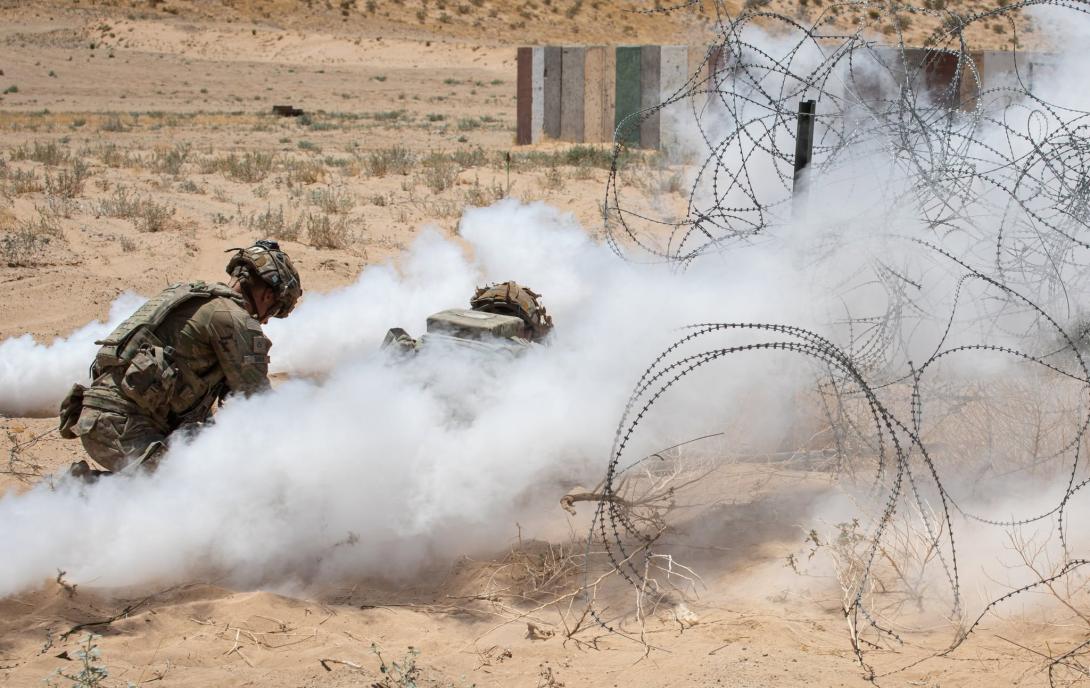
The 2nd Armored Brigade Combat Team members, otherwise known as the Spartan Brigade, participated in a combat training center rotation at the National Training Center (NTC) at Fort Irwin, California, and throughout the event, officials tested out and evaluated a handful of fresh technologies in the Switchblade, electronic warfare (EW) and unmanned aircraft systems (UAS) spaces, along with a brand-new unmanned ground sensor.
During a media roundtable discussion, event contributors offered praise and said that the Switchblades, EW and UAS platforms all worked and supported their operations, noting that there are certain gaps in the technologies and there is room for improvement, especially in the UAS field.
The Switchblades were the best capabilities that they had at the combat training center rotation, according to Lt. Col. Joseph Steadman, commander of the 6th Squadron, 8th Cavalry Regiment. These tools had almost 200 “kills” and were extremely responsive. Because of their excellent performance, Steadman said the Switchblades appeared to be game changers on the battlefield.
Additionally, Steadman is pleased to see that their hard work in evolving systems in the EW realm is paying off. “I'm 20 years and a couple of months in the Army, and we've had EW for just about the entire time I've been in the Army, but our understanding of EW and our ability to use that down at the troop and platoon level, I saw, really expand over the past year and a half while I've been in command,” Steadman said during the media roundtable. “We're finally getting systems that we can constantly train with, constantly use and constantly see the effects from. That's not only from the knowledge of our soldiers but also the policies and things that we have in place to be able to enable us to use these things a little bit more in the exquisite ways that they are designed to be used.”
At the exercise, crews had access to short- and medium-range UASs, which proved their ability to fill in the existing gaps in the maneuvering forces; however, they are still trying to tackle battery- and distance-related problems associated with UASs. Steadman noted that the extreme conditions of Fort Irwin’s location in the Mojave Desert interfered with the battery capacity, but nonetheless, teams still have a lot of work to do to get these tools flying the distances they want them to.
Lastly, with the help of Army Research Lab personnel, Spartan Brigade soldiers developed and implemented a new unmanned ground sensor. The capability did not have an optimal showing, but Steadman remarked that the sensor’s demonstration certainly had value.
“We brought in a lower technology readiness level system to really start to understand it,” Steadman said. “We didn’t get the full effects we wanted from that system, but we understood what different autonomous systems doing different stuff for us could mean in the future, and it helped advance the research lab’s program probably by a couple of years compared to if they wouldn’t have partnered with us going out to the NTC.”
Comments