
JIOC Explores Agentic AI Adoption for Mission-Specific Operations in DDIL Environments
Joint Intelligence Operations Center (JIOC) personnel will be executing rapid experimentation events—revolving around artificial intelligence (AI)—in the near future as part of their attempt to customize the tool to successfully carry out mission-specific events.
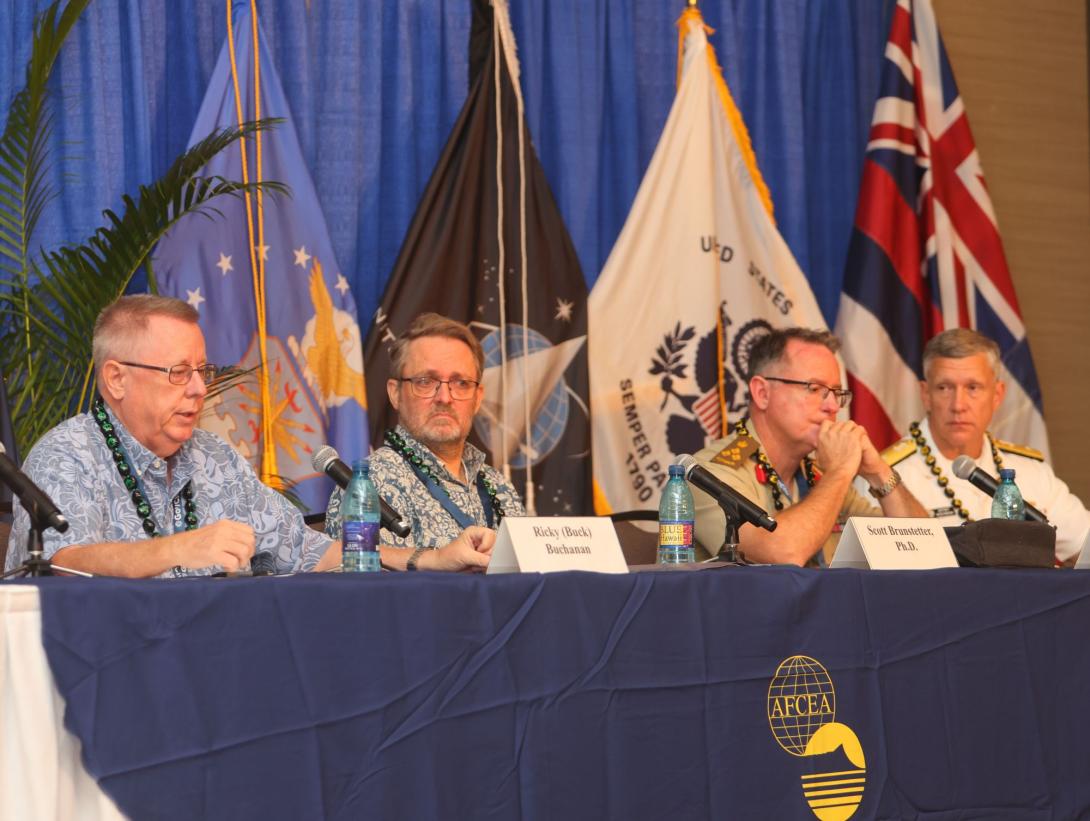
The AI landscape is ambiguous because there is typically no single solution to patching up a vulnerability. During a panel discussion at TechNet Indo-Pacific 2026 in Honolulu, one expert, Scott Brunstetter, chief artificial intelligence officer for the J2/JIOC at the U.S. Indo-Pacific Command (USINDOPACOM), explained that this ambiguity can lead to uncertainty about which tools can be applied to which mission sets. In other words, defense officials could have access to a handful of capabilities to address a handful of gaps, but one individual tool is not custom-made to fill one individual gap. This challenge is one that JIOC leaders are working to tackle.
“There’s not one capability and one model to rule them all,” Brunstetter stated. “So, as we look at frontier models, yes, they’re very capable and things, but the idea of small language models to do very specific elements that require less compute and less power is very much in our mindset right now. The whole idea then is to make that very tailored with the right data to the right target in the sense of the decision that we’re trying to make. I think this is also part of the learning environment that we’re in as these new capabilities evolve, especially as we get into the agentic world.”
And the effort is not stopping there. During these assessment exercises, crews will also be researching ways to ensure that these agents and AI capabilities can continue to operate even in denied, degraded, intermittent and low-bandwidth (DDIL) environments, especially regarding trade winds, Brunstetter stressed.
“That is actually something we’re taking very seriously and looking at doing some rapid experimentation in the next couple of months or six months, I think is when the next one is, to understand what that is and then bring those capabilities in,” he said.
Another panelist, Ricky (Buck) Buchanan, chief of the Intelligence Information Systems Division in the J26 of the U.S. Pacific Command (USPACOM), added that servicemen and women must be able to use these types of capabilities regardless of where they are located.
“To key in on something [Brunstetter] said, we cannot have our warriors become dependent on a tool that is dependent on a mainland data center or a Hawaii data center,” Buchanan underscored. “We’ve got to figure out how we put the correct data and the correct processing power forward to the edge, so the warriors—whatever we train them with in Hawaii—they’re able to use on Okinawa or anywhere else, and that is a big concern of mine is making sure that we get that right edge solution forward.”
The private sector plays a significant role in helping military organizations like the JIOC achieve their goal of looking at and integrating AI in ways they are not yet familiar.
“You all are our key partners in a lot of this,” he told a room full of industry personnel. “We have to partner with industry. You are in many ways the leaders in a lot of this, and we are getting so much out of that partnership, so the conversations we’ll have afterward are what’s going to help drive that.”
“We are all about eliminating barriers and doing things differently,” Brunstetter said.
The threat that we see here in the Pacific has the possibility to really change the world in a way that my generation has not seen, so I know that we’re up for that challenge.
In Hawaii specifically, since the cloud is so far removed, the armed forces face power and cloud-related challenges, according to Brunstetter. This space is one that JIOC officials are looking at differently, and they are working to innovate.
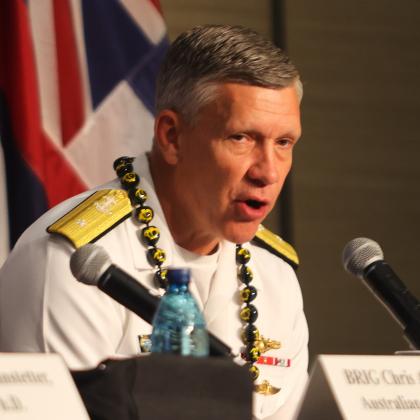
This development comes as the impact of the threat in the Pacific is monumental. During the same panel, Rear Adm. Jeffrey Buschmann, USN, director for intelligence at the USPACOM, illustrated the potential scale of the risk in this region.
“The threat that we see here in the Pacific has the possibility to really change the world in a way that my generation has not seen, so I know that we’re up for that challenge,” the rear admiral said. “But, if our workforce does not take this seriously, which I’m not concerned about [because] I know that they will, then this could be a very different world for my children and my grandchildren to grow up in, and for the rest of us. That’s the reason we come to work every day with such a fire to work hard.”
TechNet Indo-Pacific is co-sponsored by AFCEA International and AFCEA Hawaii. SIGNAL Media is the official media of AFCEA International.

Comments