
NATO Prioritizes Rapid Procurement, Industry Collaboration
The challenge is not whether innovation exists, but rather the speed at which it can be integrated. NATO and its procurement agencies are taking essential measures to bridge the gap between innovators and the alliance. Subject matter experts at TechNet International noted industry collaboration initiatives to be announced next month.
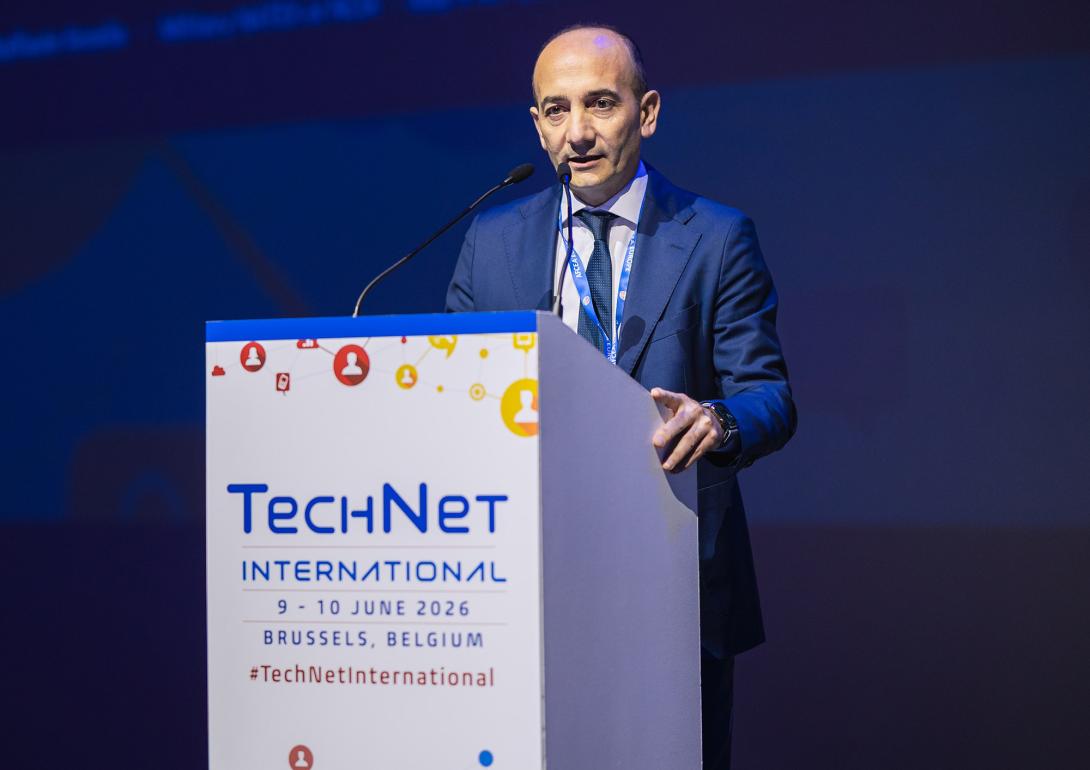
“What I’m witnessing is the fact that NATO is trying to update its procurement policies,” said Capt. Raffaele Rotella, national technical expert at NATO Communications and Information Agency (NCIA).
Rotella also currently sits on the NATO Innovation Fund (NIF) investors committee.
To accelerate procurement, Rotella said that agencies like NCIA and the simulation-based acquisition, or SBA, are adapting their internal procurement processes. Currently, NCIA is undergoing a process to reinforce its ability to procure and deliver faster.
Adoption of the Maven Smart System NATO has been an exceptional example of adoption at speed, Rotella offered. Looking forward, procurement times will continue to shrink, he said.
When it comes to the adoption of emerging technology like artificial intelligence (AI), Rotella claims there is room to grow.
“The question I’m most often asked is how fast the alliance is embracing AI, and the honest answer is faster than many assume, but not yet fast enough,” Rotella said during his address at TechNet International in Brussels on June 10.
“Allied nations are not short of innovation; the real challenge lies elsewhere, because AI is not a tool you want to fight, it’s the tempo we fight at,” he said. The speed of adoption is becoming the decisive advantage across all domains—including air, land, maritime, space and cyber. “The problem is not in inventing AI, new models, new algorithms, it’s adopting it.”
However, the alliance is steadily working to bridge the gap between innovation and operational capability, with key projects, including NCIA and the Defence Innovation Accelerator for the North Atlantic (DIANA), in progress over the last few years.
Just days ago, DIANA announced six new challenges in search of its 2027 cohort of innovators who will participate in a six-month accelerator program beginning in January. The deadline to submit proposals is Friday, July 3, 2026. The challenges include:
- Human survivability
- Multidomain autonomy of uncrewed systems
- Multidomain sensing and advanced data processing for intelligence and surveillance
- Operational resilience in contested environments
- Responsive logistics
- Scalable and adaptable countermeasures for air defense
NATO’s Rapid Adoption Action Plan, launched this time last year, sets a limit of 24 months to integrate new technologies across alliance nations.
“Sometimes we award contracts after several months, and we realize that the capabilities that we buy are based on requirements that are perhaps obsolete,” said Claudio Palestini.
Palestini, head of innovation and technology adoption at the Defence Industry Innovation and Armaments division at NATO HQ, spoke during the first day of the conference.
“There are new concepts coming like defense as-a-service . . . meaning you don’t need necessarily to buy the hardware . . . but you could also lease, for example, the system or have a service contract that will provide you [the most up-to-date] capabilities at speed,” he said.
Other examples of procurement changes have included establishing contracts for delivery based on readiness, awarding the capabilities ready within 24 hours. Another initiative looks at subcontracting startups through prime business contracts.
Palestini also noted an upcoming training session in the next few weeks for all acquisition agencies to learn about best procurement practices.
NATO is putting innovation directly into the hands of the warfighter, Rotella noted. DIANA’s rapid adoption team and the NIF’s mission platform group exist to turn portfolio companies into programs of record, he said.
Furthermore, initiatives like Task Force X and NATO Innovation Ranges allow for further acquisition at speed and scale.
Innovation ranges offer companies facilities to test and mature their technology products, to then demonstrate them to end-user communities within NATO. Recent projects have included capability testing in electronic warfare, underwater systems, counter-UAS and more. Partnerships have included Estonia, Finland, Sweden and Latvia.
Task Force X focuses on delivering emerging and disruptive technologies, including AI and autonomous systems. According to a NATO press release, the initiative is similar to U.S. Navy projects such as Task Forces 59 and 66, with an initial deployment to the Baltic Sea.
“The same model will be applied in other two operational environments, one is look at the Arctic and one looking at the Central Mediterranean,” Palestini shared. The Arctic region will look at persistent intelligence, surveillance and reconnaissance, and the Mediterranean project, together with Italian partners, will deploy and test unmanned systems.

Sometimes we award contracts after several months, and we realize that the capabilities that we buy are based on requirements that are perhaps obsolete.
The two initiatives are currently under deployment and will deploy capabilities in the next few weeks.
“With all these elements, all these initiatives, the main concept is going directly to industry and test these capabilities in an operational context,” Palestini said. “It’s not only how the system performs, but also how the system integrates into NATO command and control, in NATO concept of operations and in the full architecture.”
Palestini also referred to an upcoming announcement from the NATO Summit in Ankara, Türkiye, July 7-8, 2026. The NATO Front Door for Industry concept will aim to connect industry directly with the alliance.
The program is expected to be officially launched in just a few weeks at the summit.
“In one portal, you will have all the procurement opportunities,” Palestini emphasized.
Contractors will be able to upload their innovative solutions into the portal, which will then be directed to the respective point of contact within the alliance.
Rotella echoed Palestini’s comments. While unable to speak in detail, he shared that a document is in the works to present scale-up packages, which will include “a number of initiatives to increase collaboration with [the] private sector to increase the amount of private capital that would be invested in defense,” he said.
The idea is also to increase allied defense industry production of capabilities, Rotella noted.
TechNet International is organized by AFCEA Europe, AFCEA International's European office. SIGNAL Media is the official media of AFCEA International.



Comments