
NATO Task Force Maven Is a Good Thing, Says Program Director
With 32 nations in its alliance, NATO is challenged with tremendous amounts of data across various domains. Having acquired Palantir’s Maven Smart System NATO (MSS NATO) in 2025, NATO’s Task Force Maven has moved at record speed to integrate new technology, reshape outdated culture and overcome bureaucratic complexities.
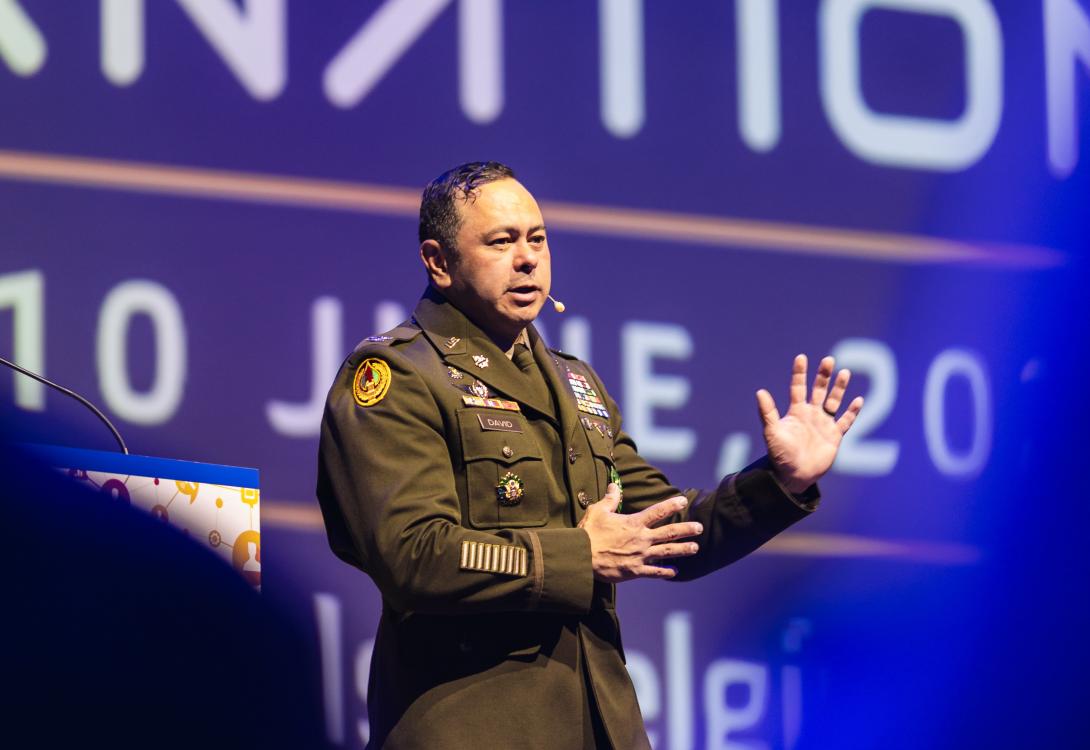
“We’re drowning with data, but we’re starving for wisdom and strategic insight,” Col. Arnel David stated while delivering the opening keynote address at TechNet International 2026 in Brussels, Belgium.
David currently serves as the director of Task Force Maven at NATO’s Supreme Headquarters Allied Powers Europe, or SHAPE.
“If you take artificial intelligence, whether it’s frontier models, machine learning, regression models . . . if you point it at only one system, you’re not getting a whole picture,” David said.
“Enter the Maven Smart System,” he said, a product of the Pentagon’s 2017-established Project Maven. Although the initial contractor for the program was Google, the company withdrew in 2018 due to employee protests.
In 2024, the U.S. Army Contracting Command awarded a five-year $480 million firm-fixed-price contract to Palantir for its MSS prototype. Just over a year ago, Palantir announced an increase to its contract ceiling to almost $1.3 billion through 2029.
While specific details of the capability have remained largely under wraps, recent reports cite its role in helping the United States strike more than 1,000 targets within the first 24 hours of the war in Iran.
According to David, a misinformation campaign has been targeting Palantir capabilities, consequently misleading the public about NATO’s MSS initiatives. Notably, discussions and initiatives on digital sovereignty in Europe have increased due to geopolitical tensions with the United States.
A few days ago, EuroNews reported on the House of Representatives of the Netherlands' call for an alternative to Palantir capabilities within two years, instead seeking European contractors.
France has also made headlines by testing an AI-powered command system, Arcadia, during a NATO exercise this month. The capability is a response to Maven, Deputy Chief of the French Army staff Gen. Patrick Justel told DefenseNews. “. . . The question arises whether [we should] adopt Maven blindly, or should we look for other solutions,” Justel said.
Meanwhile, the United Kingdom is conducting thorough reviews of its Palantir contract with the National Health Service due to privacy concerns.
“There [are] a lot of forces in the media . . . painting a negative picture, and there’s nothing negative about it. It’s positive,” David stressed. “We have to take and make full use [and] reach our full potential with this capability, and I’m confident we’re doing it.”
In less than one year, 15 systems have been integrated into the MSS, David told the audience. The program allows for organizing and structuring of the enormous datasets, which allow for unique, AI-enabled workflows.
“We have the most advanced platform now within the alliance to manage identity-based access controls and permissions and need-to-know,” David stated.
On its way to receiving full accreditation in the coming weeks, David’s team completed its accreditation for authority to operate on the secure NATO network in under six months, a record-breaking time, according to the speaker.
The true value of the MSS system is the warfighters, David emphasized. While Palantir engineers provide the software and system models, the warfighters are those building new applications within the platform.
There are currently under 50 new applications, and David expects that number to grow significantly thanks to online training opportunities. “By the end of the year, we’ll have hundreds of builders building brand-new software in the alliance. It’s powerful.”

We’re drowning with data, but we’re starving for wisdom and strategic insight.
Through the MSS, David’s small team of eight is working to create a cognitive competitive advantage for decision-makers.
“We are moving out to connect a multinational sensor-shooter kill chain,” David continued. “We’re doing that in all the countries, and we’re doing it in ways that have never been done before.”
By pulling in data from all participating nations for full data visualization, commanders, operators and beyond can leverage human-machine teaming for rapid decision advantage.
“We’re stitching together all the best AI and tech capabilities for our warfighters,” David said, noting companies from France, Germany, Finland and the U.K. integrated into the MSS. The integrations were a result of Task Force Maven’s Industry Day, hosted in November 2025.
“The goal was to highlight how MSS’s open, extensible architecture enables integration with third-party solutions, thereby powering rapid fielding of new technology combinations and enabling cutting-edge outcomes for the warfighter,” a March Palantir blog reads.
David also mentioned an upcoming announcement from the Defense Innovation Accelerator for the North Atlantic, or DIANA.
“We partnered with them these past two months, and we’re about to announce 10 new prototypes that are integrated into the Maven Smart System, coming from across the Europe landscape,” he said.
Starting with an initial batch of 425 applications, 10 were selected just yesterday.
TechNet International is organized by AFCEA Europe, AFCEA International's European office. SIGNAL Media is the official media of AFCEA International.

Comments