
Quantum Explodes on the International Stage

The capabilities and networks of quantum computing are expanding around the world, advanced by university researchers, government support and corporate investments.
In Europe, companies and institutions are taking a continental view, seeking partnerships and advancements not only within their own country, but also across the region with the aim of strengthening Europe’s quantum capabilities as a whole.
The Netherlands’ QuiX Quantum is an integrated photonic quantum computing company focusing on a quantum computing architecture and hardware. The company is based in Enschede, Netherlands, with expansions to Amsterdam and to Stuttgart, Germany, in 2022.
QuiX Quantum announced its new quantum architecture in July 2026, called Carina, for use in data center environments.
“The significance of Carina lies in the combination of two capabilities that have historically been pursued separately,” the company claimed in a white paper entitled “Carina - Universal Photonic Quantum Computing Built for Customer Deployment.” “Some quantum computing approaches have focused on near-term commercial deployment but rely on architectures that are not designed to scale toward universal, fault-tolerant computation. Others pursue universality and long-term scalability but remain dependent on specialized laboratory conditions that limit practical deployment.”
The company’s system design is modular and includes two main systems: the photonic assembly control unit and the high-speed feed-forward control unit. The integrated system includes on-chip photon generation, high-speed switching and multiplexing, cluster-state generation, real-time feed-forward control and scalable photonic integrated circuit control through the photonic assembly control unit.
“Together, these technologies enable the execution of a universal gate set and establish the foundations for measurement-based quantum computing using photonic qubits,” QuiX stated. “In this architecture, computation is performed through measurements on entangled photonic states, supported by real-time feed-forward mechanisms.”
In addition, the silicon nitride-based photonics chips upon which QuiX’s architecture relies are manufactured in Europe. “This was made possible by years of investment in photonic technologies, particularly in silicon nitride,” the company noted.
As part of its demonstration efforts, the company delivered parts of the Carina hardware platform to the German Aerospace Center in Ulm, Germany, on July 14. The solution will be part of that center’s quantum computing initiative, called DLR QCI. In the coming months, the parties will work on system integration, commissioning, calibration, measurement and validation of the subsystems.
“For Europe, this milestone also supports technological sovereignty,” the company stated in a release. “Deployable quantum computers will be essential infrastructure for future industrial competitiveness, scientific leadership and secure digital capabilities.”
The company is optimistic that its solutions will confirm that photonic quantum computing is progressing from component-level units toward system-level integration and validation in actual customer environments.
“This is an important milestone for QuiX Quantum,” said Stefan Hengesbach, CEO, QuiX Quantum, in a statement. “With the delivery of key Carina subsystems to DLR QCI, we are moving from component development toward system-level integration and validation in a real customer environment.”
Germany’s Bechtle Competence Centre for Quantum Technologies in Bonn is providing quantum-related certifications. Bechtle, which recently created the center, is an established information technology company that provides technical assistance for its customers across Europe.
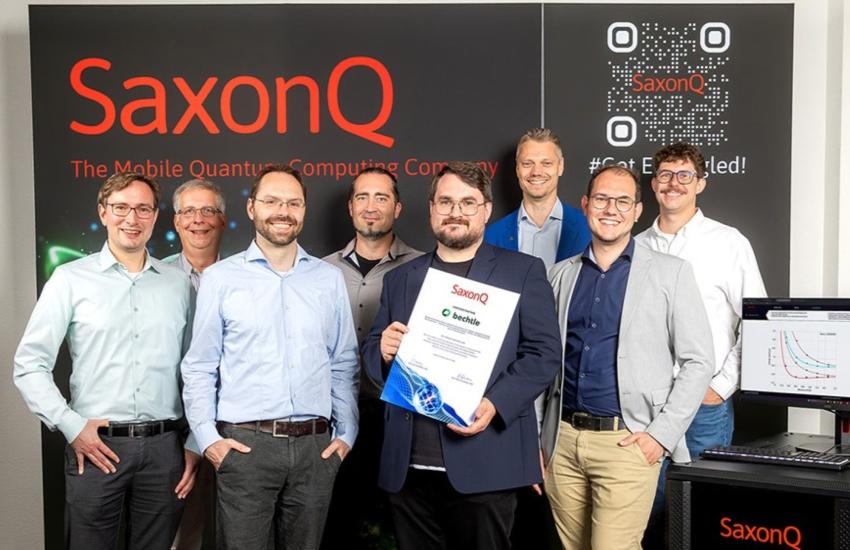
For Leipzig-based quantum computing company SaxonQ, having Bechtle as SaxonQ’s first certified partner signals an important start to the quantum ecosystem in Germany.
SaxonQ announced on July 21 the release of two new quantum computers, 128-qubit and 512-qubit, respectively, that are diamond-based nitrogen-vacancy units that operate at room temperature, have a 99.92% fidelity rate, are fully modular and upgradable, fit within a server rack, and plug into a standard outlet, the company stated.
“The mobile quantum computer moves even closer to users,” SaxonQ said in a statement. “The team from the Bechtle Competence Centre for Quantum Technologies in Bonn visited us in Leipzig and successfully completed certification for sales, integration, and operation. This is a real milestone for us and a genuinely strong partnership. Bechtle is Germany’s largest IT systems house, with locations in 14 European countries and technical support directly on-site at the customer. That is exactly what it takes to bring quantum computing into practice.”
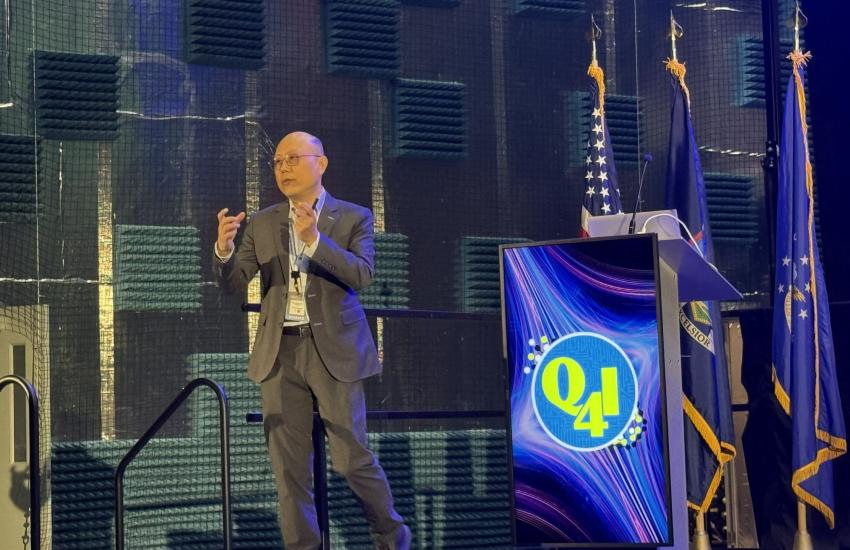
In Taiwan, the Hon Hai Research Institute’s Trapped Ion Laboratory is the country’s first private sector-funded quantum research and development facility, explained Ming-Shien Chang, associate research fellow, Institute of Atomic and Molecular Sciences, Academia Sinica in Taipei. Chang spoke June 24 at the Griffiss Institute’s annual Quantum for International (Q4I) workshop, held June 23-24 in Rome, New York.
Chang specializes in research of ultracold atomic physics, quantum simulation and quantum computing. He is currently exploring diamond-based nitrogen-vacancy centers for quantum sensing and quantum optics applications. Most recently, he partnered with the Hon Hai Research Institute to advance trapped-ion quantum computing technologies.
The idea for the Hon Hai Research Institute began in 2021 from Young Liu, the CEO and president of the Taiwanese multinational electronics contract manufacturer Foxconn, Chang shared. Foxconn makes Nokia devices, iPhones, MacBooks, Kindles, Nintendo, PlayStation devices and other consumer electronics.
“The new CEO at the time said, ‘I want a research institute,’ so he quickly picked four areas, artificial intelligence, semiconductor, low-Earth orbit satellites and cybersecurity,” Chang shared. “Then he said, ‘I want quantum,’ but the advisors said, ‘No, don’t do it. It is too difficult.’ One year later he came back and said, ‘Well, we are a hardware company. How can we not have [quantum] hardware?”
After that, the institute expanded into five research centers and added the trapped ion lab. By 2027, the institute aims to develop an open-access quantum computing system, Chang shared.
The general-purpose quantum computer will be based on an ion trap platform, and include quantum control, scalable quantum architectures and semiconductor chips that integrate micro ion traps and opto-electronic circuits.
“Our near-term goal is try to get a 5- to 10-quibit open-access quantum computer next year,” Chang noted. “Right now, we have a small team, and the testing of the quadratic fiber array coupling system is our first step. This year we still have to demonstrate some elementary quantum gates.”
Their first surface trap is designed to fit into a standard programmable gate array- (PGA-) compatible electrode layout, Chang continued. For this, they are turning to other companies—Kyocera, Sharp Electronics and Wave Photonics—as well as Taiwan’s Industrial Technology Research Institute.
“For the PGA, we actually asked Kyocera to make a ceramic PGA for us,” he said. “We asked the Industrial Technology Research Institute in Taiwan to integrate that for us. It is silicon-based, and then we also collaborated with Sharp, using a sapphire or glass-based solution. And besides that, we are also looking into the PIC, or the photonic integrated circuit, for ion traps, with Wave Photonics.”
Additionally, the institute’s trapped ion laboratory will work with another center, the institute’s Quantum Research Center, to advance quantum compilers and quantum applications.
“We are collaborating closely with Hon Hai’s Quantum Research Center to co-develop quantum compilers and quantum applications,” the laboratory said in an online statement. “Through interdisciplinary collaboration and the integration of diverse expertise, our ultimate goal is to build a quantum machine with unprecedented computational power.”
“Leveraging the Hon Hai group’s strengths in precision manufacturing, semiconductors and advanced packaging, we aim to accelerate the development of ion trap chips,” an institute statement indicated.
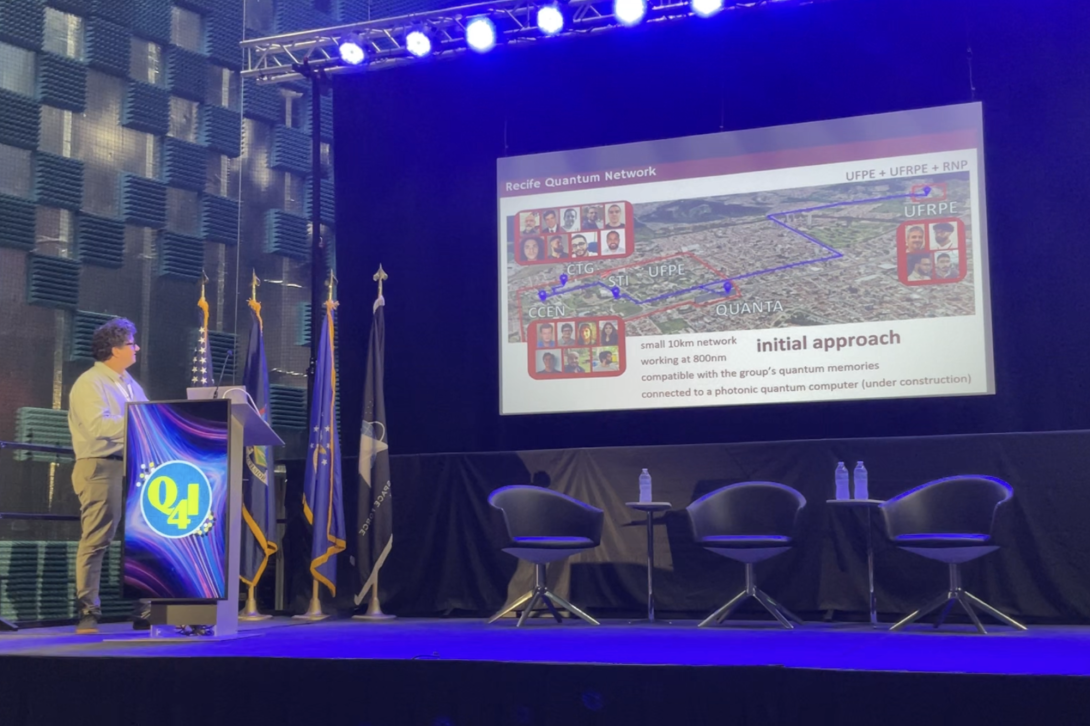
Meanwhile, in Brazil, researchers are setting up a National Quantum Network, explained Daniel Felinto, professor of physics at Brazil’s Universidade Federal de Pernambuco (UFPE), and co-founder of UFPE’s Quantum Networks Laboratory.
Felinto also spoke at the QI4 event in Rome on June 24. He began his career at the California Institute of Technology as a postdoctoral fellow in quantum networking in the early 2000s. Felinto is also the founder of the QWEB company that is providing compact quantum hardware for secure communication, computation and research applications. The company spun out from the Quantum Networks Laboratory at UFPE.
Over the last 20-plus years, quantum information science in Brazil has expanded, thanks in part to Felinto and other researchers, through the establishment of the National Institute of Quantum Information, which started in 2001. Their funding levels were small, but the institute’s leaders have built a large network of 120 researchers across the country and across various sectors, Felinto noted.
“In Brazil, our funding oscillates a lot,” he said. “But the recent funding of $12 million, that has allowed us to start to really develop a quantum network. It is interesting because this kind of funding is not coming only from government. We also have companies involved, including banks and oil companies. The demand is not only to develop the science. It is also largely a demand to do innovation and to develop technology.”
In turn, the institute is funding the Quantum Technologies Institute (Institute of Quanta), which has three branches, including the quantum communication branch that is focused on building Brazil’s National Quantum Network. It also includes the quantum computing branch that is setting up a photonic quantum processor in Recife, and a quantum sensing branch, which is working with various stakeholders.
“We have this new network of applied quantum computation,” he said. “And our community is now coordinated by the UFPE, and it involves more than 60 researchers throughout Brazil. We also recently added an effort for a quantum sensing branch to explore quantum lidar with some of the Brazilian oil companies.”
The National Quantum Network that is underway in Recife will initially span 10 kilometers, Felinto shared. The network will tie into the region’s existing fiber-optic network, which offers great expansion possibilities. Felinto and his team are working with a Brazilian organization that manages fiber-optic connections in cities, with the idea, once the network is operational, to connect to hospitals and various other institutions.
“We have this ring of fibers already installed for receiving, and this is 400 kilometers of fiber that we want to move to for this structure,” Felinto stated. “Our initial approach for this network is to actually work with a small quantum network at 800 nanometers, because we have a lot of equipment for 800 nanometers. We still have to buy more equipment for the telecom. The quantum network is also connected with the photonic quantum computer that we are building, and that is both the quantum memory and the photonic computer—they both are projected to work at 780 nanometers, so we are learning how to actually work with this network at this wavelength.”
They chose the modular photonic quantum computer approach, given their experience in quantum optics, Felinto continued.
“We will have some quantum light source that will be provided by us, and we would buy the other components, both the photonic circuit and the single-photon detectors, and so for this modular photon quantum computer, it can be the network itself,” Felinto said.
The group will continue with construction and equipment procurement of the network in Recife, with plans to expand in Rio de Janeiro, São Paulo and São Carlos.
“And we are now working together to develop a quantum network in the Amazon,” he stated.
The effort is being shared by researchers from the UFPE, the Universidade Federal Rural de Pernambuco, and the Rede Nacional de Ensino e Pesquisa, which is Brazil’s National Education and Research Network, a collaboration for education and research of 560 institutions. The group is also working with an integrated center for cybersecurity in advanced systems to make sure the network is secure and for post-quantum cryptography.
For Felinto, the value is seeing their work in quantum information science go beyond the network, physics and labs.
“What I like the most about these new movements is that now we are starting to build quantum networks in Brazil, and we are attracting the interest of other fields,” he emphasized. “We have physicists and chemists, of course, but we also have a lot of people from computer science, electronic and system engineers, and also production engineers, who are entering quantum computation through problems related to optimization for analysis of risk and reliability.”



Comments