
Foundational Quantum R&D Pushes the Envelope of Possibility

Part of the Air Force Research Laboratory (AFRL), the Information and Spectrum Warfare Directorate, in Rome, New York, is working to discover, develop and deliver quantum technologies across the research spectrum, explained Kathy-Anne Soderberg, acting chief technology officer and quantum technology lead. The effort also includes advancing enabling quantum technologies for timing, sensing, networking and computing; supply chain issues; and workforce development.
The AFRL has active research “in all of these areas,” Soderberg emphasized.
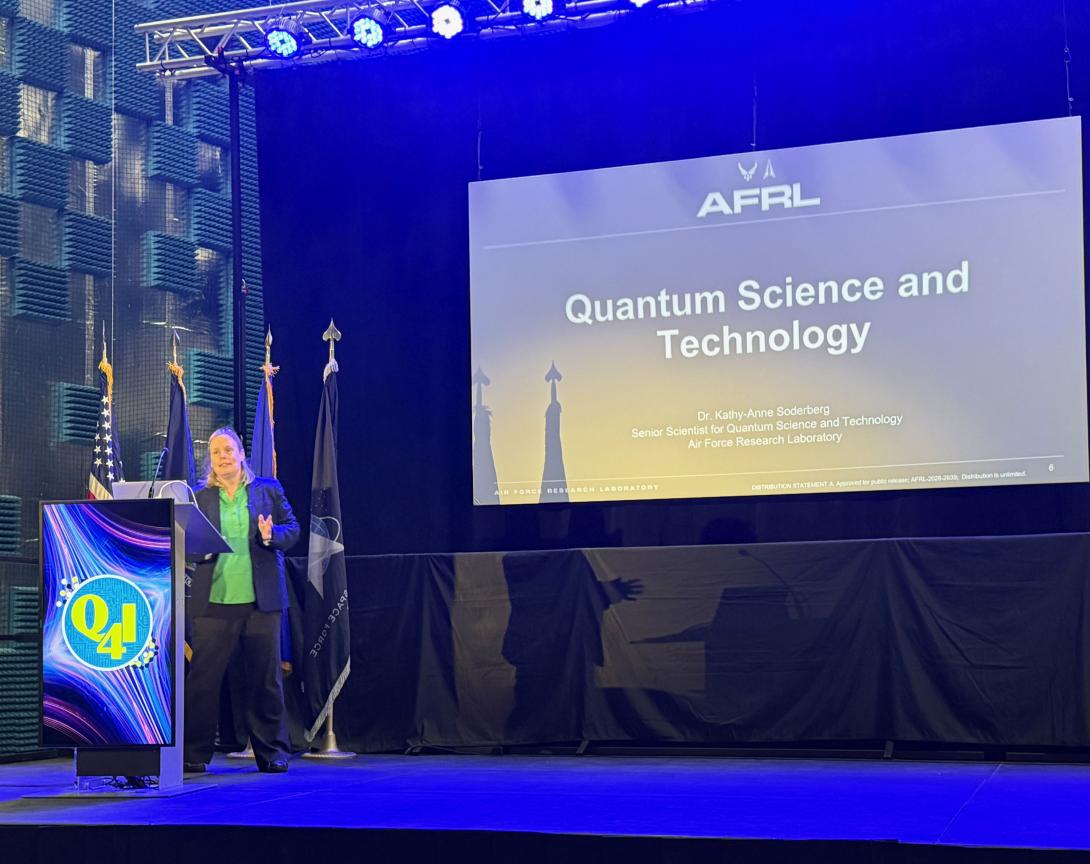
The lab’s quantum technology lead spoke at the directorate’s 6th Annual Quantum for International Workshop on June 25, 2026, in Rome. The annual event is presented by AFRL Rome and is hosted by the Griffiss Institute. The Griffiss Institute is a science, technology, engineering and mathematics talent and technology accelerator located next door to the AFRL facility.
The AFRL has already seen significant advancements in integrated photonics, sensors and atomic clocks, thanks to its foundational quantum research and development (R&D) over many years, she noted. And despite a recent Department of Government Efficiency-mandated reorganization, the lab is continuing to make significant strides in quantum.
“Timing and sensing are much more mature quantum technologies,” Soderberg said. “They do not necessarily need this thing called entanglement to operate. They only rely on quantum superposition for most of what they do, and so in some sense they are easier. I would not say they are easy, but they are easier than some of the things we are trying to do on the network in quantum computing.”
For timing, their work includes advancing the understanding of cold atoms, applying that to cold-atom optical atomic clocks, then advancing low size, weight and power for such clocks. The lab has a goal of delivering portable atomic clocks in the near future.
“Right now, we are looking at portable atomic clocks, where we can hopefully replace all of the optical components with integrated photonic circuits to have something that is truly handheld and more portable,” Soderberg said.
Quantum-related sensing technologies are about two to five years out, depending on the type of sensor.
“Under the sensing category, there are actually about 10 different quantum sensors you could talk about that all do different things,” Soderberg said. “The team is focusing on alternative position, navigation and timing for resilient navigation. That is a big theme within the Department of Air Force ... to navigate in denied or degraded environments where you may not have access to GPS.”
The lab has a unique relationship with the institute, with lab personnel working side by side with researchers at Griffiss’ facilities, “outside the fence” of the AFRL’s classified and secure buildings. For Heather Hage, the CEO and president of Griffiss, it is the close relationship that the institute has with the AFRL that brings effective results, while growing a talent ecosystem. .
The arrangement supports the AFRL’s role of exploring the art of the possible and proactively anticipating future quantum needs, Soderberg continued. Today, it is being applied to work in quantum applications for use on drones.
If it sounds futuristic for a quantum computer to be mobile and small enough to fit on a flying drone, the scientists at the AFRL and Griffiss are working every day to answer the foundational considerations to make that a reality. One capability that is making that possible stems from the AFRL’s work in integrated photonics, particularly entangled photon source development, that has led to successful wafer manufacturing—of a fist-sized chip based on entangled photonic technology—with the American Institute of Manufacturing (AIM) Photonics in Albany, New York.
The resulting Quantum FLEX Process Design Kit from AIM provides an accessible foundry process to accelerate quantum system manufacturing.
“Our team has worked over the last 10 years or so to go from tabletop to miniaturized systems, then to integrated photonics when they became available,” Soderberg explained. “Then they took the integrative photonics and showed that we could package them and put them out in the field, and the systems would survive and work. Since 2020, we’ve had a fully packaged photonic integrated circuit-based entangled photon source. We are working toward a chip-based design to make them even smaller.”
The AFRL has reduced the costs of the photonic chip by about 50 times, the footprint by 40 times and the weight by about 20 times, which is important for drone applications, Soderberg shared.
“Our goal is to get some of this up on a drone, at an unmanned aerial system-compatible weight, which is quite light for a scientific system,” she acknowledged. “Since we have transitioned all this to a commercial foundry, AIM Photonics, we are now starting to field them in the quantum networks that we have both here and with some of our partners.”
Longer-term efforts at the AFRL include quantum computing and networking. This does not mean trying to build a quantum computer. Instead, the AFRL will turn to industry advancements in that area.
“But what we do need is a team that understands how to use these devices, and so, we have an algorithm team that is looking into potential use cases for the Department of Air Force,” Soderberg stated. “Once there is a quantum computer that is big enough to be able to solve an Air Force-scale problem and one becomes available, we will be ready to use it. That timescale is 10 to 20 plus years out, likely.”
Quantum networking is the most nascent area of the AFRL’s research, and that is because of the difficulty in distributing across any geographic area with quantum entanglement. The AFRL’s primary focus is on resilient quantum networks and ultrasound communication, with a timeframe of about five to 10 or more years.
“For most of the quantum computing work to date, all the entanglement has been held in one housing, if you will,” Soderberg clarified. “But now, if you want to spread it out between different housings, or you want to do something different, like have an actual network that connects something like a clock or a sensor with distributed entanglement, it is quite a bit more challenging to send it places and hold it there.”
Moreover, the AFRL’s quantum researchers are also interested in all the intersections of quantum and other capabilities.
“If you combine timing and sensing, you can get toward things like self-sustained PNT [position, navigation and timing] and networking may give you unique ways to do higher precision time transfer,” Soderberg said. “And then sensing and computing. If you can attach a sensory capability to the computer, there are different ways that you can do sense-making.”
Comments