
The U.S. Military’s Achilles’ Heel: Acquisition
The manner in which the government procures services, weapons, systems and software is still a problem that is preventing the military from being ready in near-peer environments.
Erratic funding cycles, irrelevant policies, outdated program of record processes and cultural gaps are limiting technological innovation and warfighting readiness.
First, funding issues are impeding effective procurement cycles, says Tammy Griffith, deputy director, Business Management and Acquisition and senior acquisition executive, National Security Agency (NSA).
The lack of an annually passed budget from Congress greatly impacts the military and intelligence community agencies’ ability to procure what is needed.
And for the first time, this has impacted cash flow and the ability to pay the contractor bills, Griffith noted. The NSA has even had to change when they schedule contract renewals when designing solicitations and contract language, to make sure they could pay the outlays.
“With the way the government funds us on especially October 1, if we are under continuing resolution, and we’ve got a lot of software products, I have a cash flow problem,” she said. “I have spent a lot of time my entire career in the government. I've never said I had a cash flow problem, which is generally not something that the government talks about. But what we are actually doing now is saying, ‘OK, if we are going to go commercial this way, we are actually going to need to award that in January because that is when we'll probably have the full budget available, so that we can actually pay the full bill.’ Versus if I award it in October, I can only give you 65 days' worth of funding, and that doesn't work.”
Griffith also has to hold the line when end users want to procure advanced commercial software or products but immediately want the product to be modified for outdated processes. “Our internal flaw is we do not like to change our processes,” she explained.
As a solution, their NSA acquisition community is putting a lot of effort into getting customers to accept upfront what changes will be needed with new technologies and make a plan for that.
“They have got to be willing to change their own processes to conform to the products,” Griffith stressed. “I cannot take new technology and put some antiquated process in it. It just does not work. We’ve even seen it in our user acceptance testings. We put products out there, and it’s like, ‘Well, it doesn’t work with what my job is.’ Your job needs to evolve, and that is the problem, not the product. You are not procuring new software if you are not willing to change your process. Otherwise, you are wasting all of our time. So, we are putting that up front into the planning so that we can leverage the best of the technology that is out there today, as it was designed to operate.”

I have spent a lot of time my entire career in the government. I've never said I had a cash flow problem, which is generally not something that the government talks about.
And as a technology-heavy agency, the NSA has “an insurmountable amount” of technology debt, Griffith acknowledged. This is an issue they are tackling head-on in solicitations, making sure sustainment and infrastructure renewal is included—which is best addressed through service contracts.
“If you have watched the NSA, we have fully embraced going into services,” she shared. “We got out of owning our own data centers. And we are really moving into that whole ‘buy- it-as-a-service’ because part one of that is acknowledging you can never stay relevant with the government fiscal cycles we have.”
Griffith also holds firm on those who say they cannot afford sustainment. “A program cannot come to us and say, ‘Well, I just don’t have enough money, so I can’t do the tech refresh,’” she clarified. “That is not a conversation that can be had in our agency anyway. So, partnering with our CIO [chief information officer] and all we have put out, we say it is not negotiable. You can’t build it if you can’t sustain it, so building that process in is going to be key for us.”
At the Central Intelligence Agency (CIA), the director is emphasizing American ingenuity, reported Efstathia Fragogiannis, the CIA’s chief procurement officer. And the agency has been able to reduce the time it takes for acquisition.
“It has been difficult at times, to say the least, to work with the agency,” she said. “We have a lot of security requirements for a reason, of course, for protecting information. But we do recognize that some of our acquisition timelines have not been the greatest. So, we have made really a concerted effort to go through a significant amount of acquisition information and really reduce our average acquisition timelines to about six months. About a year and a half ago, it could have taken about two to three years with onboarding technology.”
The key was eliminating bureaucratic reviews and streamlining acquisition-related decision-making. “About 90% of our acquisitions no longer require those burdensome bureaucratic reviews,” she noted.
Ret. Maj. Gen. Charlie Cleveland, USA, senior counselor, Palantir Technologies, is seeing how parts of the military are shifting away from the outdated requirements process, with the addition of “characteristics of need” instead.
“It really is in the evolution of requirements,” Cleveland said. “Anybody who’s been in the government has seen, it is commonplace to have a 30-page statement of work and 175 requirements,” he recalled. “And you have to have this button turning red and that button turning green. As we collectively move forward, this broader idea of having a more umbrella capability—I know the Army’s referring to it as a characteristics of need—is an outcome-based direction. I think it is something we can all work with.”
As we shift to commercial-first thinking, our role in COMSO is to help our executives and our program offices think more opportunistically, less about the prescriptive requirements and more about what is the end state, the capability need at the end of the day.
The Space Force and the Air Force are heading in that direction, with acquiring capabilities for mission sets, said Col. Timothy Trimailo, USAF, director, Commercial Space Office (COMSO), Space Systems Command.
“As we shift to commercial-first thinking, our role in COMSO is to help our executives and our program offices think more opportunistically, less about the prescriptive requirements and more about what is the end state, the capability need at the end of the day,” the colonel explained. “It takes us changing our processes from the start to identify what the end user needs and what that minimum viable product truly is and then translating that into something that looks kind of like a requirement, the capabilities that you need.”
This approach is not yet widespread, though, Trimailo said.
As an industry contractor, Tara Murphy Dougherty, CEO of Air—an enterprise readiness company—has experienced two types of barriers to acquisition at mission speed, starting with outdated policies.
“We run into a lot of the same old barriers that we have faced for a really long time,” she said. “We have a backlog, what we actually call internally ‘a waiting list’ of people in offices, primarily program managers in the Air Force, for example, where the demand is very significant for access to our platform. Most program offices in the Air Force actually cannot buy software with sustainment funding. It’s a policy issue. But it turns out that sustaining America’s aviation fleet also would benefit from commercial software.”
“Another example of a barrier that we saw active and massively in action this year was in munitions production,” Dougherty continued. “This is an ongoing challenge, of course, but in this case, one aspect of this issue is the unbelievably high amount of manual effort and tedious manual work that is performed in the intersection of the program office working with primes and their suppliers in order to get these capabilities fielded. It is unbelievable how much paperwork is still done in 2026 on a critical national security program.”
Here, AI can help automate acquisition processes, she said.
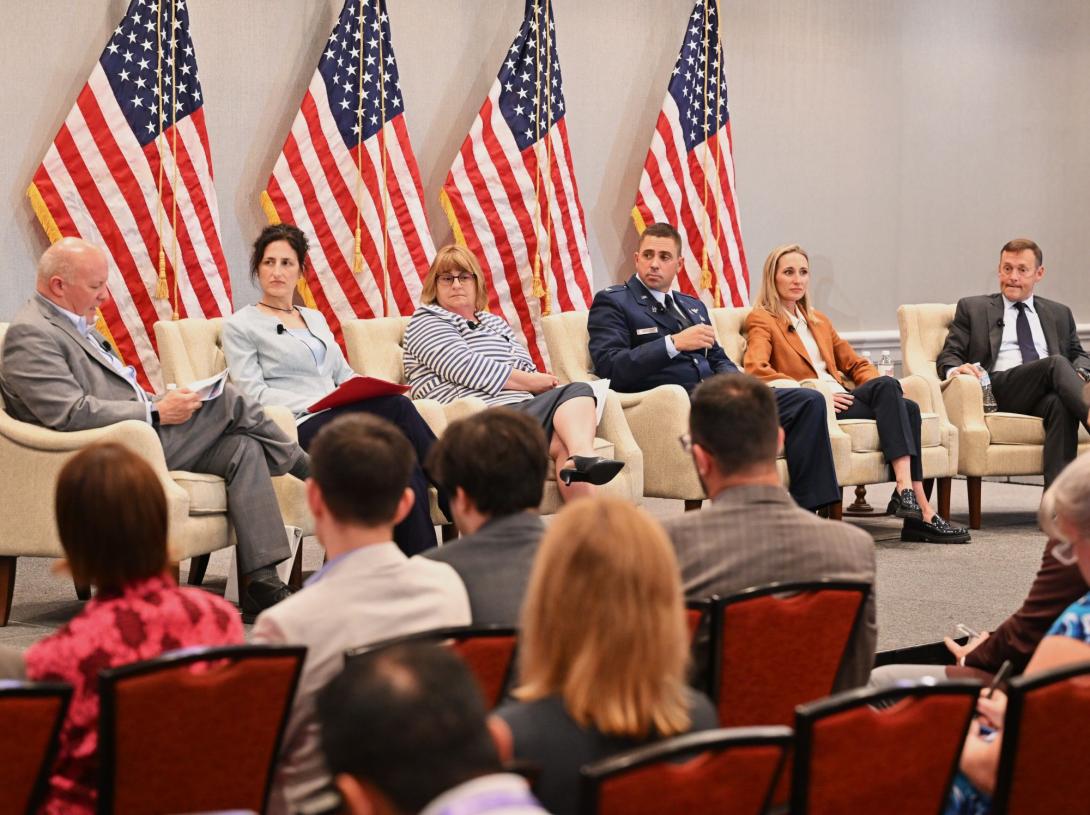
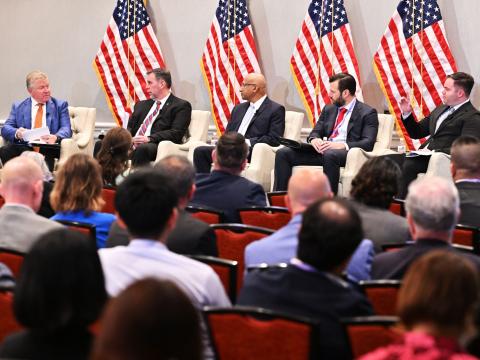
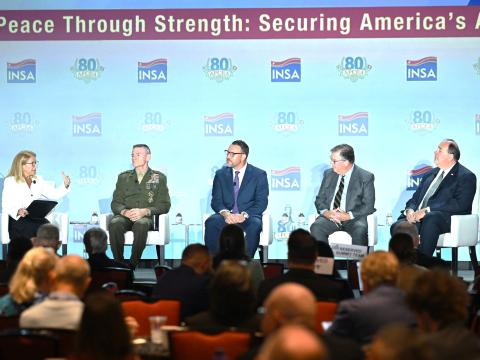
The acquisition experts spoke August 27 on a panel, with Ron Carback, vice president and client executive at CACI, moderating, at the 2026 Intelligence & National Security Summit.
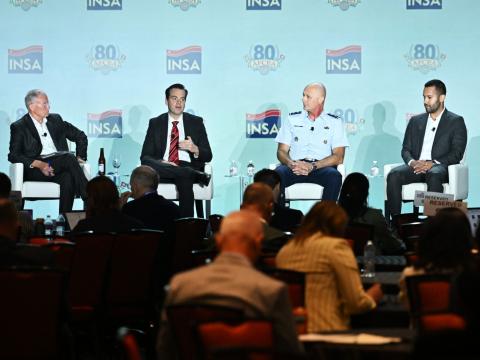
The 2026 Intelligence & National Security Summit is co-hosted by AFCEA International and INSA. SIGNAL Media is the official media of AFCEA International.

Comments