
Countering Small Drones
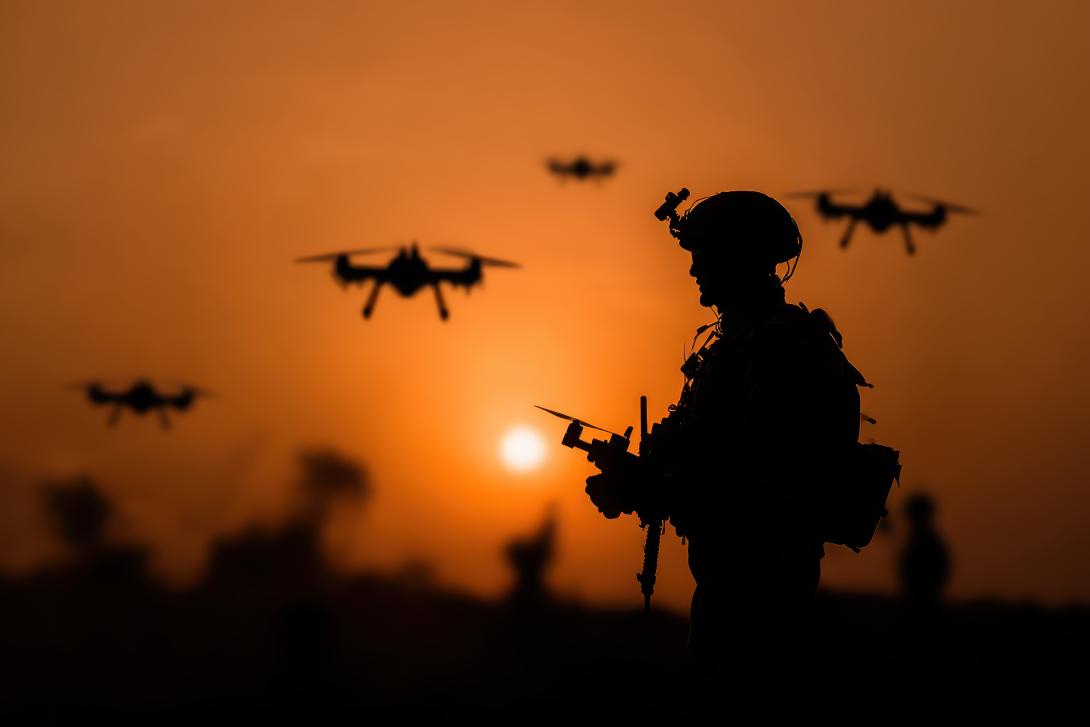
The pace of change in unmanned aerial system (UAS) capabilities is so rapid that new technologies are coming in weeks and months, drone experts say. This rapid innovation also brings great risks from adversaries potentially using UAS against the United States and its allies in nefarious ways.
Small UAS are generally classified as under 50 pounds and less than 6-7 feet long. Given their size and flight speed, detection and mitigation operations are difficult, requiring various sensors.
Luckily, for countering small drones, the solution sets are growing, across an ecosystem of capabilities, experts say. What may not yet be available may come soon, given sensor and subsystem advancements.
Small UAS can be disabled through several means: radio frequency, radar, optical solutions and acoustics, said Col. Bill Edwards, USA (Ret.), on December 3 in Frankfurt, Germany, at AFCEA International’s TechNet Transatlantic conference, during a panel with UAS industry representatives.
“This ecosystem is very complex, and it may be even chaotic,” Edwards said. “But really, when you simplify it down to the ways to detect a drone, those are typically the four ways. [And with] a layered sensor package, we are talking about using all of those sensors to try to get a really good, accurate picture of where that drone is in airspace. Because, these drones, they fly fast, they are small, they are agile, they carry payloads, and some of these payloads are, of course, ordinance or bombs or some type of explosive.”
What’s needed at this point from industry are payload identification technologies, said David Sonntag, senior director of business development at Walaris GmbH.
Acoustically, some drones may sound different because of their weight—heavier UAS carrying bombs may be louder—but there are not too many available solutions yet to determine if the payload is an ordinance.
“There are ways to do it, but it is definitely something that's not there yet,” Sonntag said. “I don't know any company who has great solutions for payload detection right now. It is really something we have to work on, and we are working on it. And if such an update is then ready, of course it has to be deployed to the customer very quickly.”
Here, the military needs to even be able to update its existing UAS capabilities when new breakthroughs happen. For some companies, software updates and solutions run on edge computing and can be available out in the field, usually through a lightweight docket container of sorts that also allows for quick testing.
“The biggest challenge here is that the speed of technology is not the same speed of military bureaucracy,” Sonntag acknowledged. “It is one thing to provide an update. It's another thing if it gets an operational approval to be deployed. This is very frustrating. When we have updates, crucial updates, the customers won't deploy them. They have to test and certify an update, and that takes time. Sometimes they are happy that they have a system at all that is running and working, so they don't want to open the system up at all. So, some updates just don't get into the field, and this definitely has to change.”

This ecosystem is very complex, and it may be even chaotic.
In addition, swarms of UAS are considered a great risk, although in Ukraine, even with the advent of drone warfare, swarms have not yet been seen.
“At least in my experience, we have not seen a swarm in Ukraine,” Edwards noted. “We have seen mass distribution. Mass distribution means there are a lot of drones in the air at one time but not centrally commanded and controlled.”
To combat swarms, Sonntag said, a multitude of orchestrated sensors are needed, especially if several subgroups of swarms peel off to attack in different ways.
“If the swarm then splits up, which part of the swarm is the one we should follow with which sensors?” he asked. “Probably we need not one sensor mix, but multiple sensors, distributed sensors. And we have to orchestrate or coordinate which kind of sensor follows which kind of object.”
Sonntag reasoned that operators have to first determine which part of a swarm poses the biggest threat. Here, classification of the roles the drones are playing is necessary.
“Because, there are attack drones, there are surveillance drones, there are dumb drones, there are probably multiple different kinds of drones within one swarm, and it is not easy to determine or do a threat assessment, so we need to develop new technologies like payload detection or analytics,” he stated.
TechNet Transatlantic is organized by AFCEA International in conjunction with the AFCEA Europe office. SIGNAL Media is the official media of AFCEA International.





Comments