
For Digital Transformation, the Military Needs To Decrease Complexity
Communication and information technology (IT) military leaders positioned in the U.S. European Command and U.S. Africa Command areas of responsibility must contend with differing levels of technological capabilities, with interoperability depending on partner nations' capabilities, leaders say.
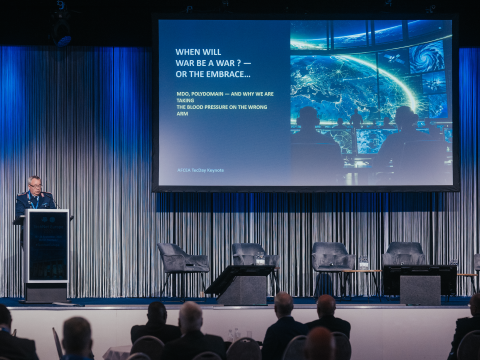
Known by their job category as “6s,” several high-level leaders spoke at AFCEA International’s TechNet Transatlantic conference on December 3. The conference, hosted by AFCEA Europe and the AFCEA Stuttgart, Kaiserslautern and Wiesbaden chapters, is being held December 3-4 at Kap Europa in Frankfurt, Germany.
Addressing industry, the 6s relayed a need for improved command and control (C2) technologies, and interoperability—or at least technologies that are integrable.
From a joint level, with 53 African nations, Col. Joseph Gardner, USA, the J6 and chief information officer at U.S. Africa Command, emphasized that interoperability must be flexible and scalable, as each partner nation has different requirements and standards.
“From a national perspective, each one of us has different laws and regulations that we must adhere to because of our association with our governments,” Gardner explained. “We must take those things into consideration when we build out our environments.”
At U.S. Africa Command, Gardner is working on tailored environments, a data exchange framework and access controls.
“Those are our three pillars we look at while building out an environment that supports not only our African partners who sit at an information technology level one, but also as we scale up and we interoperate with our European partners that are at a different information technology level and an interoperable level of about a five,” the colonel said.
And while common data standards are important, the J6 works its connection to an African partner in a way that allows the command to inaugurate at their level. This means taking into consideration that nation’s skill sets and network environments.
“We must consider the technology level of each partner as we develop our standards and our frameworks for interoperability,” he noted.
Col. Ed Kendall, USAFR, G6, U.S. Army in Europe, noted that many leaders in Europe have multiple roles—up to six or seven—with responsibilities to NATO’s land component or to U.S. European command, for example.
That makes an inherent level of complexity across relationships, networks and data-sharing, Kendall said.
“Interoperability, being a focus, is all about the fact [that] there are things that are different,” Kendall said. “And if we look at decreasing complexity for us, what is really adding a lot to that challenge is because of the multiple roles that we have in U.S. Army, Europe and Africa. In peacetime and wartime, there are different roles, different aspects, different policies we go by that led to that complexity of interoperability.”
To improve operability, Kendall said, it is all about establishing core mission command capabilities that allow us to leverage live data at speed and scale.”
U.S. Army in Europe is relying on the Maven Smart System, including as a data aggregator.
“We can bring data in across multiple domains to then make decisions and bring that capability to our staff, he shared. “The key to that is, how do you pair these different instances together so you can have that common flow of data standards, and you can leverage all the execution that each one is doing.”
With that, every organization does not have to create all the workflows and processes. Instead, they can leverage each other’s solutions.
“And if you have access to that common data backbone, you can scale exponentially,” he said.
James Austin, USAF, the deputy J6 at U.S. European Command, warned that implementing artificial intelligence (AI) into military operations must be done with care—such as with targeting operations.
It puts pressure on U.S. military and NATO intelligence to be correct. And while it is great that AI can handle weeks’ worth of work in minutes, a human still has to look at the data and make sense of it, to verify that it is accurate, Austin emphasized.
“I think in the next couple of years, that is where artificial intelligence and machine learning is going, in the NATO fleet and the technology from both U.S. European Command and Africa Command,” he noted. “But the human always has to be sitting there thinking, is that data right? [This is] especially true if I am going to make a target, if I am going to strike somebody. And let's be honest, we are talking about 21-year-old kids that are probably on the frontline. They have got to understand their left or right limits.”
Austin also shared that the U.S. European Command has held several successful hackathons, and that kind of forum should be leveraged to view different vendor solutions.
“With a hackathon, I am assuming a certain amount of risk as the authorizing official,” he said. “It is a controlled test environment with some test data. And if it is successful there, I'll bring it in. From my perspective, a hackathon would be the easiest way . . . to try and bring it on to our side, test it and go.
And even though the NATO body is a complex organization, officials are making progress in digital standards, Austin noted.
“NATO is like 32 family members going to dinner, and it is, ‘what do you want to eat?’” he said. “That is where we are. We are getting standardization, kind of going back to the future, where we were with our standards in the 80s and the 90s, with ‘Alpha, Bravo, Charlie.’”
Notably, U.S. Marine Corps Force in Europe and Africa (MARFOREUR/AF) has the smallest footprint in NATO, with no assigned forces, meaning Marines must come in from the continental United States when needed, explained Lt. Col. Zachary Cesarz, USMC, assistant chief of staff, G-6, MARFOREUR/AF.
“We do not have allocated forces in theater, and so we are caught between a rock and a hard place by supporting the folks to my left and folks to my right,” Cesarz said, speaking of the Marine Corps’ support of the joint forces. “For us at least, that creates a certain challenge in trying to keep up [with digital transformation].”
From the outset, though, MARFOREUR/AF has to be an integrating force, with capabilities and information technologies that provide an immediate ability to communicate C2 and share data across services and partner nations.
“Because we are limited in capacity, we have to focus on making sure we can talk to the folks left and right of us,” he noted.
Moreover, as the Marines are “very focused” on the warfighting aspect, they need proper military IT and communications technologies, Cesarz told industry.
“MARFOREUR/AF sits at that C2 operational level . . . and we are always focused down to the lowest tactical level,” he said. “There is an opportunity for industry here. Instead of focusing on the business side of things, the business process, the business applications, we are looking for you to focus on C2 systems and the interoperability of those. We are able to integrate, but I need your help to enable that C2-system traffic to flow across partners and mission sets.”
In addition, any offered technological solution from industry must improve operations, and not just be a shiny, new technology, Cesarz emphasized.
“We absolutely need to incorporate digital transformation as much as possible,” he stated. “But if it is taking away from the basic blocking and tackling that we are all charged with doing, actually putting warheads on foreheads, we have got to do that basic blocking and tackling. If we are chasing the next ‘whiz-bang thing’ that only solves one micro problem set, it does not really help the greater good, the greater problem sets.”
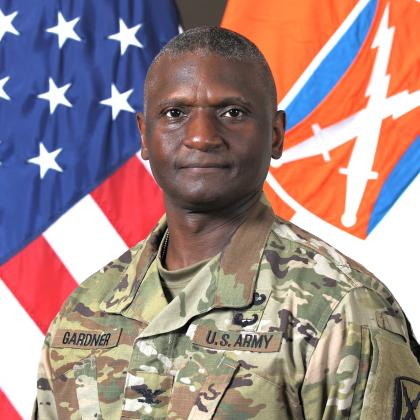
We must consider the technology level of each partner as we develop our standards and our frameworks for interoperability.
Meanwhile, at DISA Europe, Rodolfo "Raven" Fuentes, the technical director, sees the global reach of the combat support agency. And so, while their focus at DISA Europe is on the European continent, they must implement things from a global perspective, for solutions that work in any combatant command.
“General [Paul] Stanton has his foot on the gas, and he is pressuring us to ensure that we provide the data that is needed now, when it is needed, in a timely manner,” Fuentes said. “And we cannot do that unless it is capable of being integrated and interoperable.”
Over the last year, the agency has also worked to standardize architecture for command and control products needed across the military and for work with NATO partners.
“We are specifically also looking at how we bring in those different levels of countries that don't necessarily have the same standards as us,” Fuentes noted. “It is important for us to consider everything and everybody as we're developing how we integrate them into these different levels. We have broken it out by trust, so a person that is at a lower trust level will still be integrated and receive all that data and those systems and services that they need to operate and share information at their level.”
In addition, solutions are needed at the tactical level, not only to place cloud computing capabilities and C2 products with forward-deployed units, but also providing reach back, even if it is just to centralized locations within the European theater.
“It does not necessarily have to go all the way back to CONUS [the continental United States],” he noted. “Those are the type of things that we're developing now.”
DISA Europe continues to examine identity, credentialling and access management, or ICAM, especially for operations in contested environments, Fuentes continued.
“I have great technical directors, and we have had some conversations about how we are going to utilize enterprise ICAM or other capabilities out there at the forward edge,” he said.
A key enabler for everything is the transport layer—an important factor, especially outside of CONUS—and the agency continually addresses its resiliency.
“Most importantly, I would say that we are also looking at the overall transport resiliency and being extremely transport agnostic,” Fuentes explained. “We need to work with our commercial satellite communicators as well as many of the other big corporations, data centers, et cetera, that potentially could provide us a better resiliency plan and program to support the warfighter in the future.”
Fuentes emphasized that twice a week, the Defense Information Systems Agency (DISA) hosts a commercial forum—technical exchange meetings—to hear about technologies and solutions.
“Over 100 people around the globe will see your product, and, if applicable, will be able to say, ‘yes, potentially I can use it in my region,’ or ‘yes, my combat command or my service components need this type of service,’” he said.
Any solution would need to scale for department use and, of course, be effective for warfighters and cyber-resilient.
Lastly, Gardner added that while U.S. Africa Command headquarters might not be using certain solutions, their partners “may love” the technology. He urged companies to still reach out.
TechNet Transatlantic is organized by AFCEA International in conjunction with the AFCEA Europe office. SIGNAL Media is the official media of AFCEA International.
Comments