
Finland Reaches Milestone With NATO

Today was a busy day at the U.S. European Command’s headquarters, as officials met with leaders from Finland, given the country’s completion of its Command and Control Interoperability Board (CCIB) obligations, reported Maj. Gen. John Phillips, USAR, director, J-6, Cyber/C4, U.S. European Command (EUCOM). Phillips’ boss is Gen. Alexus Grynkewich, USAF, the supreme allied commander Europe (SACEUR) and the commander of EUCOM, who stepped into those roles in July.
“It was a phenomenal day in Stuttgart, Germany,” Phillips said. “It was a great close-out session with a great, capable partner.”
Almost a quarter of a century ago, Finland first signed the CCIB agreement with the United States to provide command and control (C2) compatibility between the two nations' military C2 systems. For years, the nations also met at EUCOM to conduct an annual cooperation forum, which, in recent years, involved about 50-60 people.
Finland agreed in April 2023 to join the NATO alliance, followed shortly after by Sweden in March 2024, given Russia’s second invasion of Ukraine in February 2022. And with Finland's ascent to being the 31st member nation of NATO, Finland’s CCIB items were no longer necessary, as NATO is now providing communications security, or COMSEC, Phillips explained. Nonetheless, Finland wanted to complete the measures, Phillips noted.
“Today, we concluded a 24-year CCIB, Command and Control Interoperability Board program,” he stated. “For 24 years, we were able to share COMSEC intelligence techniques and procedures, to be able to provide that integration, so when they did join exercises, not as a NATO member, they could communicate. Technically, we were supposed to stop that CCIB process the day they assessed, because at that point, they draw NATO COMSEC, but Finland wanted to continue it until they completed every box on that checklist. That is the great partner we have here.”
Additionally, Finland is purchasing 64 U.S. F-35 Lightning IIs over the next four years. Finland’s border with Russia extends 1,340 kilometers, which is now the outer edge of NATO’s border, so that increase in air power is indeed welcome.
The J-6 sees the 77-year-old alliance as a stark contrast to the NATO that he saw when he was on the continent in the 1990s. “Europe is not the Europe that we served in when we were captains,” Phillips explained. “In 1997, Captain Phillips, company commander in Bosnia, [was] doing platoon PT [physical training], with a Russian parachute company [that was] serving together with us in Bosnia. They were part of the peace enforcement.”
Several of the 16 newest members of NATO were former Soviet Socialist Republics, and four members were former republics of Yugoslavia. “Poland, Bulgaria, Romania, Albania and Hungary, all members of the Warsaw Pact, and those countries show a complete resistance to Russian power,” he noted.
Moreover, the United States’ role in the alliance is shifting. EUCOM’s main role is to position the NATO alliance to defer, deter and defend.
“And it is kind of a different approach than we've ever done in the past,” he said.
The command also projects combat power, such as supporting recent strikes in the Middle East, that could not have happened without EUCOM and refuelers and fighter escort aircraft out of Ramstein, Germany.
In addition, EUCOM protects the homeland from nefarious actors.
“You are thinking, ‘you’re in Europe. How do you protect the homeland?’” said Phillips. “Air and missile defense radars, protecting the SOSUS line [the Sound Surveillance System], protecting Russian subs from coming into the open Atlantic. That's how we protect the homeland, stopping Chinese influence in the European theater and Russian influence inside the European theater.”
However, American officials want NATO countries to carry more of the burden. Newer members of NATO understand this, Phillips continued.
“Of the 32 NATO countries, 25 countries contribute above 2% of their GDP [gross domestic product] to defense,” Phillips stated. “Who are the other seven? I won't call them out and embarrass them by name, but five of those seven were the original 12 founding members of NATO. It is the new members of NATO that understand the threat. They're closer to it. They have been part of that [kind of] regime.”
And there are three NATO countries contributing more of their GDP to defense than the United States, with respect to European security, the J-6 said.
He shared that “there are concerns” across Europe about the United States and its commitment inside NATO, but he said that America, for now, was making its way.
“Just as I think our own government sometimes is confusing, for lack of a better term, France has had 17 prime ministers in five years,” Phillips acknowledged. “There is no perfect democracy out there, but that is the joy and the beauty of democracy. It is about the people and relationships and what we are doing on a daily basis. [It is] the partnerships, the training exercises and the shared capability.”
The J-6 himself has visited Mons, Belgium—the headquarters of SACEUR—five times since September, and two of those visits were during the U.S. government shutdown when officials were prohibited from traveling.
“It was important to be there,” he stated. “And back on November 28, 2024, we had an operational planning group. That’s Thanksgiving Day. It is probably the greatest American holiday we have. But that is only a holiday in the United States. We were there because it was the right place to be at the right time for the right mission.”
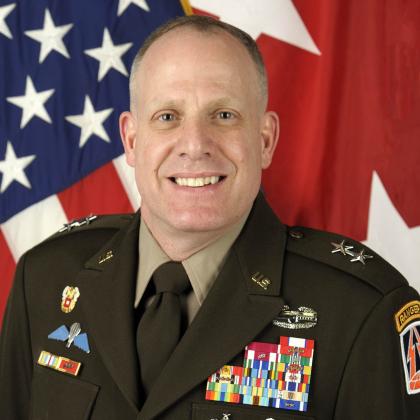
There is no perfect democracy out there, but that is the joy and the beauty of democracy. It is about the people and relationships and what we are doing on a daily basis.
Even countries outside of NATO are taking new stances. Switzerland, for example, has entered into a state partnership program with the U.S. National Guard.
“Switzerland now has a state partnership program with the National Guard, and if you would have told me that 30 years ago, I would have said, I don't know what you bought down by the Frankfurt train station, but you are smoking something good,” Phillips laughed. “Switzerland having a state partnership program—it is a country that is essentially neutral but understands military partnerships for capacity building.”
He noted that other NATO members, prior to joining the alliance, entered into such partnerships with American states. “Poland, Bulgaria, Romania, all those state partnership programs existed prior to accessing into NATO,” he shared.
Lately, NATO’s Maven Smart System (MSS) has received a lot of attention. The MSS, which is reaching operating capability in less than a year, is an advanced targeting and logistics tool based in artificial intelligence (AI).
For the J-6, however, Maven is just one tool in NATO’s important foundation.
“Obviously, the technology is there and everybody wants to rush,” Phillips shared. “I get asked more often, ‘How are we enabling Maven?’ Maven is the very top of Maslow's hierarchy of needs. It is the apex, and we often forget about that foundational layer that enables things like Maven Smart Systems to provide a common operating picture to the alliance.”
Phillips was critical of MAVEN’s setup, which requires data to be moved from Ohio to the U.S. European Command and data processing in Pennsylvania.
“There's a lot of bad policy in NATO; there's a lot of bad policy in the United States,” he said. “As we look at Maven, the Maven compute capability for EUCOM is in Ohio. The data is stored in Mechanicsville, Pennsylvania, so we have to log into a Maven terminal here that goes all the way to Ohio, and the data has to go to Pennsylvania, back to Ohio for compute, then provide that capability back to EUCOM in Stuttgart, Germany. We cannot accept the architecture that we've been given.”
Lastly, the J-6, who is retiring from the military in six months, noted that he was thankful to have served on the continent across the decades and is optimistic about NATO’s future.
“With respect to European security, NATO’s future is strong,” Phillips said.
TechNet Transatlantic is organized by AFCEA International in conjunction with the AFCEA Europe office. SIGNAL Media is the official media of AFCEA International.
Comments