
A Retooling in the Western Pacific
For the U.S. military to succeed against near-peer adversaries in the Indo-Pacific, the U.S. Marine Corps (USMC), the nation’s first-to-get-there, stand-in forces are advancing maneuverability, “inside force” postures, and relationships with allies and partners, including Japan and the Philippines.
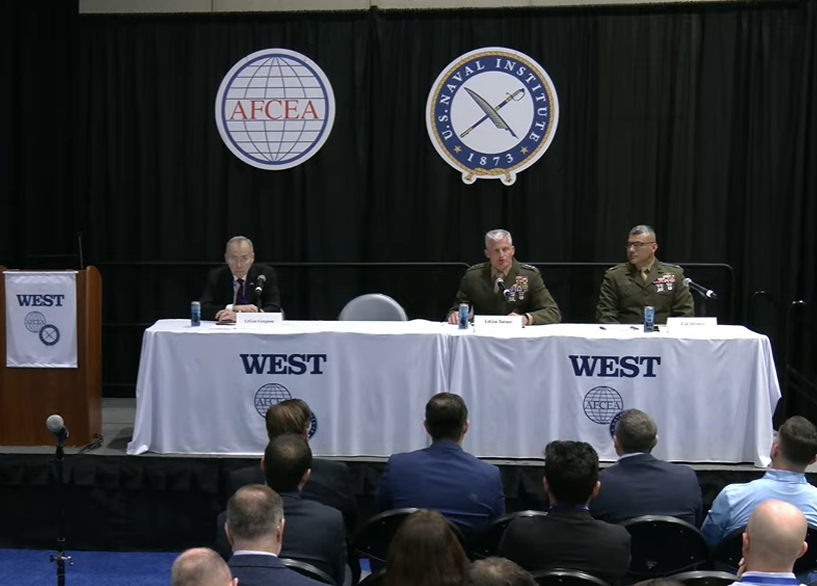
“The basing issue is not about ‘heads and beds,’” noted Lt. Gen. Wallace Gregson, USMC (Ret.), former commander, U.S. Marine Corps Forces Pacific, and commanding general, Fleet Marine Forces Pacific.
“It is about widely-distributed operational maneuvers throughout the first island chain and beyond, setting conditions in the theater, strengthening deterrence and reassuring allies and friends,” he said.
Gregson spoke with Lt. Gen. Roger B. Turner, USMC, commander, III Marine Expeditionary Force (III MEF), and Col. Richard Alvarez, USMC, commanding officer, 13th Marine Expeditionary Unit (13th MEU), on February 10 during the WEST conference in San Diego, held by AFCEA International and the U.S. Naval Institute.
The former commander advised that the widely distributed Marines need to be an operationally resilient and politically sustainable littoral force for this near-peer era.
“Mobility and agility across the air, land, sea interfaces are as essential as locations,” Gregson stated. “We and our allies must fight as one integrated force across air, land and sea. Exerting sea control and sea denial operations from the land is critical.”
Long gone are the days when the United States’ main adversary in the region, the People’s Republic of China (PRC), had no appreciable capability to project force seaward, Gregson stressed. The PRC has asserted its dominance in the South China Sea for the past 15 years, declaring it has sovereignty and building up major facilities for its military operations—under other guises.
“China created nearly 3,000 acres on top of coral reefs, despite the likelihood of great environmental damage,” Gregson said. “These manufactured features are now thoroughly militarized with long runways, deep water, ports and fortifications, despite assurances to the contrary, one such is bigger than Pearl Harbor, another larger than the area inside the D.C. beltway.”
Accordingly, the USMC has, for the last several years, improved its tactics, capabilities and partnerships, to deter aggression and to respond effectively to crises in the region.
“Our traditional amphibious power projection remains a key focus area and key value proposition,” Turner said. “To be able to project power from the sea to the land is absolutely essential to everything that we're doing in the Western Pacific.”
The MEF generated and deployed the 31st MEU three separate times in 2025 and is preparing for another deployment in early 2026, he said.
And, as it continues its traditional amphibious power projection, the III MEF is also evolving its new-ish “inside force” tactics, the commander noted. By growing and developing their inside force—meaning those strategically placed warfighters, in Japan, for example—the Marines can elevate their ability to deliver capability from the land to the sea, into the air, space and cyberspace, from key maritime terrain, Turner emphasized.
“This is the capability that the service has been developing over the last six or seven years,” the commander stated. “We have been maturing this concept about using the ‘inside force’ to leverage that and be able to project power, and so that capability continues to mature and becomes much more meaningful and much more relevant as we have moved forward.
For technologies, the Marines in the Indo-Pacific region will continue to rely on a solid foundation of command and control, unmanned systems and counter-unmanned capabilities, and counter-command, control, computing, communications, cyber, intelligence, surveillance, reconnaissance, and targeting, or counter-C5ISRT.
“As the CNO [chief of naval operations] mentioned, is our ability to fight the counter-C5ISRT fight,” Turner highlighted. “We have deepened our investments in counter-C5IRST, and what we have seen is that our concepts are now maturing into real capabilities and capacity. And that probably is one of our key contributions, especially with our posture.”
Alvarez emphasized that the service’s MEUs are key to security in the region.
“What the MEUs actually provide is immediate crisis response,” he stated. “I'm obviously biased. I've had the opportunity to deploy with MEUs from all coasts. [We are] just extremely flexible coming into it, and that's our job as well, as we specialize in rapid response planning. Our proximity and placement, wherever that may be, allows us to quickly adjust and get to the point where we are tasked command, control, computing, communications, cyber, intelligence, surveillance, reconnaissance, and targeting, or counter-C5ISRT—no need for requesting access basing or overflight.”
And while the MEUs are also presented to the joint force, the challenge ahead is for the warfighting to succeed in all domains, air, land, sea, space and cyberspace.
“It is critically important that we are integrated at all levels,” Alvarez said. “Now, it is truly an all-domain fight. If you look at space capabilities, cyber capabilities, the expertise exists within the components and at the command element to a certain extent, but we have to provide reachback capabilities, back to the MEFs, back to the combatant commands.”
In addition, the United States will continue to leverage relationships with its partners and allies, “to build synergy using meaningful contributions,” in the Indo-Pacific region, Turner said.
Given the risks in the region, Japan has shifted its mindset over the last several years to that of a collective self-defense and is more readily in support of combined operations with the United States, as well as with other allies such as the Philippines, Gregson pointed out.
“Japan's capabilities expanded with significant Japanese political support, and their joint operational command element is developing on schedule,” Gregson said. “The goal of combined allied operations is in sight.”
“In the last several years, we have seen really profound changes with the Japanese,” Turner added. “We are now seeing really rapid changes within the alliance for the Japanese to focus on their own security and really strengthen their capabilities.”

We and our allies must fight as one integrated force across air, land and sea. Exerting sea control and sea denial operations from the land is critical.
The III MEF’s headquarters is in Okinawa, Japan, and some of its Marines are stationed on mainland Japan and Hawaii, Turner explained.
And like the United States, Japan is pursuing an amphibious, rapid-ready brigade, as a new capability for them, as well as a “deepening” of their inside force capabilities to project power from the land into the maritime and air.
“So, we find ourselves on a force design front with the Japanese that is very similar at the strategic level,” Turner noted. “I think that the Japanese realize the neighborhood they're in and that they are making the necessary investments in changing their capabilities to address the threat.”
Likewise, the Philippines are on a similar path. “We find them very thirsty for both our amphibious capabilities and also our stand-in force capabilities to create that synergy across the first island chain,” Turner reported.
“Japan is standing up their new joint operational headquarters,” Gregson relayed. “And the Japanese and the Philippines have signed mutual, reciprocal access agreements, which means we could have Philippine forces training in Japan, and Japanese forces training in the Philippines. The Japanese have gone further, and they are signing an acquisition and cross-servicing agreement with the Philippines.”
Strong ties must continue to develop with these allies and partners, Gregson said, for the United States to succeed.
“The Marines should achieve a widely distributed and mobile posture through the first island chain,” he stressed. “We must operate in close integration with our allies, the Marines must be armed with modern, long-range cruise missiles, and air and missile defense systems capable of employment from any traditional or new platforms, and through the Navy's composite warfare commander network and joint and combined command networks.
“Our warning time in the Western Pacific has expired, and we are burning through our preparation time,” Gregson added.
WEST 2026 is co-hosted by the U.S. Naval Institute and AFCEA International. SIGNAL Media is the official media of AFCEA International.

Comments