
C2COE Official Calls For a New Equilibrium for Deterrence
This article was updated and republished on September 21, 2026.
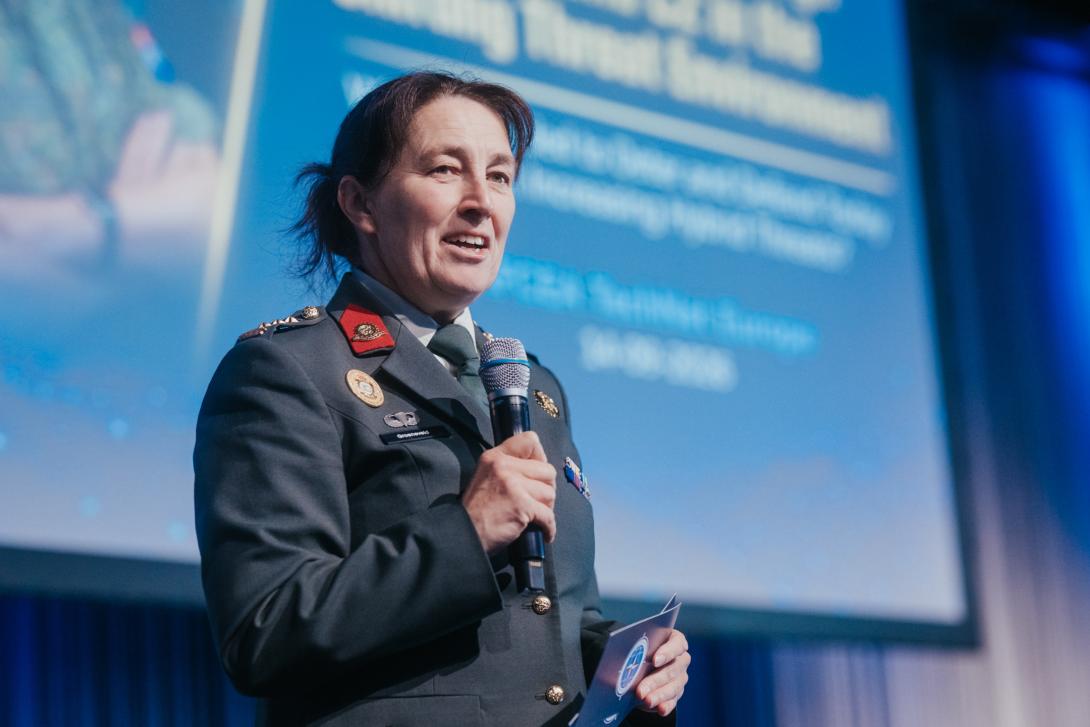
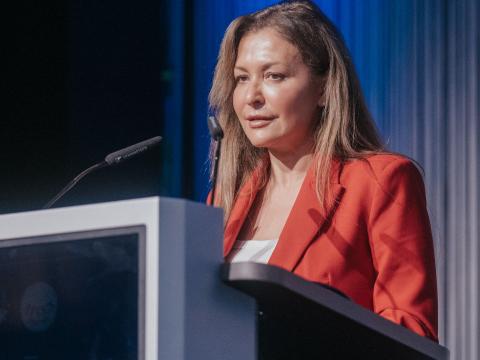
At TechNet Europe 2026, Col. Mietta Groeneveld, NLD A and director of the NATO Command and Control Center of Excellence (C2COE), suggested moving away from the old equilibrium, which she implied has room to grow. Achieving a new balance level can help European forces more effectively repel adversarial threats, especially hybrid-related threats.
“We have this old equilibrium that we worked on,” Groeneveld said. “We thought that showing that we are very strong is going to be good enough. It’s not at all good enough. So, if you want to get to this new equilibrium and if you want to get the guinea pig back in the box, we will need to do something, and we need to rethink how we are going to do that on those different levels at the same time.”
What might that “something” be? Groeneveld expounded on her plea by saying that NATO should accomplish three tasks before this goal can become a reality.
Firstly, NATO countries must build resilience at the national level. Secondly, NATO must ensure that artificial intelligence (AI) will strengthen their socioeconomic structures rather than tearing them down. And lastly, NATO countries must prevent the proliferation of lethal weapons, and they must work together to execute this assignment.
Similarly, the new equilibrium idea has six principles associated with it: whole of society; resilient by design; informed and connected; deny, disrupt and degrade; partnered and aligned; and democratic strength.
The new equilibrium mindset is more suitable to confront the threat posed by adversaries on the advanced battlefield of today, the threat of which is constant and continuous. Even though an enemy might not physically attack in the near future, the enemy could still launch attacks via other avenues, such as cyber, at any time. C2COE officials are learning that defense and deterrence mechanisms must be ready and at hand at all times. They are taking on the challenge of grasping this concept, Groeneveld assured.
“I think that the threat in the homeland is more acute, but it is yet not fully represented in our military mindset,” Groeneveld said. “We’re all in bubbles, and when I get in this military bubble, go away. We’re working; we’re very, very hardworking.”
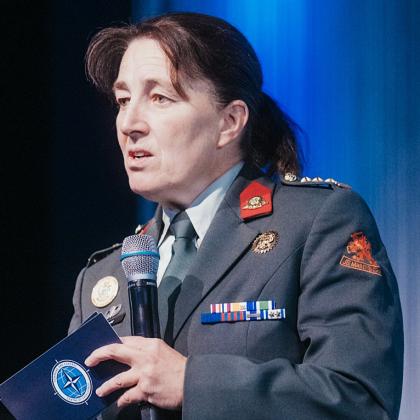
We thought that showing that we are very strong is going to be good enough. It’s not at all good enough.
“This military mindset and this cultural shift are extremely hard because we think linearly,” Groeneveld added. “We have based our systems hierarchically. We change NATO’s posture every five years, so we have cycles of five years. We will implement this new thinking in 20 years—that’s not going to work. So, we have this linear and symmetric approach to a very asymmetric threat, and it requires us as a community here to act and to talk to the other side.”
Groeneveld concluded the keynote address by saying that if everyone stays in their own “bubble,” they cannot achieve progress. NATO and its partners need to work together because one side could have a solution that the other side needs. Contributing members also must always remember what they are defending: their freedom and values.
“I am not a mercenary, so a military person always only can fight when it’s about value, and you can only make this argument when you talk about values,” Groeneveld said. “It’s very important to state that if you also look in our constitutions [and ask] what are we about. I think that’s a relevant point to make. Our military role really needs to shift a little bit, and [we need] to rethink how it’s stated.”
This story has been corrected to reflect that Groeneveld is not a NATO official as originally described. According to its website, the NATO C2COE “supports NATO, Nations and International Institutions/Organizations with subject matter expertise on command and control.” Additionally, NATO Centres of Excellence are nationally or multinationally funded institutions accredited by NATO that are part of a wider framework supporting NATO Command Arrangements, but they are not part of the NATO command structure.
TechNet Europe 2026, taking place in Berlin, is an international event organized by AFCEA Europe in cooperation with the AFCEA Bonn E.V. Chapter. SIGNAL Media is the official media of AFCEA International.
Comments