
The LLNL Recruits Emerging Technologies for Nuclear Missile Modernization

As part of its mission to ensure the safety, security and effectiveness of the nation’s nuclear deterrent and to support the transformation of the stockpile and the nuclear weapons enterprise for the future, Lawrence Livermore National Laboratory (LLNL) is applying artificial intelligence (AI) supercomputing, quantum technology development and advanced manufacturing.
Under Executive Order 14347 issued last year, the U.S. Department of Defense is modernizing the nation’s strategic nuclear forces. The modernization includes multiple major defense acquisition programs and warhead modernization programs implemented by the National Nuclear Security Administration (NNSA), a semi-autonomous agency within the Department of Energy. In 2025, the Congressional Budget Office estimated that programs to operate and modernize nuclear forces would cost $946 billion over the next 10 years. The Defense Department stated that its fiscal year 2026 budget request includes about $60 billion across the nuclear enterprise to sustain nuclear forces and fund a major recapitalization across all three legs of the nuclear triad, which includes land, air and sea-based missiles.
The LLNL, which also falls under the Energy Department, serves a wide variety of national security missions, with a primary focus on nuclear deterrence. And the national lab is applying a varied arsenal of emerging technologies to accomplish the mission, Brad Wallin, the LLNL’s deputy director for strategic deterrence, reported in a recent interview with SIGNAL Media. He cited the El Capitan supercomputer and the National Ignition Facility (NIF) as two examples.
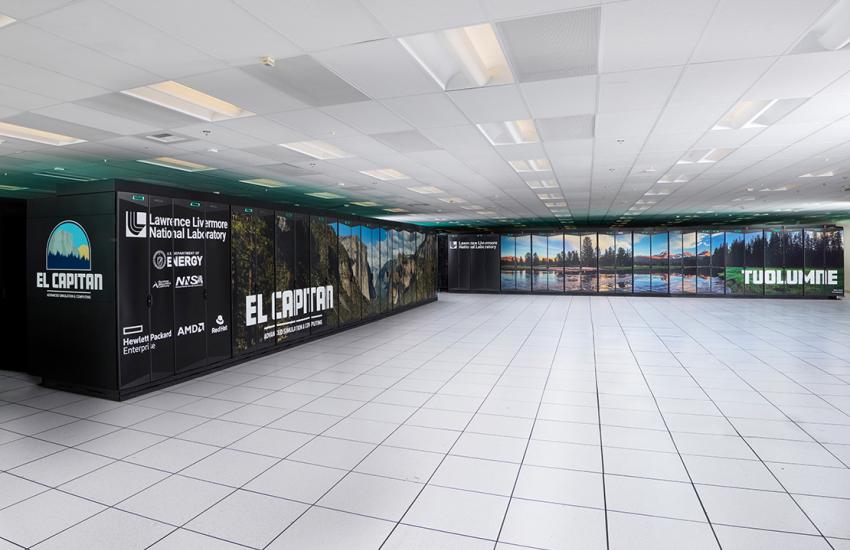
“I manage our nuclear weapons program that involves sustaining the warheads that we have in the active stockpile, as well as the modernization work we’re doing to modernize the deterrent. And we do that using various scientific tools that we maintain and advance here. In particular, for Livermore, that’s high-performance computing. We host El Capitan, which is still the fastest computer in the world according to the Top500, and NIF, which is the most energetic laser in the world, that we use to help recreate the conditions that nuclear weapons experience.”
El Capitan is an exascale machine built by Hewlett-Packard. An exascale supercomputer can calculate at least one quintillion (1,000,000,000,000,000,000+) double-precision (64-bit) operations per second, which equates to one exaflop. Deployed in 2024, El Capitan can perform more than 2.79 exaflops per second, according to LLNL information available online.
The supercomputer is a tri-lab resource that the LLNL shares with Sandia National Laboratory and Los Alamos National Laboratory. “We moved that to classified operations last year, and ... it’s just an incredible step forward in terms of our capabilities. It’s about a factor of 20 faster than the previous machine that we had, and it’s really allowing us to do three-dimensional design iterations in much faster times than we were able to do before,” Wallin said.
And with its 44,000 graphical processing units, the current king of supercomputers is also “helpful to explore artificial intelligence and how it could accelerate some of the ways in which we do things,” according to Wallin. “It wasn’t actually the driving need. It wasn’t based on AI when we got it, but it turns out that it’s a pretty useful machine to be able to explore some of those techniques. That’s something we’re just jumping into now, but the machine itself is having a big impact on how we do our design and assessment work right now.”
The Department of Energy’s Genesis Mission is designed to connect the world’s best supercomputers, experimental facilities, AI systems and unique datasets across every major scientific domain to double the productivity and impact of American research and innovation within a decade. “Specifically for national security, we want to use AI to accelerate our ability to come up with new materials, to do the design work that we do for the stockpile, but then also really help move us towards a more digital enterprise,” the director noted. “When we design things, we work with other sites that do production, and to have that really be a seamless connection, a digital connection, with a lot of data flow, and the ability to use AI to optimize that loop from design to production, I think that’s very exciting.”
The lab is also interested in combining AI with advanced manufacturing techniques, such as 3D printing. “We can make materials or structures that you really could never have made through traditional manufacturing, where you have a big billet of material, and you machine away the stuff you don’t need. You can build exactly what you want,” he explained.
And during those advanced manufacturing processes, AI systems can gather and analyze vast amounts of data for future improvements, he added. “While you’re printing a material, you can actually be measuring what you’re printing, so AI can take this huge volume of data and help you make better decisions about how you might make the next part, or even how you might change what you’re making currently.”
Quantum technology also plays a role. “We have some experts in quantum computing here, and do have some investments in the role quantum computing might be able to play in the future of high-performance computing, which could be as an accelerator, or it could be other things, but I would say that’s on the research end of things. There are other types of quantum sensors and things that already do have impacts in commercial applications and in national security. So, we have some work going on in those things as well,” Wallin offered.
The NIF, which was built specifically for stockpile modernization, achieved fusion ignition in 2022, the first time any laboratory has done so. An LLNL press release described the breakthrough as “one of the most challenging goals in all of science and a primary objective of NIF” and described it as an accomplishment the LLNL had been trying to achieve for six decades.
“That helps us create the conditions of nuclear weapons, so we can then use that energy source to explore things like how materials behave in such extreme conditions. However, what it also did is demonstrate that fusion in the laboratory is possible, and so that has led to many different private fusion companies that have started up across the country. There’s a lot of investment in private investment going into fusion companies.”
Microsoft’s CoPilot chatbot backs up that assertion, pointing out that in July 2025, the Fusion Industry Association reported 53 fusion companies, up from 23 in 2021, showing explosive sector growth. The association report also noted eight new entrants in the previous year alone, indicating continued acceleration.
That scientific breakthrough affects more than the nuclear stockpile. “Of course, fusion energy for the grid would be absolutely transformational. We at Livermore have a Livermore Institute for Fusion Technology, which is our way to interface with those companies,” Wallin said, underlining that the National Ignition Facility itself is used exclusively for understanding and modernizing the nuclear stockpile.
Under the Enhanced Yield Capability project, LLNL officials intend to increase laser power at the fusion facility from 2.2 megajoules to 2.6, a bigger increase than it may seem. “When we’re exploring this fusion ignition and the amount of energy that can come out, we believe that can yield factors of five or six in terms of the output energy that we would then have access to for experiments. That would add capability for national security and also continue to have us learn more about fusion, which could be helpful in terms of working with these external companies.”
The LLNL supports both sustainment and modernization of the nuclear stockpile. On the sustainment side, the lab helps maintain the W80-1 warhead, currently deployed on the Air Force’s air-launched cruise missile, and the W87-0 warhead, deployed on the Air Force’s Minuteman III intercontinental ballistic missile. This work includes ongoing surveillance, assessment and refurbishment activities to ensure those systems continue to meet military requirements.
The lab also leads modernization for the W80-4 Life Extension Program, which will replace the W80-1 for use on the Air Force’s new Long Range Standoff cruise missile, sustaining the bomber leg of the nuclear triad with enhanced safety, security and reliability features, according to a fact sheet from the National Nuclear Security Administration. Additional modernization efforts include the W87-1 Modification Program, which will replace the aging W78 warhead and will be fielded on the Air Force’s Sentinel ICBM, the missile to replace the Minuteman III. And the W87-1 is based on previously tested nuclear components, incorporates enhanced safety and security features, and will maintain the effectiveness of the land-based leg of the triad without providing new military capabilities.
The director explained that production in a post-Cold War era takes longer than it did then but has been ramping up in recent years.
“Generally speaking, these timelines that we’re experiencing now are a lot longer than they were during the Cold War, when we were actively, regularly, updating the stockpile and had all of our production capabilities up and running,” he said. “During the stockpile stewardship era, we invested in incredible scientific tools, and we have a great understanding of how weapons behave, but we didn’t invest as much in production because there wasn’t a need to. Over the last five and more years, there’s been a substantial reinvestment in the production enterprise, and that’s still coming online.”
He added that his team is on track to deliver warheads to the Department of Defense and that there may even be opportunities for acceleration.
Senior reporter Nuray Taylor contributed to this report.


Comments