
Rethinking the Meeting Experience With Mission-Embedded, AI-Enabled Collaboration Infrastructure
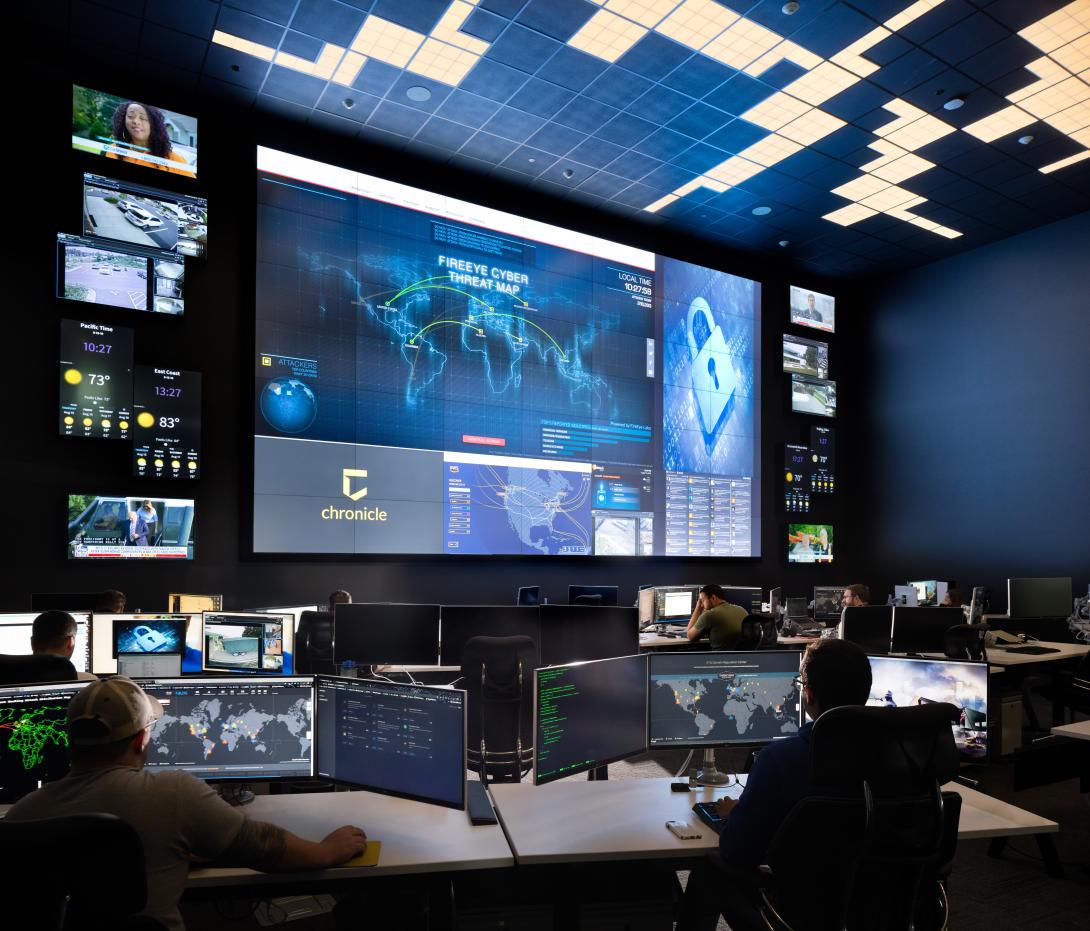
As federal missions grow more complex and distributed, agencies across the defense, intelligence and civilian communities are rethinking how they collaborate. Meeting rooms, command centers and executive spaces are no longer just venues for briefings—they are mission infrastructure that must support secure, real-time information sharing.
“Collaboration has really become critical in today’s federal agencies, just because of how the federal workplace has changed,” said Joe Schauder, director of Federal Government at Crestron. “High-level agencies must collaborate more broadly, more quickly and securely than ever before. Delays or breakdowns can directly impact mission outcomes, so secure collaboration ensures agencies
share the right information
with the right people.”
With more than five decades in business and a deep footprint across organizations, the Department of Defense (DOD), the federal courts, and state and local governments, Crestron has become the go-to expert for secure AV and unified communications (UC) in the federal space. The company’s advanced control solutions are designed to align with stringent security requirements while simplifying the user experience for warfighters, analysts and decision-makers.
From Meeting Tools to Mission-Embedded Platforms
One of the most visible shifts in the government sector is a move away from standalone “meeting apps” toward collaboration tools and platforms that are embedded into the mission workflow. Employing standardized, repeatable designs for meeting spaces allow agencies to:
- Deploy securely at scale across large facilities and campuses
- Train users once on a consistent interface and workflow
- Apply security and configuration policies uniformly
- Avoid the expense and risk of one‑off, custom‑engineered rooms
Crestron serves as the system backbone in these environments—coordinating displays, cameras, microphones, codecs and room controls so the collaboration platform can “just work,” leading to “faster meeting times and fewer failures,” said Schauder.
AV That Behaves Like Secure IT
Federal users are no longer asking for shinier displays; instead, they want an AV environment that behaves like a secure, manageable, IT infrastructure—standardized, resilient and observable.
“The user wants a one-touch join, a consistent UI, reliable content sharing and interoperability with existing room gear. Ease of use is the mission,” he added.
By making secure collaboration simpler and more intuitive, federal agencies can reduce help desk calls and discourage insecure workarounds while keeping operators focused on the mission instead of the technology.
Moving to AV Over IP—Without Compromising Security
Agencies also are moving from traditional fixed-chassis AV to AV-over-IP architectures, which offer greater flexibility and scalability. AV over IP transmits audio/video signals over standard Ethernet network infrastructure, offering high scalability, flexibility and remote management using encoders/decoders. Fixed chassis systems use dedicated hardware matrices with fixed inputs/outputs, relying on direct cabling. AV over IP makes adding screens simple: it just requires connecting a decoder to each new display and linking it to the network, allowing for virtually unlimited expansion without expensive, traditional matrix hardware. For federal buyers seeking to modernize over time, this model helps avoid costly “rip-and-replace” cycles.
Crestron’s DM NVX AV-over-IP technology combines video, audio, Universal Serial Bus (USB) and control on a single platform to reliably distribute anything across a customer’s entire network.
Alongside AV over IP, agencies are also embracing digital signage and secure room scheduling that integrate with the DOD’s secure Microsoft 365 environments.
“Intelligent” Video Experiences
Artificial intelligence (AI) is another technology area that’s beginning to change what’s possible in the government meeting-collaboration space, particularly around camera automation and remote experience.
Crestron’s 1 Beyond camera line uses Visual AI to do group framing, presenter tracking and multi-camera intelligent switching to give call participants a seamless experience. The cameras can track presenters, select the right view based on who is speaking and avoid jumping to irrelevant sounds.
Looking ahead, Schauder expects AI to play a growing role in dynamic authorization—for example, managing which networks or room resources are available based on who has been authenticated into a space and at what classification level.
Cybersecurity at the Core
For federal organizations, collaboration tools must meet stringent cybersecurity and compliance requirements. Crestron has invested heavily in certifications, encryption and deployment guidance tailored to these needs.
Crestron’s primary AV line is TAA-compliant and both Joint Interoperability Test Command (JITC) and National Information Assurance Partnership (NIAP) certified.
“We utilize FIPS-certified AES encryption, which ensures that the algorithm meets the standards of NIST,” Schauder said. “We offer support for 802.1x authentication and Active Directory credential management.”
In addition, PKI authentication validates specific devices and enables secure key exchanges. Lastly, Crestron uses Transport Layer Security (TLS), a cryptologic protocol that provides end-to-end security.
To help agencies harden deployments, Crestron maintains a dedicated security portal. These resources ensure the company’s AV and UC solutions align with federal policies, including zero-trust architectures and the evolving guidance from the DOD and the intelligence community.
A Federal Partner With No-Cost Support
Crestron’s federal team works across the entire community, from Europe to the Pacific and from defense to civilian agencies. The company’s footprint extends through all branches of the military and the DOD as well as civilian space and the U.S. federal court system.
Learn More
Beyond its technology portfolio, Crestron offers a range of no‑cost resources to help government partners plan, design and sustain secure collaboration environments, including design services, training, extended warranties and access to software and firmware.
Federal IT, AV and mission leaders looking to modernizesecure collaboration spaces can explore Crestron’s Government solution homepage, and its Design Ideas page, which serves as a jumping-off point to discuss specific solutions. Security guidance and hardening resources can be found at crestron.com/security.



Comments