
USPACOM Stresses C2, Industry Role in Deterrence
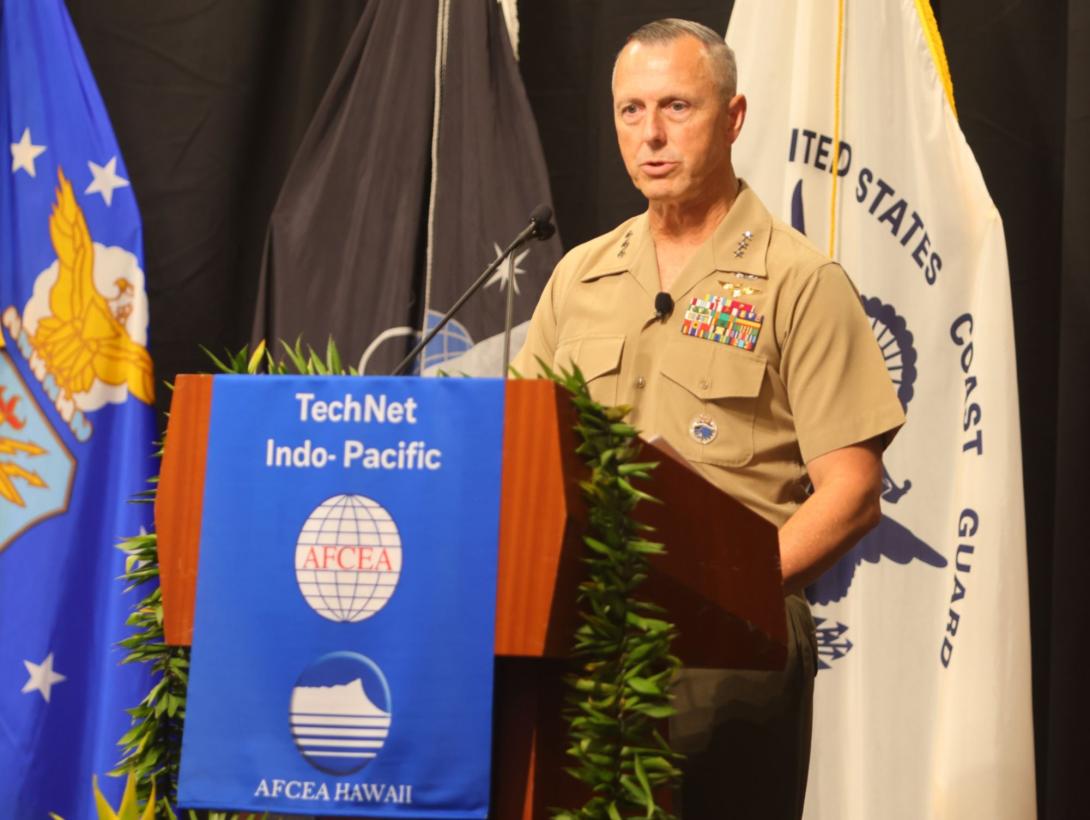
Deterrence is the highest duty for the U.S. Pacific Command (USPACOM), and assured command and control (C2) is essential to that mission, said Lt. Gen. George B. Rowell IV, USMC. Rowell, USPACOM deputy commander, delivered the closing keynote address at TechNet Indo-Pacific 2026 in Honolulu, Hawaii.
“We aim to prove that military aggression will be infeasible, escalation will be catastrophic and the costs of conflict far outweigh any gains,” he stated. “That is peace through strength in action. Assured [C2] is a nervous system that enables that strength.”
Rowell continued by outlining four key ideas to consider.
First, he described a strategic environment shaped by China’s military buildup, North Korea’s nuclear and submarine programs, and Russia’s military and industrial capabilities. He also noted the proliferation of low-cost autonomous systems, advances in precision-strike weapons and the growing importance of information and decision superiority.
“For C2 to be assured, we must build secure, resilient, interoperable and defensible architecture from the ground up, and it all needs to function through degraded, real wartime conditions,” Rowell said.
Second, the deputy commander emphasized the need for combat-ready forces operating from dispersed and austere locations, connected through resilient C2 systems. These systems must connect aircraft, ships, ground forces, space sensors and command posts while remaining operational in degraded environments.
“Without assured C2, our exquisite platforms and advanced munitions remain isolated capabilities. Combat power then fragments, leaving our forces vulnerable to defeat in detail,” he added. “If assured C2 is to play its role effectively, it must exemplify the three classic pillars of deterrence: capability, credibility and communication.”
Rowell also highlighted exercises that took place across the Indo-Pacific region.
“This year, Pacific Command conducted 17 combined joint exercises spanning nine host nations and incorporating 35 allies and partner nations. Subordinate service components have executed over 70 additional bilateral and multilateral exercises, maintaining a consistent presence across the theater,” Rowell said. “These exercises are the rigorous stress tests of our warfighting concepts.”
Exercise Valiant Shield 26, he mentioned, saw the first deployment of a hypersonic system to Guam. It also employed collaborative combat aircraft and integrated B-2 bombers with long-range anti-ship missiles. At Exercise Balikatan 26, PACOM launched its first-ever Tomahawk land attack missiles in the Philippines and facilitated the sinking of target ships by partner nations, Rowell explained.
“Another major milestone was the launch of the PACOM mission network, our zero-trust and superintelligence (SI)-enabled mission partner environment, which we used at several major exercises this past year,” he said.
For the first time, PACOM and allied partners communicated and coordinated with common tools and data flows, Rowell highlighted. The success was in the ability to pass sensor-to-shooter targeting information and data across the tyranny of distance.
Rowell’s third point addressed the institutional challenges of modernization and the need to better integrate allies and partners into C2 architectures. Advanced technology alone cannot deliver an advantage if bureaucratic processes slow time-sensitive decisions.
“Assured C2 requires cultivating mission command, training leaders and operators who possess the trust, the authority and the initiative to act on commander’s intent when communications degrade or fail completely,” Rowell said.
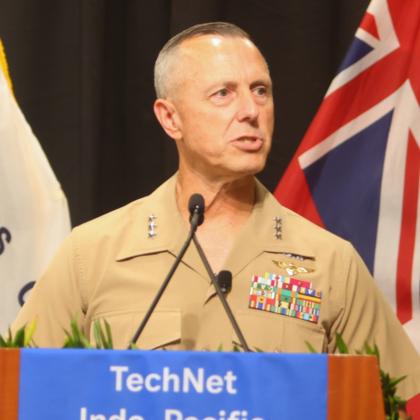
Without assured C2, our exquisite platforms and advanced munitions remain isolated capabilities.
Rowell also cited the newly formalized quadrilateral Chiefs of Defense Cooperation Council, which includes the United States, Japan, Australia and the Philippines in a common operating picture and data-sharing framework.
The PACOM deputy commander also made a call to industry.
“We need industry to focus on delivering results in assured C2. We can no longer accept proprietary software that traps operational data in silos,” he said.
“We need open application programming interfaces, containerized software and modular programs that seamlessly federate across joint and allied systems. As we transition to superintelligence-centric focus, we also need ruggedized SI and edge compute deployed across all of our warfighting IT [information technology] platforms, actively compressing the kill web and providing decision advantage.”
Most importantly, Rowell asked industry to keep the warfighter in mind when designing systems.
“If a capability requires a team of civilian contractors on site to install a basic patch, it’s not going to survive in what may be a high-end conflict. Those days are simply over,” Rowell said.
“For all stakeholders in the room, we need your analysis, we need your candid feedback, and we need a very healthy dose of intellectual skepticism. Help us evaluate the implications of emerging technologies before we field them at scale. More importantly, help us to educate our warfighters so that they are tech savvy as they are lethal.”
TechNet Indo-Pacific is co-sponsored by AFCEA International and AFCEA Hawaii. SIGNAL Media is the official media of AFCEA International.

Comments