
Academia Taking Steps To Scale Novel Threat Detection System
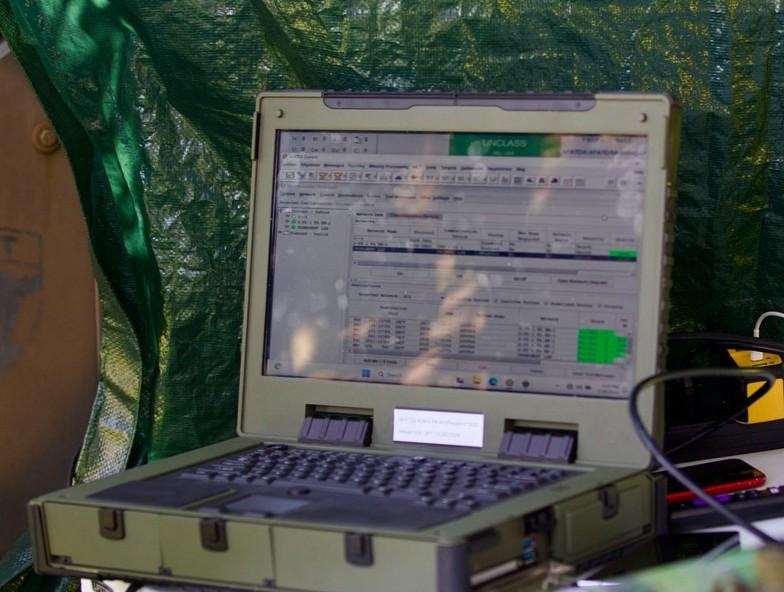
Engineers in academia are exploring additional ways to boost the effectiveness of the new Shrike system. The threat detection system is brand new, as it is currently in the experimentation phase, and despite its novelty, researchers at Carnegie Mellon University seek to expand the role and impact of the new platform in several ways.
They are striving to enable one individual Shrike system to address several fire missions simultaneously, according to Jeff Mattson, principal engineer in Carnegie Mellon University’s Software Engineering Institute (SEI) and the SEI’s Shrike project lead. This would be a monumental improvement because, as of right now, one individual Shrike system can focus on one fire mission at a time. Accomplishing this feat would allow for the services to increase efficiency while saving resources. Additionally, crews are working toward adding more fires backends that they can communicate with through the Shrike system. Currently, engineers and researchers have used the Shrike system to work with mortars and artillery, and they have started to lightly experiment with close air support. Another goal is to enable Shrike to be compatible with more communication avenues. Crews are also looking into smaller improvements, such as investigating other possible fires areas that might benefit from the infusion of data that Shrike can gather. They are also seeking a better way to feed this data to the higher echelons to increase and ensure transparency, according to Mattson.
Furthermore, officials are expected to roll out the new Shrike Information Portal sometime this month. This development will make it easier for individuals and units who are interested in Shrike to obtain and examine the documentation and installation artifacts, according to Mattson. Instead of units contacting the Army Artificial Intelligence Integration Center (AI2C) to inquire about Shrike, which has been the traditional process for gaining access to Shrike, units can now use the self-service Shrike Information Portal to learn more about and experiment with the system, according to Mattson. He also stressed that units would use the portal primarily for experimentation rather than acquisition, since there are traditionally more regulations and red tape placed on the acquisition side than the experimentation side. Engineers expect that Transforming in Contact units, which are groups Army leaders have selected to experiment with nearly matured communication systems and who have the licensing to avoid the regulations and red tape associated with acquisitions, will benefit the most from the new Shrike Information Portal.
“There’s been this discussion of let’s get a portal out there, a self-service kind of portal, so units can run with it [and] experiment with it more,” Mattson said during an interview with SIGNAL Media. “And it’s important that we talk in terms of experiment, because acquisition folks get nervous when you start talking about fielding something without them or units getting this stuff.”
“One of the whole things behind the Transforming in Contact brigades was to reduce a lot of the acquisition bureaucracy [to] let these guys innovate and generate faster,” Mattson added. “So, providing this self-service portal where the artifacts can be gotten from will be helpful to them.”
Engineers at the SEI at Carnegie Mellon University teamed up with officials from the Army AI2C to create the Shrike prototype. The idea was first brought to the table in 2022 as crews realized and acknowledged that they were not optimizing the potential of drones, according to Mattson.
“We’re looking for problems that are related to AI that can be integrated into the Army AI2C, so where are some problem areas we can integrate AI into Army warfighting capabilities?” Mattson said. “And AI2C has a wide portfolio of things they’re engaged with there, but this is, I think, the only one that kind of had a kinetic focus where the frontline folks could make use of this. And I think that’s what was driving this.”
“Drones are being issued, and they’re only being used for a fraction of what they’re capable of, so let’s add capability to these assets that are already being found on the frontlines.”
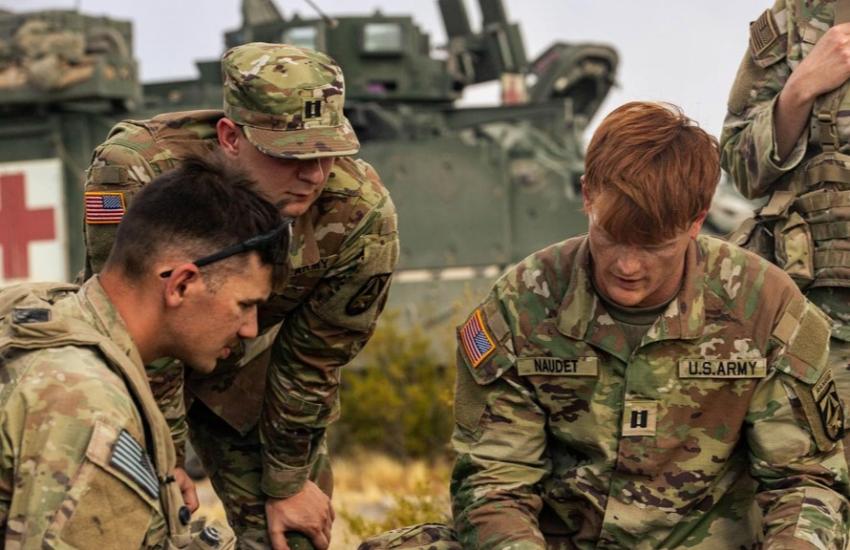
AI2C crews then developed the Shrike prototype in 2024 and continued to edit and improve it until June 2025, when it reached a stage of stability, according to Capt. Timothy Naudet, data scientist at the Army AI2C.
“Shrike is a ground-borne, passive, photogrammetric targeting software that enables a drone to act as a mobile airborne forward observer,” Naudet described. “Shrike’s primary feature is to estimate the Military Grid Reference System of an observed target as accessed through [the] aperture’s pixel space. The secondary features include interacting with third-party targeting software like Android Team Awareness Kit, Advanced Field Artillery Tactical Data System, and Artillery Execution Suite; computer-vision automatic detection of explosions; and the computations required to compute the Call-For-Force indirect fire targeting process. A tertiary feature is providing the targeting packets required for the Crowstorm targeting software to maneuver first-person-view unmanned aerial vehicles to acquire and intercept a target.”
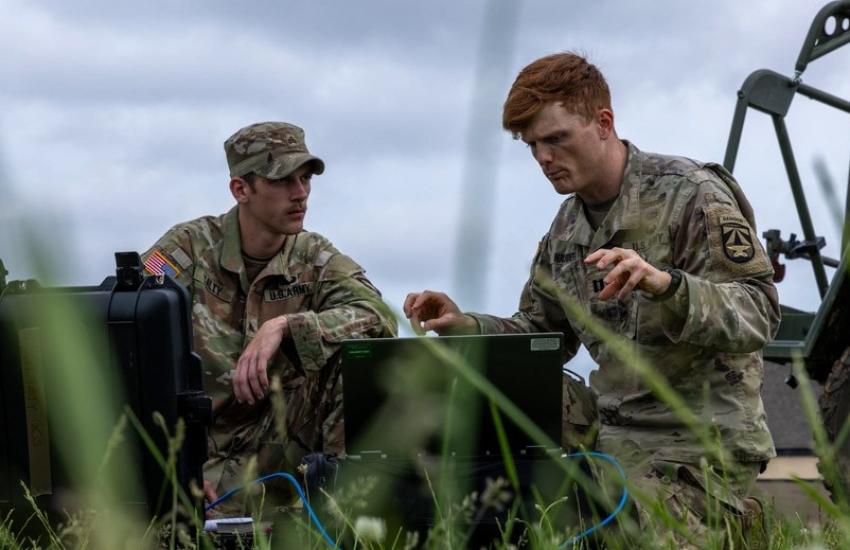
Their goal was to develop a capability that not only serves as a new way to survey their enemy or an environment but also serves as a new way to address those threats, according to Mattson. More specifically, while in the sky, Shrike uses cameras and machine learning to locate possible enemies and risks. The capability then sends those pictures and its analysis of the environment to the unit’s device. Furthermore, Shrike also gives soldiers feedback when they use the system to attack a threat. It utilizes its machine learning to locate where the round hit, and it suggests how to shoot at the target more accurately, according to SEI officials.
“The Army is starting to field these drones, these commercial off-the-shelf or government off-the-shelf drones, to the line units,” Mattson said. “So, you have infantry platoons out there; they’d have a drone with them. They’ve got this technology, but it really is just a flying camera, and that’s a great ability for them. It’s a great tool for them, but we wanted to give it some warfighter application rather than just another pair of binoculars [that] you can [use to] go see over the hill.”
Naudet confirmed that information, stating that Army leaders are distributing the software around the globe to warfighters who seek to use their unmanned aerial systems (UASs) as airborne forward observers. The process of obtaining a Shrike system is competitive, Naudet warned.
So far, shrike crews have seen several successes through their live fire tests and experiments with mortars and artillery, according to Mattson. More specifically, they have successfully targeted more than four kilometers away from UASs, according to Naudet. Furthermore, personnel associated with Shrike have received extremely positive feedback regarding the system.
“Shrike is incredibly successful,” Naudet said. “It’s used worldwide and used in contested areas; however, ironically, the success actually doesn’t align with Army fielding or funding. Fielding or funding is mostly a component of desire from the formerly named program executive offices. As a result, we’ve taken a “Department of War open-source” approach to enable formations to employ our highly competitive software.”


Comments