
Robotics Researchers Take a Groundbreaking Approach to Land Mine Detection
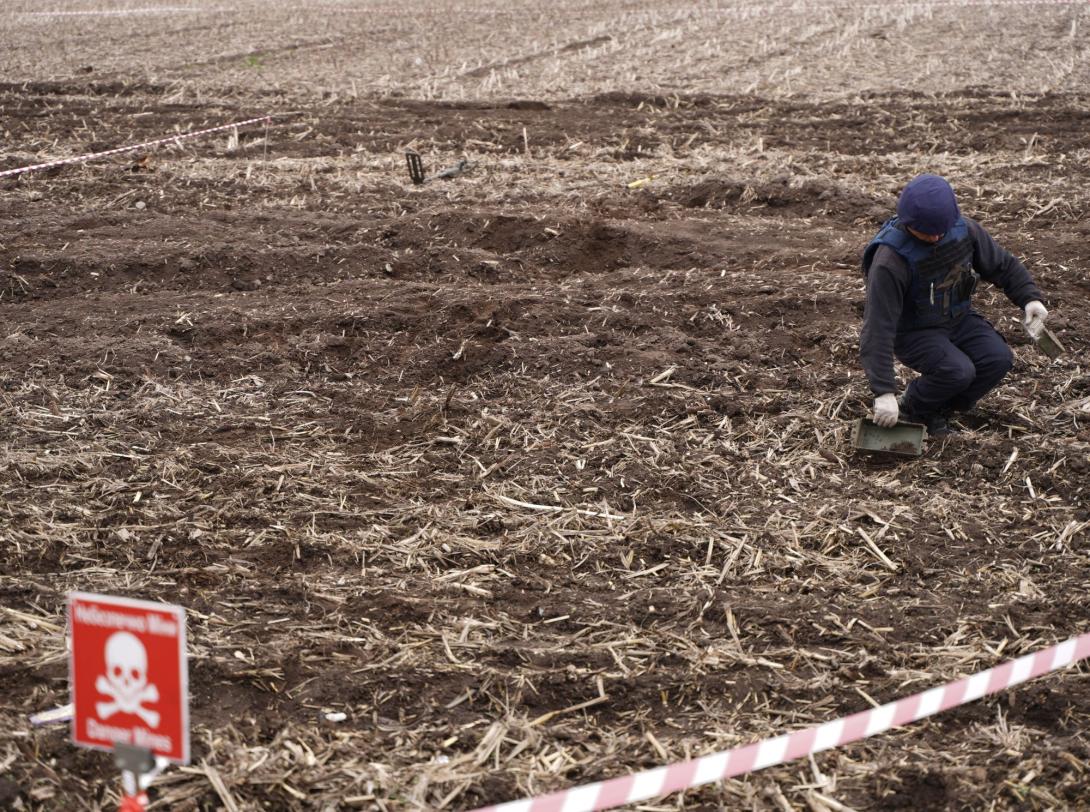

Leaving behind a decades-long legacy of threats to life, land mines continue to be used across conflict zones and surrounding areas. Globally, the challenge remains immense. A 2024 NATO report notes the presence of 110 million land mines across 70 countries and territories. While the Mine Ban Treaty has been in place since 1997, improvised explosive devices (IEDs) continue to threaten lives long after military operations have ceased. Detection is complex and costly, with just one land mine detection dog costing at least $15,000.
Although inexpensive to build, land mines are much more costly to detect and remove, which is why a group of scientists is developing robotic systems with plug-and-play sensor capabilities and artificial intelligence (AI) to accelerate the process toward a safer world.
“We’re not making a business of this,” said Tim Bechtel, director of science outreach and senior teaching professor of geosciences at Franklin & Marshall College, Lancaster, Pennsylvania. “We want to develop plans for a team of these cooperating robots and then make them public, and anybody who wants to, anywhere, can build a system,” he told SIGNAL Media in an interview.
The goal of this research is to build a product that is open source and available worldwide. While the group has two years left of its third three-year grant from the NATO Science for Peace and Security Program, it seeks partnership to expand and build onto what they have achieved thus far.
Using Clearpath Robotics’ unmanned ground vehicle, Jackal, the team is leveraging the off-the-shelf commercial product to plug in other commercially available sensors—in addition to 3D-printed parts—for land mine detection. “There’s going to be nothing proprietary, nothing that can only be built in a particular laboratory,” Bechtel said.
“The great part is that we’re also developing automated recognition of objects so that people won’t need any special expertise,” he continued. “We’re trying to put the ability to clear a field in the hands of the locals essentially, so the people can clean their own community rather than having to fly people in from who knows where.”
Aboard the robots are mechatronic systems made up of four sensor packages, Bechtel explained. “It’s a grid with the electronics and the sensors that you can drop onto a robot,” he said. The system was specifically designed for the Jackal, he added.
Each robot is battery-powered and progressively autonomous, Bechtel stated. “The data is sent through a radio link to a base station, and from there, [it goes] onto the worldwide web.” Additionally, the robots can be controlled across continents, with an operator in Ukraine having the ability to control a robot in Pennsylvania, Bechtel said.
The remote-control capability is an important safety aspect in such dangerous environments, said Lorenzo Capineri, an electronics professor at the University of Florence in Italy, one of the other two universities participating in the research along with the National Academy of Sciences in Ukraine.
“Metal detectors are handheld instruments, and the operator must be very close to the threat,” he explained in an interview with SIGNAL Media, stating that a robotic platform reduces risk to life in cases of unexpected explosions.
Standard operating procedures must be addressed, however, as different national militaries have their own policies in place. “When you’re proposing an innovation that is not included in the standards, you have to demonstrate first that the innovation is capable [of] improving some characteristics, some performance,” Capineri said. “You also have to explain to the operators that the new instrument is working and, in the future, can be adopted on the field.”
The group’s research thus far has involved the use of four robots to swarm an area for land mine detection. In this scenario, robot one would seek to identify surface threats and trip wires using a GoPro camera, an infrared camera and light detection and ranging, or LiDAR. “We’ve seen, particularly in eastern Ukraine, a lot of mine fields are protected with trip wires that lead to explosive devices to try and deter the deminers,” he noted, additionally highlighting the use of scattered land mines from artillery shells or dropped from helicopters.
On the second robot, the mechatronic interface gets swapped out for a metal detector to detect buried and unburied metal objects. “There are a ton of those in a former conflict zone, so the metal detector is useful, but it’s certainly not going to discriminate explosive devices from common scrap, harmless clutter that we don’t need to worry about,” Bechtel added.
The third robot helps enhance the detection of buried objects through the addition of an impulse radar, he said. “From the combination of metal detector and impulse radar data, we select targets to interrogate the things that are likely to be explosive devices.”
Aboard the fourth robot is a subsurface holographic radar, which takes three-dimensional pictures of buried objects. “It’s literally holography, but it’s using a longer wavelength, a lower frequency signal that actually penetrates the Earth up to depths of maybe 30 centimeters or so,” Bechtel said.
The final product is a catalog of datasets, including the location of metal objects, their risk factor and a 3D image of what the object is. The 3D image is collected by using a 2-gigahertz radar signal, Bechtel explained. “It sends out a constant beam of 2 gigahertz radar, but the beam is split ... one beam goes directly to the receiver, the other half of the beam goes underground and bounces off of a buried object, and that signal that’s bounced back mixes with the direct signal in the receiver,” he continued. “That makes a holographic interference pattern that we can digitally reconstruct, and it makes a 3D picture of whatever that object is underground.”
All of the collected information is then passed to the clearance team of explosive ordnance disposal experts.
The large database of information is a challenging aspect of the process, Capineri noted, pointing out the need to update real-time detection models as conditions change over time. “For example, if your database has been generated in a green field or in a concrete base, but you don’t include the snow, you can have land mines buried or abandoned in snow,” he said. The updating process could take months, Capineri added.
Currently, the team of scientists is developing machine learning systems to recognize objects more rapidly. The goal, he said, is to have the system ready for use by the end of NATO’s current funding.
“We do a demonstration at the end of each grant period,” Bechtel added. For the upcoming demonstration, the team intends to test their cooperating robotic system on one of the standardized land mine detection test beds. “We’ve got a couple of them here in the U.S., [and] there’s one in Croatia that we’ve been talking to,” he said.
Although the use of remote-controlled robots for land mine detection is a large part of this project, the real innovation lies in the integration of different information among the sensors, as well as the application of AI.
“Possibly in the future, the system will be completely autonomous ... making the survey without any supervision by a human,” Capineri said, offering the commonly used Roomba vacuum cleaner, which, through algorithms, can cover full household areas without any remote control.
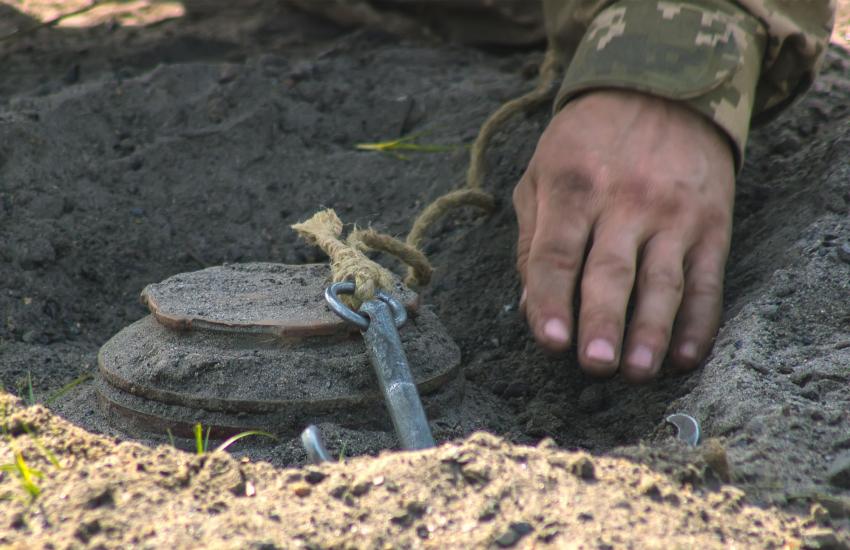
Full autonomy is not the focus, however, as the correct detection of land mines in each square meter takes precedence. “We cannot miss any target,” Capineri stressed, “if we have a lot of false alarms, you waste a lot of time excavating and checking places where the target is not of interest.”
Looking forward, the group of academics strives to continue their research following the end of their third round of funding from NATO, which helped them make one significant adjustment.
“We initially conceived this whole thing as literally four different robots, but in our latest grant, we realized that it doesn’t have to be,” Bechtel stated. “Somebody who’s building a team of these doesn’t have to buy four robots. They can buy one and build these modular mechatronic interfaces and swap them out on a single robotic platform.”
While the four operating robots are able to communicate with each other by sharing position data, the recently developed single-robot platform can send information back to a database, which all other modular interfaces can communicate with as well.
“We’re a university, we’re not a defense company, so the velocity, the speed of innovation at universities is generally slow,” Capineri said, noting an interest in partnering with industry to maintain momentum on their progress.
While there are other companies offering land mine detection technology, this group of researchers differs in its approach to detection capability.
“We’re the only group that I’m aware of that is trying to build things from commercial off-the-shelf parts or 3D-printed [components],” Bechtel said. “If you’re a reasonably smart person, let’s say a farmer in eastern Ukraine, and finally the conflict is over, you don’t have to wait for Norwegian People’s Aid ... to send deminers. If you want to try and work on it yourself, you can.”
Bechtel also mentioned the importance of an advisory board his team has been working with to connect with experts in the field and receive constructive feedback. The advisory board includes members from the State Emergency Services in Ukraine and Fenix Insights, an ammunition clearance company.
The driving force behind their work is the long-lasting threat to life posed by land mines. “They estimate that at their current rate of clearing production, it’s going to take 750 years to clean up Ukraine after this conflict is over,” Bechtel stated. “That’s motivating us. We’ve got to make it faster than that.”
At of the time of this interview, Bechtel and his team were able to scan and detect targets in 1 square meter in under two minutes.


Comments