
New Space Force Program, Capability Take Flight
Airborne Moving Target Indicator
The Airborne Moving Target Indicator (AMTI) program officially got off the ground as officials recently conducted the first launch of a prototype associated with the framework. U.S. Space Force personnel completed a competition and source selection in under 60 days for the launch, according to Col. Ryan Frazier, acting Space Force portfolio acquisition executive (SFPAE) for Space-Based Sensing and Targeting (SBST). These types of processes can take up to one year, but he explained that their ability to reimagine traditional timelines and processes enabled the competition from source selection to contract award to expedite significantly.
“I tell you, the first part of this is believing we can do it and stop accepting historical norms that source selections take a year,” Frazier said during a keynote address at Space Industry Days 2026. “Just start challenging the status quo and driving, and I believe that’s what the secretary of war is asking us to do.”
He expressed his approval to his colleagues for their ability to think outside the box and take unconventional routes to improve operations and gain advantages. “I’m really proud,” Frazier said. “I think this program has exemplified that. We’ve leveraged some nontraditional contracting approaches and things like that as well. We know that that has been different. We’ve challenged industry to turn proposals and pricing data and those types of things.”
Industry has risen to the challenge. In addition to giving his own team their flowers, Frazier also made sure to recognize the private sector for its essential role in the AMTI architecture-related launch and opening the door to faster timelines.
“Industry has a lot to do with that as well, because you get less time to do proposals,” Frazier commented. While talking to industry officials, he added, “You played along very well, and we couldn’t have done it without you.”
AMTI is a missionthe Space Force is delivering to the Joint Force through a system-of-systems architecture.
“It is not a monolithic system,” Frazier assured. “It is not just the system that we put on contract with a large vendor back in May.”
During the keynote address, Frazier laid out his vision for the AMTI architecture. He and his crew want the AMTI to consist of multiple sensor phenomenologies that work together in the space and ground layers. They envision that these sensors, which a variety of vendors can develop and provide, will share data from any number of sources, including the intelligence community, the Department of War or the private sector.
During a media roundtable following the keynote address, SIGNAL Media asked Frazier about providing details on any other launches or plans for the future. The acting SFPAE SBST said, “I can’t comment on the numbers of vehicles and the specific launch cadence. The secretary [of war] announced the first launch. He’s allowed to do that, but we’re not acknowledging each of the subsequent launches at this time. It is safe to say we’re delivering a very robust capability, and it’s going to deliver quickly.”
Meadowlands
The Meadowlands tool has enabled a 300% increase in mission capability, Lt. Gen. Gregory Gagnon, commander of the Space Force Combat Forces Command, announced at Space Industry Days 2026.
Additionally, crews developing Meadowlands used a form factor in the upgrade, and they substantially decreased the size of the system, Gagnon revealed. This reduction allows warfighters to transport the tool more easily and frequently.
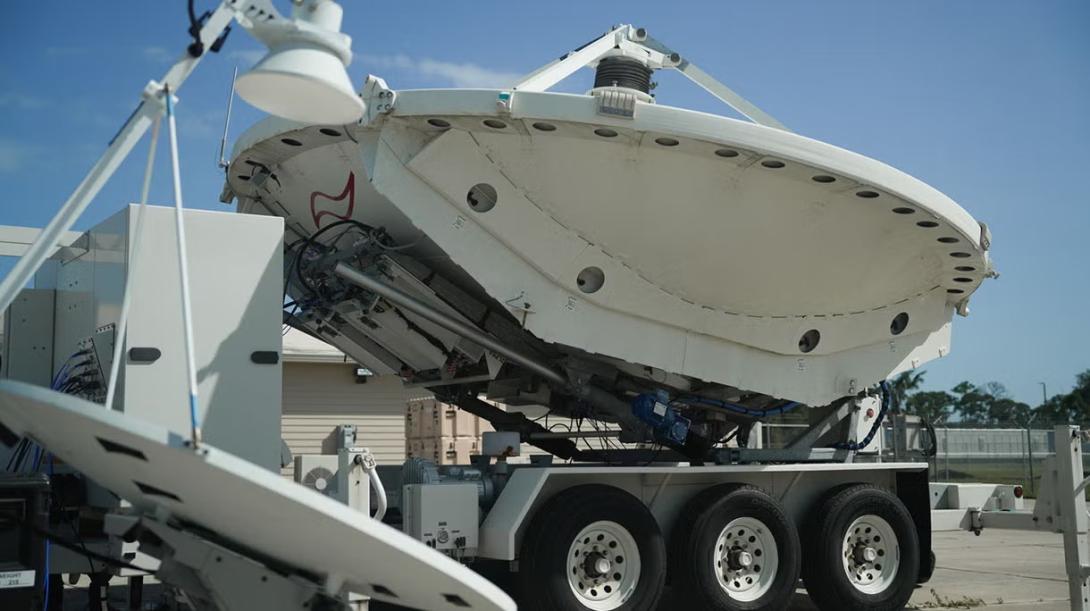
Meadowlands is a toolkit designed to give the joint force dominance in the spectrum space. It marks a crucial upgrade to the Counter Communications System, according to the Space Force Public Affairs team.
Similar to Frazier, Gagnon was appreciative of the individuals who made Meadowlands a possibility.
“Thank you, from the guys forward and the gals forward to their commander, thank you,” Gagnon said. “You have made each one of our rifles that much more effective. You have taken legacy electronic warfare, which was like a musket, and you’ve turned it into a Gatling gun, and that has been tremendously effective for operations in Central Command.”
Meadowlands is one example of the pursuit of change within the Space Force, an attempt that is deliberate with a specific mission in mind: outpacing its adversaries.
“We are changing not just to change,” Gagnon said. “We are changing because we are facing a very aggressive and fast-moving adversary—a possible adversary who has a space force that’s two to three times larger than your space force. The People’s Liberation Army (PLA) space force is large. The PLA space force gets their funding on time. The PLA space force builds on five-year plans, and they stick to those five-year plans.”
One major change leaders must ingrain into the branch is a mindset shift. Individuals in the Space Force must be aware and prepare for challenges.
“The Space Force needs to think like the Army,” Gagnon said. “The Space Force needs to program and plan for the fact that we will have attrition. We need to plan and budget for the fact that we will have attrition.”




Comments