
President's Commentary: Entering the Chat

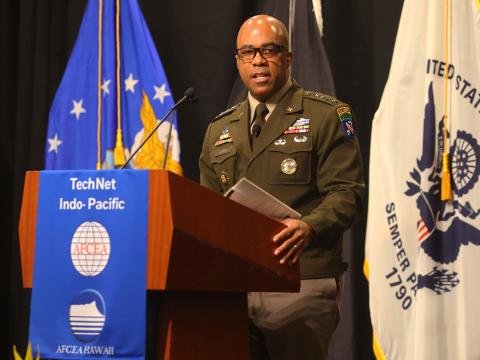
As I step into the role of president and CEO of AFCEA International, I am happy to congratulate the winners of our seventh annual The Cyber Edge Writing Award.
Andrew Vaughn, an associate fellow and cyber integrator for Lockheed Martin, claimed the first-place prize of $5,000 with his article AI-Driven Silent Breach: A Ghost Within Your Organization. David Geer, a cybersecurity and technology journalist, took second place with The Intent Architect: Reclaiming the Cyber Initiative Through Symbiotic Autonomy, and Ms. Kritika, who publishes under a single name—and who is an interdisciplinary researcher with expertise in cybersecurity, artificial intelligence (AI) and machine learning, blockchain, neuroscience and governance—won third place with Defending the Wetware: Neuro-cybersecurity Strategies Against GenAI-Powered Cognitive Attacks.
This award, which is sponsored by MANTECH, is one way AFCEA and SIGNAL Media foster innovation, build connections and drive the discussions that ultimately lead to national security solutions. These three winners were among the 109 contestants who chose to share their ideas, innovations and insights with the broader community.
Like so many in this community, I have been involved in the cyber arena even before we were commonly calling it “cyber.” In just a few decades, we have moved from “information assurance” to “computer network defense,” and to today’s dynamic cybersecurity landscape. And the threat has evolved from opportunistic “script kiddies” attacking websites to advanced, persistent and sophisticated attacks from well-resourced and commercialized criminal organizations and nation-state-sponsored cyber campaigns from China, Russia, North Korea and Iran.
And those attacks from yesterday’s low-skill, poorly resourced hackers have been replaced by stealthy prepositioning on U.S. critical infrastructure systems by state-sponsored hacker groups and advanced actors targeting internet-facing operational technology devices related to that critical infrastructure. Over the past two decades, cybersecurity has transitioned from a niche IT function into a geopolitical instrument and a fundamental element of national power.
Today, the cyber-attack surface has expanded enormously with billions of Internet of Things devices, cloud workloads, AI applications and operational technology requiring protection. Now, AI-enabled tools are rapidly taking shape in the cyber field.
The defenders’ toolkit has grown equally sophisticated with AI-driven detection, extended detection and responses and cloud-native security platforms.
With the emergence of “frontier AI” models like Mythos and GPT 5.4 that dramatically exceed current performance benchmarks, AI models can autonomously identify and exploit known cyber vulnerabilities and add “speed, volume, and noise to operations,” according to a recent report from the Center for Strategic and International Studies (CSIS).
While recent developments seem dire, our community of industry, academia and government, along with international partners and allies, can out-innovate anyone anywhere at any time. We’ve heard it said many times—because it’s so true—that people are our greatest asset.
President Trump’s Cyber Strategy for America calls for a pipeline to develop and share talented workers. “It must be pragmatic and accessible—reconciling and taking advantage of existing avenues within academia, vocational and technical schools, corporations, and venture capital opportunities—to educate and train our existing cyber workforce across industries and occupations, and to recruit the next generation to design and deploy exquisite cyber technologies and solutions,” the strategy states.
Our current workforce is highly trained, dedicated and even more sophisticated and persistent than our adversaries. And with new initiatives across government, our stellar workers will only grow stronger and more capable.
Now, I want to thank my dear friend and predecessor, Lt. Gen. Susan Lawrence, USA (Ret.), along with the executive team, the board of directors, the entire staff and the global network of volunteers who make AFCEA a national treasure.
As Susan wrote last month, the future is bright for the company and the broader community.
Given the dynamic and rapidly changing cybersecurity domain and the pace of change in the digital ecosystem, it is an important time for our association, and as I “enter the chat,” I look forward to standing shoulder to shoulder with you, confronting the nation’s challenges, inspiring innovation and discovering solutions that strengthen and secure the future.


Comments