
Task Force Examines Possibilities for Compact Laser Weapons on Drones at Whiteman
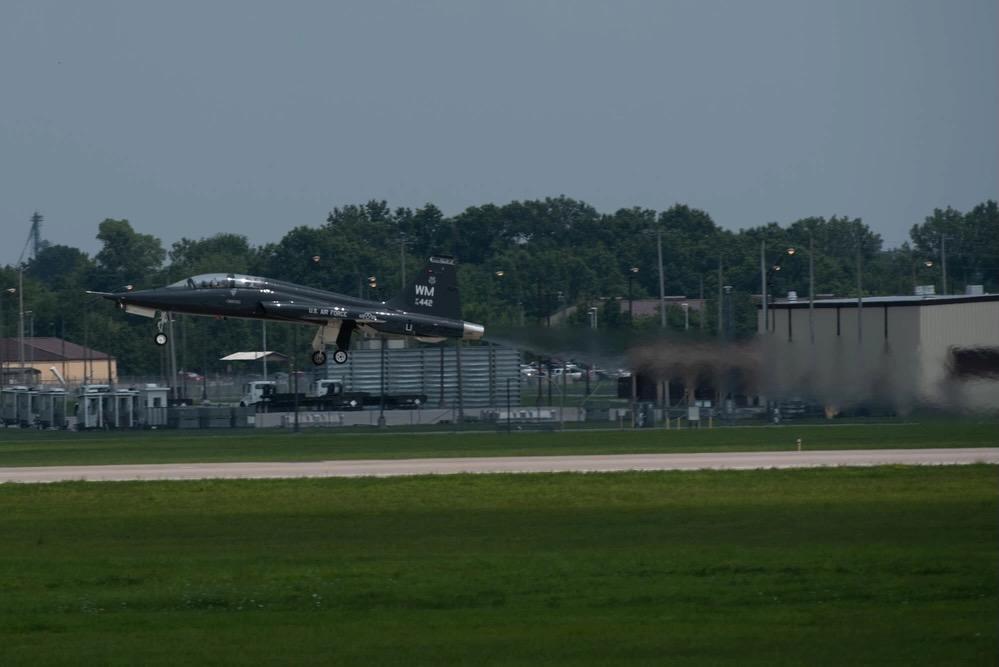
The Joint Interagency Task Force 401 (JIATF 401) announced on June 30 that task force leaders had visited Whiteman Air Force Base, Missouri, as part of the directed-energy counter-unmanned aircraft systems pilot program, according to a report from Lt. Col. Adam Scher, spokesman for the JIATF.
The program began this spring following funding received after the delayed passage of the fiscal year 2026 National Defense Authorization Act.
The task force’s goal is to advance the evaluation and fielding of high-energy lasers and high-powered microwave systems in a counter-drone capability, according to the JIATF.
In May, the task force announced it had selected five locations to conduct “rigorous testing and operational assessments” of lasers on drones for homeland security and southern border applications, Scher said May 6.
In addition to Whiteman, the locations include: Fort Huachuca, Arizona; and Fort Bliss, Texas, as well as Naval Base Kitsap, Washington; and Grand Forks Air Force Base, North Dakota.
The June 30 visit was for the stakeholders to learn about the installation's counter-unmanned aerial systems operations and initiatives in advance of the upcoming directed energy pilot program, Scher reported.
“The visit highlighted how the 509th Bomb Wing and the 131st Bomb Wing have strengthened base defense by combining advanced technologies with physical defenses and operational procedures,” he said.
Under consideration are any needed infrastructure upgrades; engagement with federal, state and local authorities; and integration challenges.
With possible weapons, such as lasers, and unmanned aircraft, strategies for safely employing counter-UAS engagement options within the homeland are crucial, Scher noted.
“The meeting also highlighted how base leaders are successfully using locally developed concepts of operation in their strategy,” he indicated in the report.
JIATF-401 has already provided Whiteman with counter-drone systems and training for its security forces. The task force is currently advancing and testing several counter-drone systems, including the Bumblebee Versions 1 and 2.
“The tools and training we’ve received from JIATF 401 allow us to respond faster and more effectively to drone threats,” said Air Force Tech. Sgt. Brent Keefler, 509th Bomb Wing section chief for counter-UAS and small UAS, in the report. “Having both the technology and training to act gives our team confidence to protect the base and our airmen.”
On June 2, the JIATF-401 awarded a $13.8 million contract to several companies to supply over the next nine months unmanned aircraft system detection and mitigation capabilities for the Joint Task Force-Southern Border (JTF-SB) to employ in support of the U.S. Department of Homeland Security and U.S. Customs and Border Protection needs in securing the southern border. This includes DroneShield as the lead systems integrator and technologies from EchoDyne, Silentium and Sentrycs.
The move to consider compact high-energy lasers and high-powered microwave systems that could be mounted on unmanned aerial systems would provide a powerful counter solution—one that has yet to be seen at scale on drones.
For several years, the U.S. Marine Corps considered the use of 5 kilowatt compact laser weapons for ground applications, on tactical vehicles. The move to the skies with such a weapon would be complex, yet groundbreaking.
“When looking at an installation's counter-drone capabilities, I don’t focus solely on the equipment or the array of assets on a map,” said Army Brig. Gen. Matt Ross, JIATF 401 director. “I ask who the commanders are that have the mission to defend the base from drones. Whiteman’s leadership and airmen are demonstrating exceptional initiative and capability in this mission.”

Comments