
Multinational C2 Interoperability of the Lithuanian Brigade
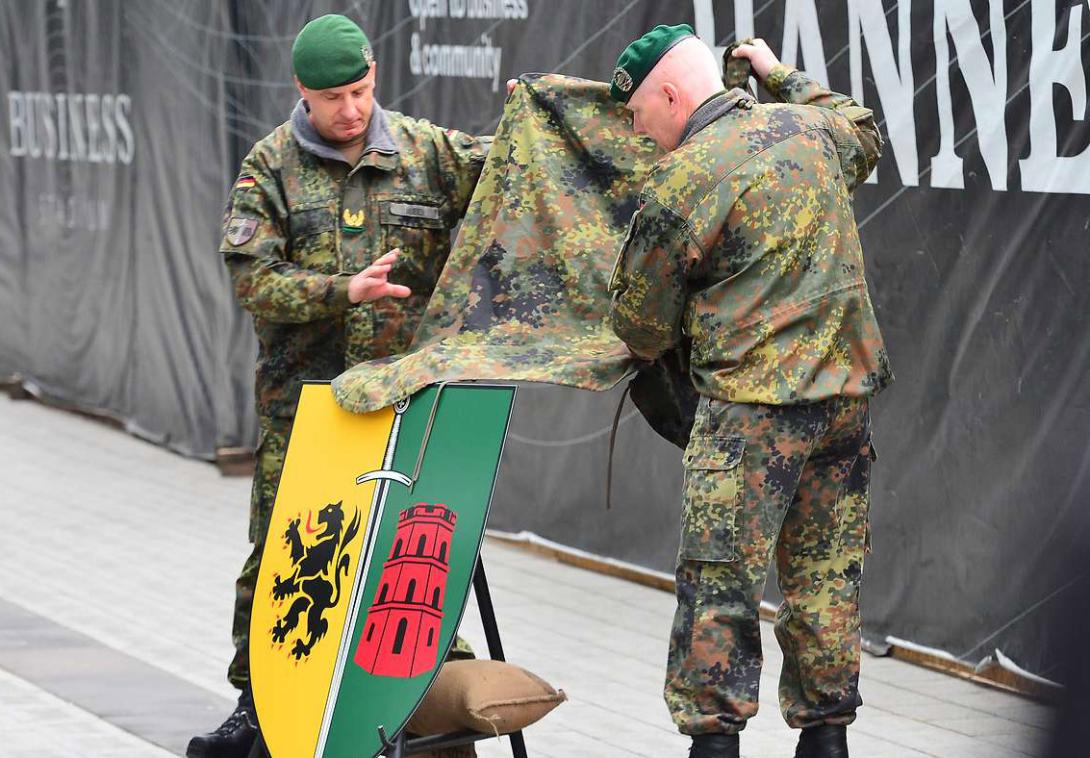

Soldiers in German uniforms walking the streets of Lithuania’s capital have become a familiar sight to the people of Vilnius. In April 2025, the brigade staff of 45 Armoured Brigade was activated, marking the first official step in the establishment of this German army brigade. In May 2025, German Federal Chancellor Friedrich Merz and Lithuanian President Gitanas Nausėda attended the official activation ceremony of the brigade.
The permanent stationing of an operational brigade in Lithuania, which was first announced by the German Minister of Defence Boris Pistorius in June 2023, has become a reality. The brigade demonstrates Germany’s willingness to be a reliable partner fulfilling its alliance commitments on NATO’s eastern flank. The corresponding road map was signed in December 2023, which at the time Pistorius described as “(...) unprecedented for the Bundeswehr. Never before has the Bundeswehr permanently stationed troops outside Germany, with military personnel deployed on an ongoing basis. Missions used to be temporary, with rotating personnel.” A visible manifestation of the Zeitenwende, three major combat units with their support elements and formations, totaling more than 5,000 Bundeswehr personnel, are to be permanently stationed in Lithuania.
The creation of the brigade in Lithuania and the inclusion of NATO partners such as the Netherlands and Norway emphasize that German armed forces will not be alone in upholding national and collective defense. They will fight side by side with their NATO partners. Interoperability is an important factor in achieving warfighting capability, especially for German armed forces deployed to NATO’s eastern flank.
The Russian war of aggression in Ukraine has shown the challenges that NATO would face in the event of an attack on alliance territory: a new kind of battlefield, one dominated by drones, hypersonic missiles, electromagnetic warfare and split-second sensor-to-shooter kill chains. Any armed forces hoping to stand a chance on such a battlefield must be able to both coordinate their own use of these assets, weapons and effects, and simultaneously defend against those of their adversaries. This is where command and control (C2) capability comes in. All actions on the battlefield must be orchestrated, from strategic decisions made at the Ministry of Defence to their tactical implementation by the forward battalion command post in Lithuania. A resilient and uninterrupted C2 capability is the basis of mission accomplishment. C2 capability—and, ultimately, survival on the battlefield—requires military leaders to be able to perform command and control under the prevailing technical and organizational conditions and with the available personnel while under constant threat from adversaries.
C2 Capability and the Zeitenwende
Against the backdrop of the Russian invasion of a European country and the simmering threat of this war of aggression’s spilling over onto NATO territory, it is imperative that we reconsider and decide what successful command and control on the battlefield looks like. We must immediately gear our C2 organization and military decision-making processes to national and collective defense and adapt our structures and even our mentality to the new threats we face. C2 must overcome any silo mentality, reflect increasing multinational interconnectedness and at the same time keep up with the ever-increasing volume and speed of data, information and technological innovation.
In March 2025, the German Bundestag and Bundesrat adopted a constitutional amendment to exempt defense spending from Germany’s strict debt rules known as the debt brake. This sent a clear signal that the financial basis for a strong and capable Bundeswehr has been created. With this historic decision also comes responsibility. It is now up to the Bundeswehr to use the funds provided with the greatest care and efficiency—to establish a C2 capability that creates additional operational value, facilitates sustainable structures and makes purposeful use of technological advancement. Several questions need to be answered: What is the Bundeswehr doing to respond to new challenges and evolving operational requirements? How can it ensure that its C2 system is warfighting-capable? What do military leaders need for success and effects superiority on the battlefield? And how is the Bundeswehr working to enhance multinational interoperability?
This is where the Operational Architecture C2 Bundeswehr comes into play.
C2 Through the Architectural Lens: An Operational Architecture of C2 Capability
The Operational Architecture C2 Bundeswehr is integrated into the Bundeswehr Enterprise Architecture. Architecture models use databases to represent complex problems and reduce them to the variables relevant to the decision-making process without losing sight of correlations, interactions and interdependencies. Data from various sources are combined and visualized in such a model. Using analytic tools, such structured merging allows for systematic and partly automated analysis of the underlying data model.
Architectures such as the Operational Architecture C2 Bundeswehr represent operational processes of the Bundeswehr across all domains in a manner suitable for digital evaluation. Building on the question of how we fight in the context of multidomain operations (MDO) and Federated Mission Networking, the Operational Architecture C2 Bundeswehr provides the basis for joint multinational capability development geared toward the requirements of national and collective defense.
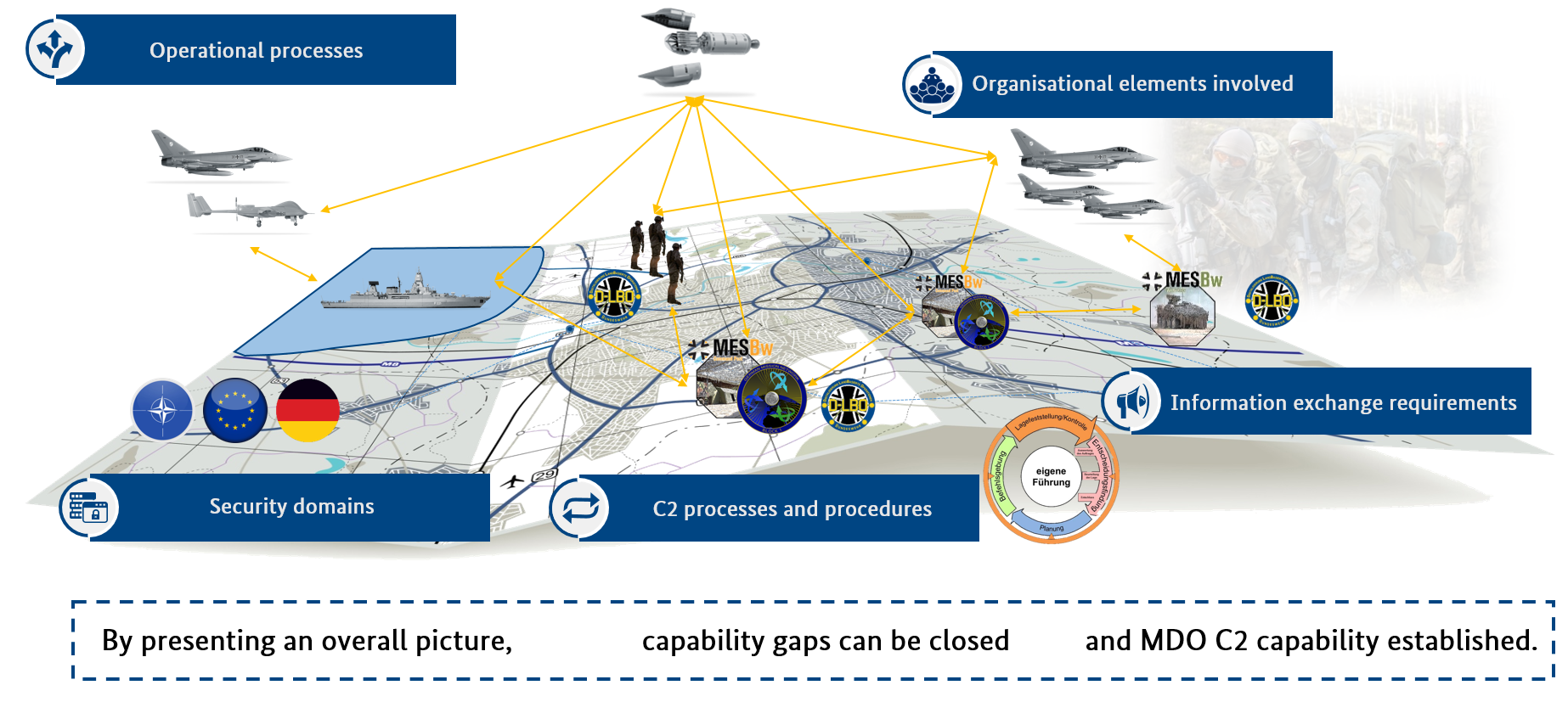
As a basis for all conclusions to be drawn, the Operational Architecture C2 Bundeswehr describes and defines an organization’s elements and procedures on five levels.
1. Operational processes: The Bundeswehr’s operational processes, i.e., its business processes as a military enterprise, in particular the operational and enabling swimlanes of Federated Mission Networking, are essential for the Bundeswehr’s delivery of effects.
2. Basic structures: This level describes the C2 organization and its elements on the battlefield, from the tactical command post in the battalion to the strategic situation center at the Federal Ministry of Defence.
3. Processes and procedures: This level comprises the procedures and processes of command and control, i.e., the rules that govern the dynamic interaction of all components on the battlefield.
4. Information exchanges and requirements: This level focuses on the quantity and quality of information exchange between different actors and systems, the so-called information exchange requirements. It identifies who exchanges information of what kind with whom via what system and the importance that is attached to the information. Ensuring the multinational flow of information is a particular challenge. Some of the multinational partners integrated into the brigade use different communication and information systems—the seamless connection of which must be ensured.
5. Security domains: Security domains define the security levels for information exchange in a defined environment to ensure the confidentiality, integrity and availability of data. A clear, multinational approach to data transmission at the interface of different national security domains among all NATO partners is crucial.
Together, these levels make up a comprehensive model of the Bundeswehr’s C2 capability. It shows who communicates with whom, when and how, and what is required for information to be exchanged—within the Bundeswehr, across federal ministries and at the multinational level. In particular, integrating the expertise of soldiers, with their knowledge of battlefield processes and the C2 capability of the Bundeswehr, ensures a realistic reflection of operational processes.
Building on this database, the tool-based analysis of the Operational Architecture C2 Bundeswehr allows conclusions to be drawn about the future setup of the Bundeswehr information and communications network—not just from a technical perspective but also with regard to C2 procedures and processes. Through consistent application of the Operational Architecture C2 Bundeswehr, the Bundeswehr will become faster, more mobile, more interoperable and more multidimensional across the entire field of C2 capability—or, in short, more warfighting-capable.
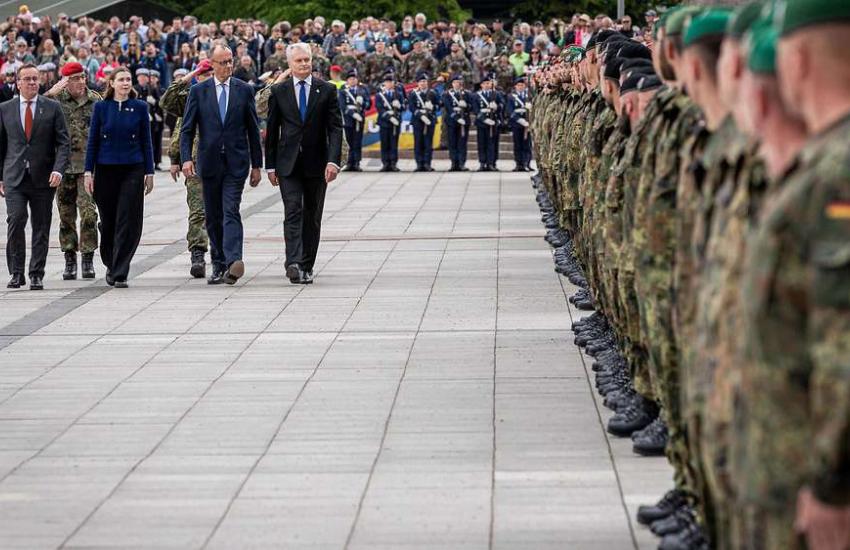
The Operational Architecture C2 Bundeswehr as a Guiding Factor in the Establishment of 45 Armoured Brigade in Lithuania
In early 2024, the recognized potential of the Operational Architecture C2 Bundeswehr to increase the Bundeswehr’s warfighting capability led to the decision to integrate 45 Armoured Brigade into the model.
The brigade and its role in NATO defense plans highlight the importance of multinational interoperability. Whether and how the subordinate multinational elements can be smoothly integrated into the brigade’s own information and communications network is of particular interest to 45 Armoured Brigade in Lithuania. To answer these questions, and against the backdrop of the brigade’s exposed position, the prevailing threat scenario must always be considered in the assessment of C2 capability.
Information exchanges, the communication and IT services used for them, and the various C2 organizations and procedures must be embedded in a transnational overall picture. The Operational Architecture C2 Bundeswehr can provide exactly this overall picture and help draw the necessary conclusions for the brigade’s C2 capability in a multinational environment. Both the brigade and its associated radio concept have now been included in the overall model, so that some initial conclusions in support of C2 capability can be drawn. The radio concept can be used to check whether the information exchanges reflected in the architecture are possible with the fielded radio sets and can highlight where interfaces, especially in the multinational environment, may be required to ensure the flow of information.
The findings gained from the Operational Architecture C2 Bundeswehr were evaluated for 45 Armoured Brigade with a specifically developed analytical wargame “Baltic Mesh – Lines of Command” in July 2025. With more than 70 participants and subject matter experts, Baltic Mesh sought to test the sustainability of the information and communications network of the newly established brigade by simulating an escalating situation development. Once validated, the model of 45 Armoured Brigade will serve as a blueprint for other major Army formations. In this way, a cross-domain, interministerial and transnational model of the Bundeswehr can gradually emerge, supporting the warfighting- and MDO-capable approach of the C2 domain in the future.
Advancing Interoperable C2 Capability Through a Shared Architecture-Based Approach
Going forward, architectures will play a leading role in the strategic planning and further development of the Bundeswehr. The architecture-based approach makes it possible to better understand complex systems and to identify and close capability gaps. Although the Operational Architecture C2 Bundeswehr is still relatively new, the example of 45 Armoured Brigade shows that architectures can already be used to draw relevant conclusions for capability development and demands being met in certain areas. In the area of C2 capability, the Operational Architecture C2 Bundeswehr will be the decisive tool for the further development of the Bundeswehr toward warfighting capability and MDO capability.
For architectures such as the Operational Architecture C2 Bundeswehr to prove effective and add practical value on the battlefield, the support and assistance of all participating partners on NATO’s eastern flank is required.


Comments